1.
So who's taking it? That was the question that was asked of me from every corner I came across while wandering through the halls of the Ramada Hotel in Jerusalem, which one day took on the appearance of an ultra-Orthodox shtetl that had become a national-religious settlement.
From the stairs came the loud voices of Rabbi Meir Kahane's supporters, most of them wearing knitted kippahs, but also a few 'blacks', with the rabbi himself dancing with them. A few hours would pass and they would be informed that they had won by only 30 votes.
 Want more news, videos and stories? Join the Haredim 10 WhatsApp channel >>
Only? Not exactly.
Now, in retrospect, it becomes clear that if Bezalel Smotrich had supported his candidacy, as recommended by the rabbinical committee appointed by the Minister of Finance himself, he might have been the winner of the evening. Indeed, Rabbi Kahane was close to the "tie 40" votes received by Rabbi Kalman Bar and Rabbi Micha Halevi.
However, after Rabbi Micha Halevi, as well as Rabbi Eliezer Igra, signed that they would accept the decision of the rabbinical committee that selected the agreed-upon candidate of religious Zionism, and after Rabbi Meir Kahane was elected - they decided to break the signature, under various pretexts, and run in the elections for the position of Ashkenazi Chief Rabbi.
Smotrich himself also made a U-turn and supported the one he had always wanted: Rabbi Micha Halevi. At first, it was a matter of suspicions and road signs, but on Thursday, in Channel 14's "Patriots" studio, he officially announced his support for the rabbi of Petah Tikva. Why? Forget it, there were plenty of excuses. Either way, many in religious Zionism were outraged that rabbis were convened to choose a candidate - only to decide whether the result was a "plan as you requested" or not. And if not - to turn the wheel.
2.
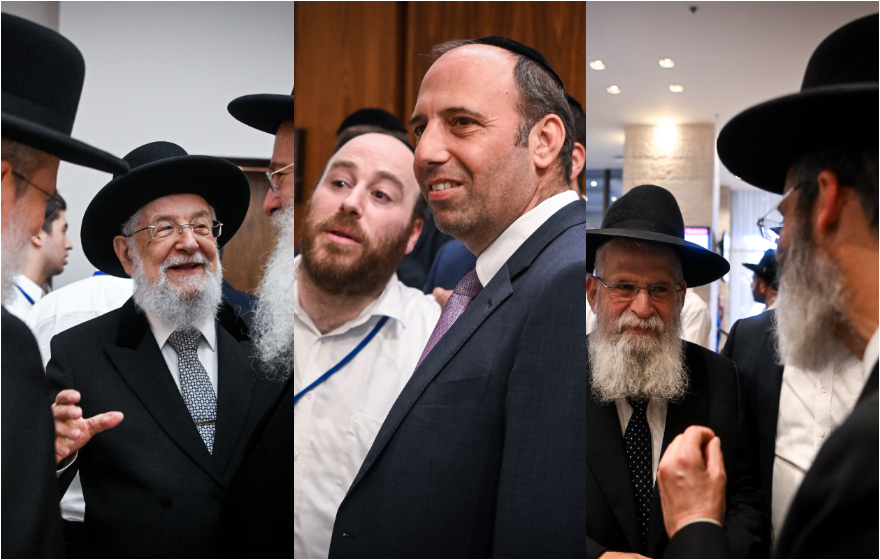
Near the elevators I met Rabbi Yisrael Meir Lau, the former Chief Rabbi, who had come to support the candidacy of his son - Rabbi Moshe Chaim Lau, a neighborhood rabbi in Netanya. He sat there for hours and talked with friends from the electorate. His nephew, the outgoing Chief Rabbi, Rabbi David Lau, was also there to support. At least, apparently. At the end of the evening, they too would know that they had failed. Rabbi Lau received only 21 votes. This failure joined the race for the position of Chief Rabbi of Netanya, when Rabbi Kalman Bar defeated him in a knockout.
Minister Amichai Eliyahu also went around in a frenzy, running from place to place, all for the sake of electing his father - the rabbi of Safed, Rabbi Shmuel Eliyahu, who received 44 votes compared to the 72 votes of the big winner - Rabbi David Yosef, who was elected to the position of the next Rishon LeZion. This is quite a few votes for someone who was supported by a single party - Otzma Yehudit, when many voted for him who did not like the U-turn of religious Zionism.
Dayan Rabbi Michael Amos, who some believed would be drowned in the votes of potential supporters of Rabbi David Yosef, was unsuccessful in his mission, and at the end of the day received only 21 votes. Too few for someone who ran on the ticket of "The Chief Rabbi must be a Dayan.".
By the way, a tour of the Ramada halls revealed that there is an opinion that is gaining momentum: the obligation to change the law, so that it stipulates that starting from the next elections, the Chief Rabbi must be an actual judge. After all, a Chief Rabbi spends half of his term as head of the rabbinical courts, and it only makes sense that he would be required to have a background in the field. This is not what happened in the previous round, when both Rabbi Yitzhak Yosef and Rabbi David Lau had no background in law. Is there a chance that such a law will pass? It's hard to believe.
Contestant Rabbi Eliezer Igra finished the race with only 6 votes.
Looking back, if Netanya Mayor Miriam Feierberg, a member of the electoral body, had come to vote (she was unable to, for personal reasons), that night would have been Rabbi Kalman Bar, the next Ashkenazi Chief Rabbi.
He was only one vote short of defeating Rabbi Micha Halevi.
3.
At the end of the procedure, at the appointed time, the results of the Ashkenazi ballot boxes were read, while the votes from the Sephardic ballot boxes were counted later.
Bottom line: It turned out that another round was necessary, because for the first time in the history of elections for chief rabbis, a tie was recorded between two candidates.
The second round, which was supposed to be held tonight at 9:30 PM, with the participation of 138 out of 140 members of the electorate, has been postponed, and it appears that the elections for the Ashkenazi Chief Rabbi will be postponed by a week - and will be held after Rosh Hashanah.
The Elections Committee announced that "in consultation with the Ministry of Justice, it was decided to set a new date for repeat elections, but a date has not yet been set.".
What happened? Well, when the votes were counted, an empty envelope was found in the ballot box of the 'Ashkenazi Rabbi', while when the votes were counted, a ballot box of Rabbi Micha Halevi was found in the envelope along with a ballot box of Rabbi David Yosef. The ballot box was legally invalidated, but those around Rabbi Halevi are hoping that the legal advice will approve the ballot box - which would give him a victory with 41 votes.
Legally, it is hard to believe that this will actually be accepted.
The Justice Ministry will discuss tomorrow whether the vote is valid or invalid. The parties will also submit their comments - and a decision will be made on Tuesday. If they decide that the tie is maintained, they will set a date for a second round between the two candidates.
4.
If we go to a second round - how will the votes be split? Here is the diagram:
It is difficult to know where the 6 votes that Rabbi Eliezer Igra won will go.
The votes of Rabbi Moshe Chaim Lau - some of them, probably, will support Rabbi Micha Halevi, in light of the tensions between the family and Rabbi Kalman Bar, in light of the rivalry in the elections for the Netanya rabbinate. But there are also members of the electorate who are not connected to the Netanyahu issue: Take, for example, Ron Huldai, an admirer of the father of the Lau family, who probably chose his son due to personal kinship. What does he have to do with Rabbi Micha Halevi, who is considered one of the followers of Rabbi Zvi Tau, president of the 'Har HaMor' yeshiva, who is identified by the liberal public as extremist in his views?
Rabbi Meir Kahane's votes - these, ostensibly, will mostly support Rabbi Kalman Bar, as these are people filled with anger at Smotrich for not adhering to the recommendation of the rabbinical committee that he himself appointed. And as such, they will not support a candidate supported by him.
And there are also the 'deal haters.' Precisely because Rabbi Micha Halevi is supported by the 'deal' of Shas and religious Zionism, they would prefer to choose a rabbi.
Why did most of them support Rabbi David Yosef for the position of Rishon LeZion, even though he was part of the Deri-Smotrich 'deal'? So, Shas did a kind of Yemenite dance of one step forward, two back, and it was a bit difficult to find on its face any excessive enthusiasm for supporting Rabbi David Yosef's candidacy. What's more, many of the members of the electorate planned to vote for Rabbi David Yosef, so as not to support 'Deri's candidate', his brother, the late Rabbi Deri. After he passed away, they remained faithful to their original heart's desire. That still doesn't mean that they aren't people who are sick of 'deals' and that they aren't people who would 'specifically' vote for Rabbi Bar, just because he wasn't part of a 'deal'.
5.
And for the last point.
Anyone who followed Rabbi Micha Halevi's team of advisors and publicists could not help but be impressed by their number, seniority and experience, and probably also the large amount of money at their disposal.
In contrast, Rabbi Kalman Bar had strategists who mostly spread smiles and much less power or money. "Publicists with flip-flops," as one of the members of the electorate described them to me. "But cute, cute.".
The feeling that powerful political forces and publicists who were 'mixing things up' stood on Rabbi Micha Halevi's side alienated some members of the electorate.
The fact that despite the intensity of the investment in public relations, and despite Rabbi Halevi being supported by a "deal" of two strong parties in the "right-wing bloc", he only managed to achieve a draw with Rabbi Kalman Bar in the first round - there is a big surprise in it.
So how will the battle end in the end? Time will tell. For now, the smiles and the cordiality have won big.