It is appropriate to ask ourselves where the Jewish heart lies. By "heart" I mean the point around which Israel unites. The question of the Jewish heart - the unifying factor - has become one of the most fundamental questions in the last hundred years, and especially after the Holocaust, and it has arisen frequently, especially in times of crisis. Is the Jewish heart located in the Beit Midrash, or is the unifying point located more in other places?.
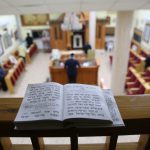
In the past, the Temple was the heart of the people of Israel, it was the "spirit of our souls" and had the power to unite the Jewish people. After the destruction of the First Temple, the power of the Temple to unite the people diminished significantly. As we know, our Second Temple was destroyed by wanton hatred, evidence of the lack of unity. During the Second Temple and even more so after its destruction, it was the Torah that became the central axis that unites the nation. "Since the destruction of the Temple, God Almighty has had nothing in His world but four cubits of Halacha," meaning that following the destruction and due to the exile, the place of the houses of study grew stronger and they became the heart of the Israeli nation. It was the Oral Torah that became the unifying axis, and throughout the exile, the crises from which the people of Israel suffered largely touched on the question of how much the Torah is the heart.
Has God created a new heart for me?
Unlike in the past when the Jewish people had no other heart, in the last century or so, something has happened and things have changed. Some of the Jewish people have begun to ask for a new heart. Some claim that neither the Torah nor the Halacha constitute the unifying axis. The national renewal and the return to the Land of Israel have provided a new heart for the nation, to the point that today, for many, the Torah and the observance of the commandments do not indicate the heart, perhaps the body, but certainly not the unifying factor.
The struggle for the heart of the Jewish people has led to a bitter dispute between the parts of the people, the ultra-Orthodox on the one hand, and the religious national and secular on the other. Externally, the dispute revolves around "ideas," or what are called "views," while internally, its main concern is the very heart. Some argue that since the Torah will not be replaced, it alone is intended to be the factor that unites the people. On the other hand, there are those who argue that although the Torah given at Sinai is binding, it still does not have the power to be the heart of the people today, and some have even gone so far as to claim that the Torah is no longer relevant.
We completely reject the claim that the Torah is not relevant, since our very existence depends on it, and as Rabbi Saadia said, "Our nation is not a nation except by its Torah." But even though our very existence and being depend on the Torah, it is still worth noting the fact that the Jewish heart today is not suckled by the Beit Midrash. Moses, the truth, and his Torah, the truth, constitute more the body, or rather, the heart that is covered up and less the heart that is revealed.
These things are reflected in the war that is currently taking place. Unlike the "Second Lebanon" war, which was characterized by numerous disputes and where one man stood up for his brother, this latest one is very evident in its unity. The kidnapping of the three boys aroused enormous identification with them and their parents and brought about an uncommon unity. The war that broke out later, the sympathy for the fighters - affectionately called "our children", the many wounded and the soldiers' funerals are what have the power to unite the people of Israel in a special way. Tens of thousands came to accompany the lone soldiers "Sean Carmeli" and "Max Steinberg", and it was discovered how it is precisely the funeral of an unknown soldier that has the power to move the hearts of tens of thousands. Tens of thousands come to visit hospitals, their hearts full of love and gratitude. The war in general has aroused a deep emotional identification that has great power in removing the barriers between people and between the different parts of the nation.
A simple desire to come together
But there is more than just gratitude and appreciation here. Behind all of this stands an essential point, and it is the one that has the power to move a large crowd to the funerals and visits to the wounded, to distribute gifts and food, to cry, to be moved, and to mourn bitterly, and if you wish, even to watch and listen to the news for hours. In my heart, I feel that the motive for this great heartfelt movement is the desire of the masses to be together. Simply put, the masses are seeking the heart, that is, that precious unity that humanity has been striving for since the beginning of time.
More than an ideal, it is precisely the gathering and the togetherness that stand behind great movements that move the masses. It is true that people need each other, but there is something else here, and that is the desire to come together as one body. However, in most mass movements, the proverb of the late Rabbis is fulfilled: "A gathering of the wicked is bad for them and bad for the world." Their gathering ends in disaster, expressed in the creation of destructive power. Instead of seeking unity in itself, people convert unity into power and cling to the power that accompanies power.
There is also a form of gathering that is not intended to generate power, where power is not the goal in itself but at most exists as a consequence. Sometimes the gathering of people is truly aimed at eliminating separation and removing the barriers between them, intended to create a higher existential system. This system is called "togetherness," as a unity of the kind that overflows mainly with mutual compassion. One can imagine how hearts suddenly opened and we began to have compassion for one another, and this without the gathering serving only as a source of generating power, the desire to be together was revealed.
The new unity of the secular
As a Baal Teshuvah, I testify to the deep feelings of holiness that I have been blessed with, starting with the very act of returning to Teshuvah through Torah study. From faith in Passover and increased joy in Sukkot, through an inner longing for G-d during the Ten Days of Teshuvah, and ending with a loving heart that acknowledges the closeness that arises from the closing of Yom Kippur.
And yet I must admit that I did not come to feel a sense of all of Israel "together." All of these feelings, however noble they may be, remained private feelings. I want to say that my life of Torah and mitzvot is incapable of evoking a comprehensive and broad Tzavta that removes barriers, and certainly not the kind of unity that arises in the face of war and bereavement that afflict the people.
It is important to me to note that the religious experience today is shaped more as a private experience and much less as an experience that creates a common heart that unites all of Israel.
The examination of the heart also takes place in the secular world. Year after year, it is more noticeable how, compared to the fragility of Independence Day, the power of "Remembrance Day" is growing stronger and stronger as a content axis with the power to unite the people.
The Jewish heart never ceases to seek its discovery, and therefore the question is no longer "Why don't the ultra-Orthodox join the army?" Now the question is infinitely greater and more fundamental: what is their power in establishing unity, the unity that constitutes all of Israel.
My intention is not to ask why the ultra-Orthodox do not contribute their liter of blood to the total amount of bereavement, but to ask why we are not honest in the face of our inability to stand "together"? How is it that an entire community whose heart is the Torah is stuck behind the walls and partitions it has built for itself, left heartless.
How is this not part of the unity that bereavement establishes, and even more so why do we not understand that unity is the heart of the Israeli nation? How is it that we do not listen to the whispering of our Jewish heart that yearns to gather within the unity that is forming in the people of Israel.
Several years ago, when I was riding the bus every day, I was surprised to discover that many of the secular passengers were reciting Tehillim or the General Tikun. Anyone who looks closely at the religious changes that Israeli society is undergoing feels that a new religious movement is taking shape.
The forces of Jewish life seek to break through, once again it is impossible not to notice how a new faith discourse is penetrating the Israeli existence. Belief in God is changing, in a way that becomes more comfortable and natural, connected and even more attentive to life itself and to the events that are taking place. The human encounter between religious and secular soldiers creates a natural closeness between the religious and the secular and thus also brings the secular together with the Divine. Both sides require a human encounter without barriers, an encounter that the army, for example, produces in abundance.
It is very evident that Torah scholars also desire to bring their Torah and faith together with life as it is lived in the Israeli experience. They too recognize the fact that the circles of unity of the people living in Zion revolve more around the existential matter known as the army and more around the bereavement that accompanies it and less around the Beit Midrash. They too yearn for this unity.
• Aharon Stern is the editor of the monthly magazine 'Adaraba''
 Join the Haredim 10 Facebook page >>
 Join the X page of Haredim 10 >>
 Want more news, videos and stories? Join the Haredim 10 WhatsApp channel >>