The most well-known custom on Lag BaOmer is the lighting of bonfires in honor of Rabbi Shimon Bar Yochai - which is his day of celebration.
For the 14th time in a row: This is the lottery that the entire Haredi sector is waiting for
Many sources have been written on this subject, and it is common in all Jewish denominations. The author of the book 'Iva DaAvraham' wrote: "It is possible to give reason to the fact that people light candles and make bonfires on this day, to teach that the days of the Sefirah were given in order to illuminate the darkness of materiality, and something capable of this is the teaching of Rashbi, the Book of Zohar, and therefore people light candles on Hilula Delia, and this is in accordance with the scripture, for when I sit in darkness, the Lord is my light.".
 Want more news, videos and stories? Join the Haredim 10 WhatsApp channel >>
The book 'Masa Meron', which describes Jewish journeys from Jerusalem to Meron 130 years ago, contains a fascinating story that is considered one of the milestones in the tradition of joy on Lag BaOmer, according to Rashbi:
The light of the Beit Midrash during the time of the Holy Ari was a Jew named Rabbi Elazar. He was great in Torah, but no one knew about it. Everyone considered him a simple man who feared God. On Lag Ba'Omer, Rabbi Elazar ascended to Meron and saw the Holy Ari there with the sons of the Chavria. He joined them and danced with them for a long time in honor of the Rashbi's hilula.
Suddenly, an old man dressed in white, of a handsome figure and stature, joined them, and danced alone with immense joy. When he saw Rabbi Elazar, he joined him in his dance and they danced together. The Holy Ari also joined in and danced with the old man for a long time. After that, he took Rabbi Elazar's hand and danced with him for a long time.
After leaving there, the Ari's students gathered courage to ask their rabbi: "Why did the rabbi dance alone with Rabbi Elazar? He is indeed God-fearing, but in the end he is nothing but the sun?""
A smile came to the Ari's lips and he said to them: "If the Rashbi danced with him alone, wouldn't it be an honor for me, the young man, to dance with him?" From then on, Rabbi Elazar's respect increased in the eyes of the group. He became known as Rabbi Elazar Azkari, author of the book 'Haredim' (ibid., page 9).
•
• One of the most common customs on Lag BaOmer is the shaving of the hair of a toddler who has reached the age of 3 years by the grave of the holy Tanna (the 'halaka'). What is the origin of this custom? Rabbi Chaim Vital relates that Rabbi Yonatan Shagish testified that the holy Ari, z"l, on Lag BaOmer "took his little son there (= to Miron) with all the members of his household, and there they shaved his head according to the well-known custom, and there he held a day of feasting and joy.".
• Chabad customarily eats eggs that have been dyed brown during cooking on this day. Another custom that belongs to Chabad is eating carob on Lag BaOmer, in memory of the carobs that Rabbi Shimon and his son Rabbi Elazar ate when they were hiding in a cave from the Romans (Shimirat HaMoedim, page 259).
• In Bukhara, on the night of Lag BaOmer, they used to read the 'Edra Rabbah' and the 'Edra Zuta' from the book 'Hadrat Zakenim'. And many Jews would try to go up to the tomb of Rashbi in Meron on this day (Yahudah Bukhara Gedolia and Managiya, page 592).
• In Libya, Jews used to decorate their homes on Lag BaOmer with paper chains that were called "Koajed Mata Rabbi Shimon" (the inheritance of the ancestors of the Jewish people).
• In Pressburg, the Hatam Sofer would gather on Lag BaOmer together with the 'Chevra Kadisha' for a festive meal, where new members of the Chevra Kadisha Association would be appointed. During the meal, the Hatam Sofer would ask them about daily matters. The day before, that is, on the day of Lev BaOmer, he would ask them about matters concerning visiting the sick and kindness, etc. (The customs of our rabbis and their ways – page 22).
• Another from Pressburg from the time of the scribe (son of the scribe): On the day of the Lev BaOmer, the members of the Habra Kadisha would fast until the time of the Great Mincha, and after the Shacharit prayer, they would go to the cemetery and circle the graves of the righteous, asking for their forgiveness.
• Another from Pressburg, from the time of the writer Sofer: On Lag BaOmer, which was a day of joy, the rabbi would go out with the Torah scholars to the forest and sit among the trees to breathe fresh air while he spoke to them about Torah (see page 10).
• In Worms, it was customary during the morning prayer (but not in Arabic) of Lag BaOmer to play the recitation of the "Barchu" on the melody that was played on Rosh Chodesh (Practices of Worms, page 10).
• In the book "Tsyonim Yakrim" the following incident is narrated: Once upon a time, there was a rabbi in Meron, and he saw men and women coming and prostrating themselves before the Zion, the Darshbi, and bringing with them valuable garments of silk and other handkerchiefs with precious blood, and burning them at the tomb of the Rashbi with great joy. Seeing this, the rabbi prevented them from burning the aforementioned garments and ordered them to sell the garments and give their blood to the poor. Immediately that night, the Rashbi came to him in a dream and said to him, "Just as you prevented them from doing my will, therefore he will not complete his sleep, may God have mercy on him.".
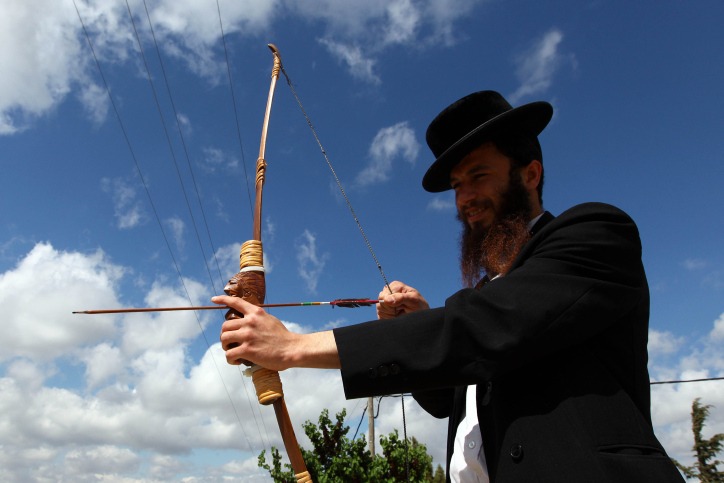
• The Hasidim used to play archery and target shooting games. The explanation: According to those who connect the issue of Lag BaOmer to the Bar Kokhba revolt and the day of victory over the Roman occupier, the game with bows and arrows will be interpreted as seeking to signal to generations: "Teach the children of Judah the bow." See Bnei Issachar (Article 3, Lag BaOmer, Section 4).
• In the city of Eden in Yemen, they used to light candles in the synagogue as on a holiday, and the public would come to the synagogue and study the Book of Proverbs, and recite Zemer and Piyoot Bar Yochai, and then they would read the Zohar (Tikkun Hamidot website, and Shitim website).
• The Yemenite sect of Dardaim, who oppose the Zohar, go to work on this day as usual and also do not hold weddings on that day (ibid.).
• In Rhodes, Greece, it was customary to bury the Genizah on the 30th of Omer. After collecting all the torn books, as well as old books and torn prayer pages, they would hold a funeral for them, and the congregation would sing songs of lamentation, recite psalms, and recite a requiem prayer. They would also bury the old congregation books, laws and accounts from the life of the congregation, and notebooks that had outlived their time [there].
• In Tunis, people travel from all over the country to the ancient "Il Djerba" synagogue, located on the island of Djerba near Tunis. There, they stand in prayer all day and in the evening, they hold a large feast for the poor. Those who cannot travel to Djerba gather in synagogues. Each person prepares a special corner for himself and his family, the "Rashbi's Corner" - and the right of the righteous man will protect him all year long. In this corner, a special menorah is lit, the "Menorah of Rabbi Shimon Bar-Yochai." At home, a huge chandelier with dozens of candles decorated with colorful flowers is lit. In the afternoon, everyone brings their menorah to the synagogue to study by its light in memory of the righteous man. At the end of the "study," a large feast is held, mainly for the youth.
• In Bukhara, it was customary on the eve of Lag BaOmer to prepare Sukkot and Tabernacles in the courtyards of large synagogues, hold a lighting ceremony with a large crowd, and treat oneself to food and a feast.
• In Samarkand, it was customary for anyone who came to light a candle in honor of Rabbi Shimon Bar Yochai and his fellow Tannaites to be treated to a glass of drink and a dish of chicken, and the audience would accompany the lighting with singing and chanting. Afterwards, they would build a bonfire outside the synagogue courtyard [Bukhara Jewry there].
• In the Beit Yaakov community in the city of Hebron, it was customary on the night of Lag B'Omer after the evening prayer to light candles for our holy ancestors, Adam the First, and Rabbi Shimon bar Yochai (Customs of the Beit Yaakov community in Hebron, page 22).