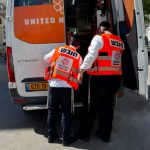
A group of yeshiva students who entered the Darja Stream trail lost their way. Their worried parents contacted the ZAKA hotline, which involved the Megillot rescue unit. The boys were found safe and sound around 9:00 PM.
•
Drama in Nahal Og in the Judean Desert: Five girls went missing at the end of a hike organized by a group of seminary girls from Modi'in Illit. After an extensive search with the assistance of the Megilot Rescue Unit and police forces, the girls were found safe and sound.
•
Yeshiva students were rescued last Friday morning in the Judean Desert after several of them collapsed and suffered from dehydration and progressive exhaustion.
•
At around 2:00 AM, the Ihud Hatzalah hotline received a call from a group of yeshiva students who were hiking on the Sde Boker trail in southern Israel and, due to darkness, could not find their way back. The Har Negev Rescue Unit's emergency medical technician was able to provide them with precise instructions over the phone on how to safely exit the trail.
•
Between times.
Many yeshiva students go out to relax, change the atmosphere, and gather strength for the next 'time.' The supply is large. Sometimes too large - too large for them.
Flowing streams of water in the Upper Galilee, hiking trails of rare beauty in the Judean Desert leading to the Dead Sea, climbing cliffs and descending valleys, swimming in the Sea of Galilee and racing on ATVs – all of these invite lovers of extreme sports and challengers, those who are good at walking and those who are not.
""We're leaving first," one young man, who studies at a famous yeshiva in the center of the country, told me, as he loaded himself into the rented car. "When we get to the north, we'll 'flow' already.".
So, this 'flow' can disrupt plans. The dangers inherent in nature do not always 'flow' with travelers.
The desert is not paved with asphalt.
""When everyone is off, we work," he says.Haredim10 Noam Eldan, commander of the 'Megilot' rescue unit in the northern Judean Desert.
The Megilot Rescue Unit is a volunteer unit that was established in 1994 by the Security Department of the Megilot Dead Sea Regional Council, but only four years later did the unit become established as a professional body, and as an organization that provides assistance in the field of mountaineering (climbing, surfing and rescue), locating missing persons, flood rescue, marine rescue and traffic accidents.
The unit operates in rescue incidents from places where the various emergency bodies - the Israel Police, Fire Department and MDA - cannot provide a response.
The unit is made up of about 50 professional volunteers in various rescue areas: water, high places, wadis, and more. "They're all working people and they all have families at home," says Eldan, "but when there's an incident - they leave everything and come to rescue.".
And when he says "drop everything," he means it could be in the middle of work, in an important meeting, or even at a pleasant family meal.
Teach us about the dangers that can disrupt any trip, I asked.
""First, a car accident. Imagine a jeep or an ATV, even a family vehicle, flipping over, crashing or falling from a height. Regardless of the severity of the impact and the quality of the accident, the mere fact that the accident occurred in such a place makes the event much more complex and complicated.
""The desert is not paved with asphalt," he explains. "If rescue forces can appear in a few minutes in every accident in the city, here it can take many hours, which is very critical in such situations. Furthermore, even when they have already arrived to rescue and are loading the injured onto the SUVs, it is not possible to drive quickly to the meeting point with the ambulances. Such a fast drive can make the injury much worse. This is why in some cases there is no choice but to call a helicopter.".
""Even a bike trip can end in disaster. The desert infrastructure is not what you're used to in the city. You can easily overturn or crash a bike, and that happens a lot.".
A trip with high heels
When is it better to go for a walk, day or night?
""Of course, during the day," he states. "I know people like to go out at night and walk in the moonlight, but we in the rescue unit really don't like it. We know how a nighttime walk like that can end.".
how?
""Look, people start the route at night with the goal of finishing it by morning – which in most cases doesn't happen. The hikers find themselves in the middle of the route, when morning begins and the hot desert sun beats down on their heads, and discover that they don't have enough water because they planned to be at the end of the route. From here to dehydration is a short journey.".
And on day trips?
""Every day has its own dangers. It all depends on the planning before setting off on a trip and preparing the necessary equipment. First find out the length of the route, the degree of heat or cold in the place, its degree of difficulty: ascents, descents, ladders, ropes, etc. It's important to know first where you're going and whether you're including a water route in the trip. If so, make sure that all participants know how to swim. Sometimes you get to a place where you have to cross water and it turns out that one of you can't swim. What do you do then?
""In addition, take enough water to drink and dress accordingly. People arrive at a desert trail wearing slippers, and we've even rescued girls who arrived wearing high heels. Beyond that, go on a trail with the right people. Don't take adults who have difficulty walking on a strenuous hiking trail, and don't take children who don't know how to swim on water trails.".
""Another thing we encountered a lot is going on a trip without taking medication for those who need it. It has happened more than once that diabetics and others have gotten stuck waiting for rescue. Besides the danger that anyone who needs rescue has, the danger is greater for them when it comes time to take medication and they have to wait hours until rescue arrives.".
As true as that is, I think most people are just not aware of these things.
""Look, this is not a complex issue. All I'm telling you is one and one. Simple logic and sound judgment that should be exercised before going on a trip.".
""For example, on most routes, your hands need to be free, because you use them while walking or climbing. That's why you should come with a backpack and not a bag. In addition, leave things that aren't necessary for the route itself in the car or at the pick-up point. There's no need to carry a change of clothes or various devices, if they're not part of the route.".
""And there are the more logical things: not to go off marked trails, to pay attention to instructions and signs along the way, and not to suddenly decide to continue the route alone.".

What can be done to prevent a situation of complete disconnection in the middle of nowhere?
""It is very important to leave all the information about the trip at home. Before you leave, inform those who are staying at home about the trip route, who is participating in it, the phone numbers of those going on the trip, etc. These things are done in a few minutes and can save you many hours of headache later.". Also, have the phone numbers of the emergency centers: police, MDA, fire department, rescue organizations and rescue units operating on site.
""Don't go on trips with an unfamiliar group of people. Go only with people you know or an organized group. It happened not long ago that a minibus passed through a certain city and picked up people for a casual trip to one of the streams in the area. They agreed on a meeting place and time to arrive at the destination. When they finished the route, it turned out that one person was missing. Of course, no one knew him or knew where he had gone.
""Therefore, only go out in the company of people you know who can help provide details if, God forbid, something happens.".
Don't take pictures, don't talk.
Throughout the conversation, Noam Eldan – who has been the commander of the 'Megilot' rescue unit for seven years – reiterates an important emphasis: ""Even people who take into account what might happen, like accidents or injuries, still, most of them have simply forgotten the main thing that makes everything so complicated.".
""Let's say a traveler is injured and has 'only' a sprain. If it happened to him in the city, within a few minutes he would already receive the treatment he needs. In a place like a desert and on remote trails, even a simple wound or a minor accident is much more complex and complicated – just because it happened in such a place.".
""The wait for rescue – when they have already managed to get one, in most cases without enough water, in heat that causes dehydration very quickly – is what makes the matter much more difficult for the rescuers and certainly for the injured person.
""You see, a group of a hundred hikers may not be as much of a concern for us as a single hiker. It all depends on the quality of the event. Rescuing a single hiker who is seriously injured is more complex than rescuing a hundred hikers who are standing and have lost their way.".
In the unlikely event that an injury or accident occurs, what to do, and just as importantly – what not to do?
""The first thing in cases like this is to get the rescue. The natural tendency is to call MDA and various rescue organizations, but that's a mistake. After all, the rescue units are trained to rescue from areas that regular rescue organizations cannot reach.
""If there is no rescue unit phone number within reach, it is a good idea to call the police and ask them to arrange for rescue on the spot. Under no circumstances should you prolong the conversation with the police or MDA.".
""Another tendency in such cases is to call family and friends and even take pictures. This is a dangerous mistake that can even cost a person their life. The phone must remain available and free for the rescue unit. They are the first to arrive at the scene. Sometimes people don't even notice and the battery runs out - which will cause the rescue to be delayed for additional hours.".
""People need to understand that there are disabilities in the area. There is no outlet to charge your cell phone. Therefore, in the event of an injury, make sure to get the rescue unit and then keep the phone free for them – do not talk and certainly do not take pictures.
""Another important thing: don't scatter. There is no reason for travelers to scatter in order to call for help. In most cases, they get lost and they also need to be rescued. In the event that it is not possible to call for the rescue unit, such as there is no battery in the cell phone, etc., it is better for two people to go together to look for help. Under no circumstances should they go alone.
""And be reliable in reporting.". There is no point in "inflating" the incident when it is a minor one, or omitting details when a serious incident has occurred. The rescue team that sets out must be informed with a high level of accuracy about the condition of the people.
""And always remember that rescuers are volunteers who leave everything behind to go out and save lives. It is the responsibility of travelers to make it as easy as possible for them. The rescuers will arrive and do their job to the best of their ability.".
 Join the Haredim 10 Facebook page >>
 Join the X page of Haredim 10 >>
 Want more news, videos and stories? Join the Haredim 10 WhatsApp channel >>