Those who feed on the media may get the impression that the institution of marriage has gone bankrupt; that the general public no longer gets married according to the Mosaic and Jewish laws; or that who even needs this unnecessary ceremony called a wedding?.
This impression is created because there are factors that ensure that these messages are repeatedly pumped out, and when a slogan is repeated many times, it is absorbed.
The media also eagerly reports on any initiative that defies the traditional Jewish wedding, to the point where it seems that this is how most people practice.
This is of course not true.
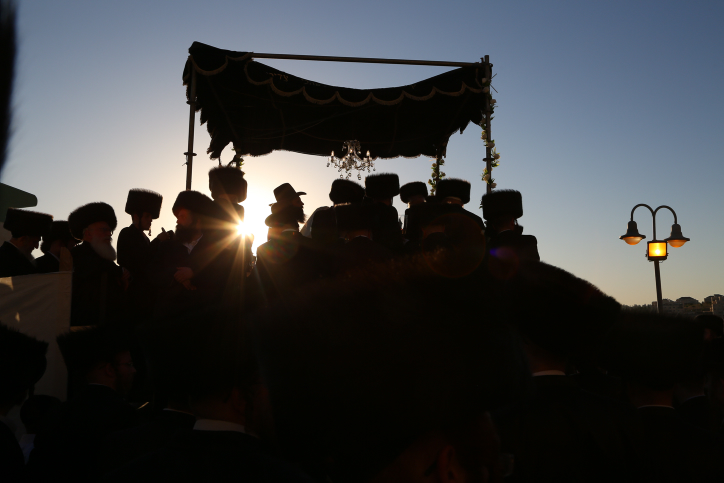
The majority of the public still chooses to marry according to Jewish law. Every evening, hundreds of weddings are held across the country, with a chuppah and a kiddushin according to the law. Even in surveys published by those who strive to undermine the institution of the rabbinate, the fact stands out that the majority of the public would choose to marry according to Jewish law, even if other legal options were presented to them.
The gravity of the responsibility
However, one should not underestimate the trend that is being led by those anti-religious elements, with the enthusiastic assistance of the media. There are certainly circles in which the prevailing atmosphere is that people do not get married in the rabbinate. Couples about to get married are subject to social pressure, and they do not always withstand it.
This reality places a heavy responsibility on every rabbi who conducts a wedding and a kiddushin.
At any such event, hundreds of guests are present, and the experience of the event can be decisive for them. Many rabbis say that couples have often approached them with a request to marry them, after attending a ceremony they conducted. These couples have explicitly stated that they had not considered getting married in a Jewish wedding, but after attending the ceremony, which was conducted in good taste, they changed their minds.
It is also very important to bring to the public's attention the profound meaning of wedding, in the Jewish perspective.
This is not an 'official ceremony', external and technical, but a spiritual status, which introduces a dimension of holiness into the lives of the couple, and lays the foundation for a Jewish home with roots, which is another link in the golden chain of the Jewish people for generations.
Especially in our day, when we are constantly bombarded with different and strange ideas and diverse perceptions of every possible kind, people are looking for an anchor and a place to belong. A person wants to feel a connection to their roots, to their people, to their heritage.
This moment, when a man and a woman make a covenant with each other and build a home in Israel, is one of the deepest elements of our identity and sense of Jewish continuity.
A brick in the building of the nation
Couples who have undergone proper preparation and learned to understand the inner meaning of the marital status will not give up the deep spiritual experience and the connection with generations of Jews who established a home in Israel in precisely this way.
With all due respect to changing fashions, there is nothing stronger than the feeling that this is exactly how Jews got married a hundred, two hundred, a thousand, and two thousand years ago.
Building a home in Israel is not just a private and family event, but part of the fabric of life for the entire nation.
Therefore, in the wedding blessings, one also mentions "He rejoices in Zion in her works" and the hope that "it will soon be heard in the cities of Judah and in the streets of Jerusalem.".
Because this couple, who came into the covenant of marriage, is another brick in the building of the Jewish people for generations to come. This continuity must be preserved and nurtured.
 Join the Haredim 10 Facebook page >>
 Join the X page of Haredim 10 >>
 Want more news, videos and stories? Join the Haredim 10 WhatsApp channel >>