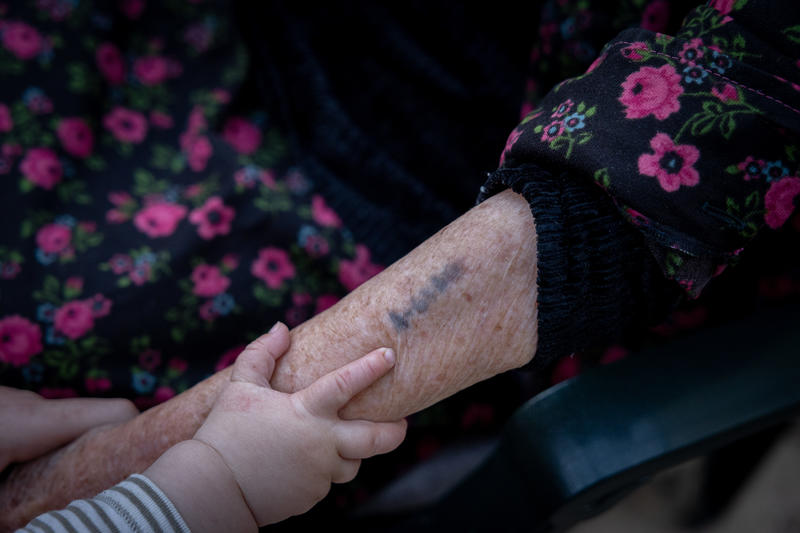
'The Holocaust Survivors' Rights Authority in the Prime Minister's Office is publishing current data today (Sunday) ahead of International Holocaust Remembrance Day, which shows that only about 351,000 Holocaust survivors, Holocaust refugees, and victims of anti-Semitic persecution in World War II are currently living in Israel, who have been recognized by the Authority since its establishment in the 1950s.
Over the years, the authority has recognized 322,997 people, but today their number stands at only 111,681.
Director of the Holocaust Survivors' Rights Authority, Ronit Rozin: "The data indicates more than anything that the window of time that Holocaust survivors live among us is shrinking at an accelerating rate, due to their advancing age. We are aware that these are the last years in which it is possible to provide a holistic response to Holocaust survivors, and therefore we are working intensively and in various ways to ensure that they do indeed realize everything they deserve and are granted optimal aging, because this is our national responsibility towards them.
 Want more news, videos and stories? Join the Haredim 10 WhatsApp channel >>
""For us, Holocaust survivors are a source of inspiration, a beacon of resilience and daily choice in lives built from deep fracture, and it is our mission to pass on their legacy of hope to future generations.".
The authority handles three main groups:
The Authority provides a response to two additional groups:
The one - Disabled people of the war against the Nazis, which number only 89 people! And these are those who were injured and suffered health damage due to their war service as part of the Allies or as part of the fighting units (such as the partisans) in World War II. The disabled from the Nazi war are entitled to monthly compensation according to the degree of their disability as well as an expanded benefits package.
The second - Widowers and widows of Holocaust survivors and war invalids against the Nazis, to whom the Authority pays a monthly benefit for the rest of their lives. Currently, there are 16,355 widows and widowers who receive survivor's benefits from the Authority, 7,669 of whom are widows and widowers who do not have a file with the Authority as Holocaust survivors.
Demographic data regarding Holocaust survivors, Holocaust refugees, and victims of anti-Semitic harassment:
sex: About 62% are women (68,955) and about 38% are men (42,726). The proportion of women increases with age: in their 80s, women are 60%; in their 90s, women are 65%; and the proportion rises to 71% over the age of 100.
age: Approximately 71% in their 80s, approximately 28% in their 90s and 1% over 100 years of age. Their average age is approximately 88, the youngest group, 80 years old, numbers 1,121 people and the oldest group, 105 years old, numbers 49 people.
Marital status: About 52% of whom are widowers (57,517) and about 36% are married (39,779). The proportion of married men is higher than the proportion of married women, about 68% compared to about 32%; and the proportion of widows is higher than the proportion of widowers, 80% compared to 20%.
Country of birth (Top 10 countries): 41,457 were born in the former Soviet Union (about 37%), 19,156 in Morocco (about 17%), 12,314 in Iraq (about 11%), 12,113 in Romania (about 11%), 5,223 in Poland (about 5%), 4,705 in Tunisia (about 4%), 3,049 in Bulgaria (about 3%), 2,846 in Libya (about 2.5%), 2,570 in Algeria (about 2%) and 1,496 in France (about 1.5%).
Year of immigration: 96% of whom immigrated after the establishment of the state, about 25% immigrated in the great wave of immigration with the establishment of the state (1948 - 1951), about 26% immigrated in the 1990s, and about 9% in the current century. In the past year, 2025, 42 Holocaust survivors immigrated to Israel.
residence (Top 10 cities): 7,445 live in Haifa, 7,148 in Jerusalem, 5,916 in Tel Aviv, 5,668 in Ashdod, 5,613 in Netanya, 4,618 in Be'er Sheva, 4,605 in Petah Tikva, 4,541 in Rishon LeZion, 3,799 in Bat Yam and 3,541 in Holon.
Nursing statusApproximately 731 TP3T of them are defined as nursing to various degrees, and approximately 751 TP3T of the nursing Holocaust survivors receive from the Authority and the Claims Conference, due to their high level of nursing (over 5 dependency points), an additional 9 hours of nursing care per week or a monthly payment supplement of 1,800 shekels.
Income supplement recipients: Approximately 30% receive the veteran's pension from National Insurance with additional income supplement. A breakdown of this group shows that approximately 86% of them are Holocaust refugees, approximately 13% of them are victims of anti-Semitic harassment, and 1% are Holocaust survivors.
Data on the Authority's activities in 2025:
Payment to Holocaust survivors - In 2025, the Authority paid monthly benefits and annual grants totaling approximately 4 billion shekels. In addition, it paid approximately 1.2 billion shekels for benefits to Holocaust survivors, including benefits such as funding for additional nursing hours, funding for prescription drugs in the basket, funding for treatments and medical supplies for recognized diseases, funding for mental health treatments, convalescence payments, and more.
Holding medical committees - In 2025, approximately 9,700 medical committees were held, and 701 of the committees increased the disability percentages, thereby expanding the possible remedies.
Operating a Rights Information Center - In 2025, approximately 49,000 calls were received, and in addition, the Authority initiated more than 5,000 calls to exercise rights in various fields, including calls to Holocaust survivors during and immediately after Operation "Am Kalavi.".
Operating mobile service centers - In 2025, the Authority opened 3 new mobile service centers in Lod, Yehud Monosun and Kiryat Motzkin. In total, the Authority operates 30 mobile service centers across the country from Tel Hai in the north to Eilat in the south to make the service accessible close to the homes of survivors. Authority employees arrive once a month and assist in the exercise of rights close to home. A total of approximately 360 meetings were held between Authority employees and thousands of Holocaust survivors across the country. The Authority also held approximately 80 conferences for the exercise of rights across the country, in which thousands of Holocaust survivors participated.
The Authority's projects - The Authority operates a series of projects for Holocaust survivors, such as:
In addition, the Authority financially supports non-profit organizations that assist Holocaust survivors in a variety of areas, such as: Operating social clubs About 650 Holocaust survivors are taking part in them, Operating therapeutic groups And there were approximately 9,200 meetings for Holocaust survivors in areas such as: body, movement and relaxation (for example yoga and exercise); music, singing and voice; cognition, memory and thinking; therapy using animals; art, creativity and crafts; emotional expression, drama and society, Emergency buttons Providing support to more than 6,000 survivors, Making apartments accessible For the medical needs of approximately 340 survivors, and individual social support within the framework of which the associations provided About 4,600 Home visits to survivors across the country.