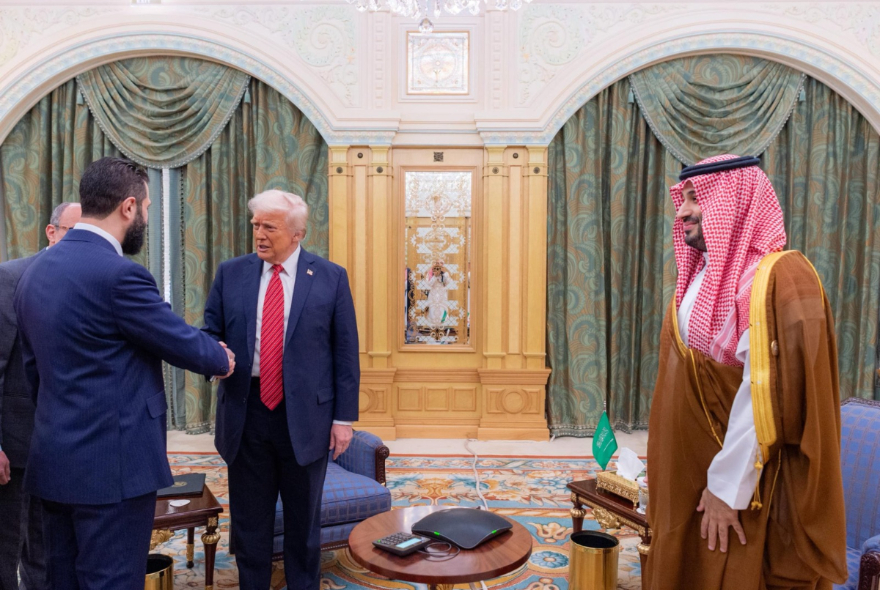
Amid reports of advanced discussions for a political agreement between Israel and Syria: United States President Donald Trump today (Monday) signed a presidential order lifting American sanctions on Syria.
Was your property damaged in an act of hostilities or war? Here's how to easily file an online claim
Earlier today, during a briefing for reporters, White House spokeswoman Caroline Lavitt made it clear that President Trump is "committed to a stable Syria that lives in peace with its neighbors.".
Tamir Morag, Channel 14's political correspondent, reported on "significant progress" and great optimism, both in Jerusalem and in Washington, regarding the talks with Syria.
Syrian President Ahmed al-Shara's interest does not stem from an ideological change, but from a strong desire to remove American sanctions and restore his country's devastated economy.
As part of the talks, it was made clear to the Syrians that the Golan Heights were not on the agenda.
However, Israel is expressing a willingness to consider a gradual withdrawal from the buffer zone, while insisting on maintaining a strategic presence at the Hermon outpost.
The hope is that a breakthrough can be announced in the coming months, and the issue is expected to take center stage in Prime Minister Netanyahu's planned visit to Washington next Monday.
Behind the talks between Israel and Syria
According to a report this evening on the Axios website, the US administration is holding initial talks with Israel and Syria with the aim of formulating a security agreement between the two countries. The report indicates that the United States prefers to conduct a gradual process that will build trust between the parties and improve relations between the countries.
At the same time, Israel is demanding guarantees that the talks will ultimately lead to a comprehensive peace agreement and normalization. Another source qualified this, saying that such an agreement "is not around the corner" and that it will take time to bring about significant progress.
According to a senior Israeli official, Netanyahu's goal is to formulate a multi-stage arrangement with Syria that will begin with the current version of the 1974 Separation of Forces Agreement, which will eventually mature into a full peace agreement and normalization.
According to the report, contacts with Syria were established through at least four channels, including through National Security Council head Tzachi Hanegbi, Mossad head Dedi Barnea, and Foreign Minister Gideon Sa'ar, for the benefit of strategic dialogue and daily coordination.
However, Israeli officials argue that the US should take a more active role as a mediator, believing that this will give Syria's new government a stronger incentive to act.
 Join the Haredim 10 Facebook page >>
 Join the X page of Haredim 10 >>
 Want more news, videos and stories? Join the Haredim 10 WhatsApp channel >>