It was on the eve of Rosh Hashanah 1976. At a gathering in the Lubavitcher Rebbe's seminary, a surprising guest was sitting there – the writer Nathan Yellin-Moor.
In his youth, he was one of the three commanders of the Lehi underground, alongside Yitzhak Shamir and Dr. Israel Eldad. After the establishment of the state, he headed the "Fighters' List" and was elected to the Knesset. However, he later turned to the left side of the political map, becoming a radical leftist activist.
One day he received a call from the editor of the Allgemeiner Zshornal, a Yiddish newspaper published in the United States. The founder and editor, R.' Gershon Jacobson, a Chabad follower, asked Milin-Mor to write a regular column in his newspaper. Of course, he knew his views, but he believed that they would arouse interest among readers and elicit responses, which would benefit the newspaper.
 Want more news, videos and stories? Join the Haredim 10 WhatsApp channel >>
And indeed, it was so, and his columns sparked heated debates.
In 1937, Yellin-Mor was in New York, and Jacobson invited him to be his guest during the holiday. Towards the end of the second day, he suggested that his guest come with him to the Rebbe's gathering.
The writer wondered: "Won't they hunt me down there?""
The host replied that he shouldn't worry.
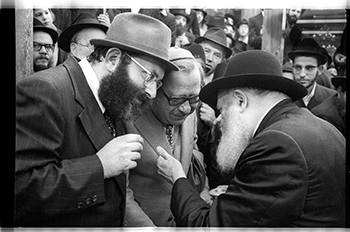
After the gathering, the Rebbe would pour a little wine from the cup of blessing and the Havdalah for each and every one of those present, in a ceremony known as the 'cup of blessing.' When Jacobson introduced his guest, the Rebbe looked at him with a radiant face and said, "Is that you?!".
The Rebbe continued, "I know that you are not afraid of the minds of men, but what about the fear of Heaven?".
""Thinking," Yellin-Moor answered in one word.
""What should we think about?" the Rebbe asked with a broad smile.
Yellin-Moor said later that he did not want to open a debate about faith, and was content with a hint: "Let it be like the Berdichuver.".
He was referring to the story of Rabbi Levi-Yitzhak of Berdichev, who saw a Jew smoking on Shabbat and remarked to him that perhaps he did not remember that today was Shabbat. The man replied that he did. "Perhaps you have forgotten that it is forbidden to smoke on Shabbat," Rabbi Levi-Yitzhak tried. The Jew replied that despite knowing the prohibition, he smoked anyway. Rabbi Levi-Yitzhak raised his eyes to heaven and said: "See, Lord of the Universe, a Jew - even though he desecrates Shabbat - is careful to speak the truth.".
The Rebbe immediately understood his meaning and responded: "The difference is that Rabbi Levi-Yitzhak taught zakut about another Jew, whereas you are talking about yourself...".
Yellin-Mor later said that he was very impressed by the Rebbe's response, which touched his heart. The Rebbe added, "Since you are a writer, you should continue your writing.".
Yellin-Mor was surprised: "The Rebbe reads my columns?!""
""Yes," replied the Rebbe, "even though I do not agree with the positions expressed in them. But since you are blessed with a talent for writing, you must continue to write. You cannot leave your column empty.".
At that time, Yellin-Mor published his book, "Fighters for the Freedom of Israel." On the 2nd of Tishrei, he came to the Rebbe again and gave him his book. The Rebbe thanked him and asked: "Do you remember what we talked about on the eve of Rosh Hashanah? Surely you will not cause me to fall into sin.".
""How can I make the Rebbe fail in sin?" Yellin-Mor was astonished.
""A sin," the Rebbe replied, "is when a person speaks idle words, which have no benefit. We talked about not leaving your column empty. If you don't, you will make me the one who speaks idle words.".
Yellin-Moor was surprised again and the words affected him deeply.
About three years later, in 1980, Yellin-Mor fell ill with a terminal illness. His ability to write weakened. Five weeks before his death in Adar, he sent an envelope to Jacobson.
""I feel that my days are numbered," he wrote to the editor, adding that he was sending him an article in the two installments. "I will ask that the articles be published only after I am in the world of truth.".
After he died, Jacobson published the articles.
First, Yellin-Mor explained to readers why he wanted to publish the words only after his death: "As I lie on my sickbed, I take stock of my life and my actions," he wrote. "I think about how I will stand before the throne of honor and what excuse I will give to the Creator of the world for the sins I have committed, and there is no one on earth who does not sin. I hope that these articles, which will be published after my death, will be a speech of honesty about me.".
Later, Yellin-Mor describes all the stages of his life, and speaks in detail and with great emotion about his experience, as someone who came from a house of 'opponents', of being at the Rebbe's gathering and talking with him, and about the Jewish point that arose within him. "I think that thanks to this light I will yet emerge from the abyss... This is the light of the soul of the leader of Israel and its saint, Rabbi Menachem-Mendel Schneerson.".
""His writing is full of love for the Rebbe, and it is clear that he has a deep soul," says Rabbi Simon Jacobson, son of Rabbi Gershon, who witnessed the events at the time. "These last articles were different from those he had written in the past. He ends them with a message of hope. This experience with the Rebbe brought him back to his soul. The Rebbe touched a hidden point within him, where he could rediscover the Jewish genius within him.".
• Published in 'Conversation of the Week', based on Yellin-Mor's articles and Rabbi Simon Jacobson's testimony in JEM