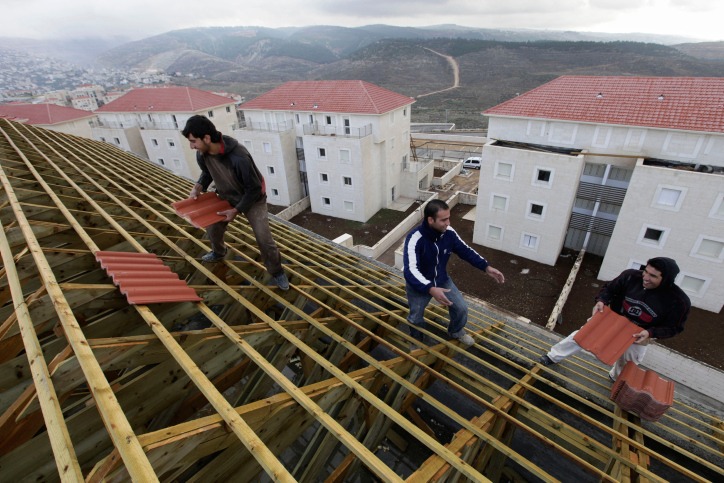
The State Attorney's Office filed an indictment with the Jerusalem Magistrate's Court against Ali al-Ma'abda, a resident of Bethlehem, for collecting patronage fees from contractors who worked in the ultra-Orthodox city of Beitar Illit in a total amount of approximately one hundred thousand shekels.
Jerusalem wants mountain air: These are the vehicles that are banned from entering the city
According to the indictment filed by Attorney Adi Biton Avrahami of the Jerusalem District Attorney's Office, between 2017-2024, the defendant collected forced payments from four contractors in the amount of 2,000-4,000 shekels per month and without documentation, in exchange for unnecessary "security services," while indirectly exerting pressure on the contractors' property in the event of refusal to pay.
 Want more news, videos and stories? Join the Haredim 10 WhatsApp channel >>
The indictment accuses the defendant of committing offenses of collecting sponsorship fees.
According to the indictment, until September 2024, the defendant worked as a guard for a security company and, as part of his work, operated mainly on the tunnel road. During the period relevant to the indictment and while working for the company, the defendant privately collected protection fees from various contractors in a systematic and continuous manner, taking advantage of their distress and fear, in the Beitar Illit area.
As part of collecting the protection fees, the defendant, on his own initiative, approached various contractors in the city of Beitar Illit and offered security services, often close to the start of their work at the construction site. These security services, which were sometimes actually provided and sometimes not, were offered to the contractors by the defendant in exchange for payment - the collection of protection fees - which he demanded, and in some cases he mentioned the damages that occurred at various construction sites in the city.
Many contractors in Beitar Illit were forced to cooperate with the defendant, and in exchange for paying the protection fees, they gained or hoped to gain "quietness" and relative security in their properties. Most contractors in Beitar Illit are not required to be guarded, since the city of Beitar is fenced with a security fence and has guards throughout the day. Nevertheless, given the course of action taken by the defendant, the contractors agreed to the requirement of forced guarding, given their distress and fear for their property.
Starting in 2017 or thereabouts, upon the defendant's arrival in the city of Beitar Illit, it became known among the contractors in the city that there was a "need" to pay the defendant or someone on his behalf security payments in order to avoid damage and to ensure "quietness" at the construction site.
The payments for the forced guarding services were given to the defendant in cash, without receipts or a written contract, and without the contractors knowing exactly what they were paying for, or the extent of the guarding that the defendant would provide them, if any.
As part of the forced guarding of the contractors, the defendant toured the construction sites for which he received payment from the contractors in a limited manner, and much less frequently than is customary with licensed and regulated guarding companies. The defendant did not compensate the contractors for damages that occurred on the site during his guarding, but at most and only in some cases did he "offset" the
Payment for the damage, versus the demand for payment for the forced custody.
The indictment describes the extortion method. Here is one of the cases: M. K. is a contractor at the Employee Development Company in Beitar Illit. On sites that he owns, M. did not need to post security services, as Beitar Illit is a closed and fenced place. During April 2022, the defendant contacted M. and offered him security services on his behalf, adding that he 'needs security' at a site for which M. is responsible in the complex near Etrog Square in Beitar Illit.
M. refused to pay the defendant for security services, since he knew that there was no need for security at the site. Shortly thereafter, three windows were broken at the site, and the damage suffered by M. was estimated at several thousand shekels. After the initial damage and due to M.'s fear of further damage to his property on the site, he was forced to pay the defendant for the forced security.
Starting in May 2022, M. was forced to pay the defendant 2,800 shekels per month. The defendant did not specify to M. the exact manner in which he would maintain the property and how often it would be maintained.
Several months later, and in light of the development and expansion of the site, the defendant decided to increase the payment demand to 3,500 shekels per month, and M. paid him the amount. Thereafter, starting in March 2024, the defendant again demanded that M. increase the payment, and from then until September 2024, M. paid the defendant 4,000 shekels per month. The defendant received the payment in cash and without issuing receipts for the payment and without documentation that it had been received.
Despite repeated demands by M. to receive the defendant's ID card in order to draft a proper contract, the defendant did not comply with the request. During most of the period of guarding, the defendant did not remain at Betar Illit during all the hours relevant to guarding.
About a year and a half after the defendant began paying, additional damage occurred in the form of theft of computers from a digger on the site, for which M. "offset" with the defendant so that he did not pay him for two months.
The day before the defendant's arrest, the windshield of an earthmoving vehicle was shattered at the site, damage for which M. did not receive compensation.
Starting in August 2023, the defendant collected a total of 47,600 shekels from M. as sponsorship fees for the forced guarding, while taking advantage of M.'s distress.