1.
I'll start with a personal confession: It's a bit difficult for me to write about Haifa as a city where there are conflicts or intrigues. I still remember it as an island of sanity in terms of coexistence between ultra-Orthodox and secular.
But things have changed.
 Want more news, videos and stories? Join the Haredim 10 WhatsApp channel >>
What happened, as the cliché goes, was so. It happened in the middle of the term before Einat Kalisch Rotem's term, when Yona Yahav was already serving as mayor for a third term. According to the coalition agreement, in the middle of the term, Michi Alper, a Degel representative in Haifa, was supposed to be appointed as a paid deputy mayor. However, Mayor Yahav vetoed the appointment.
This was the signal for the start of a battle between the two, which culminated in the 2018 elections, when Alper led Einat Kalisch to victory over Yahav (who doesn't remember the dancing of the Lithuanian public in Haifa, jubilant with joy).
Five years have passed. In the last local elections, Yahav managed to return to the mayor's seat, leaving all the ultra-Orthodox parties in the opposition.
Since then, the ultra-Orthodox community in Haifa has felt uncomfortable, to say the least. "He marked us," many of them claim.
But professional journalism checks and digs into the data, not getting carried away by feelings.
And so, when we contacted them about what seemed like harassment - "Fridays, the quiet beach, inspectors handing out reports even though there aren't enough parking spaces in the entire area" - we checked with the municipality's spokesperson. It turned out that these were places marked in red and white. The municipality is right, we didn't report.
A few days ago, residents of Geula Street complained that inspectors were going around in the mornings handing out parking tickets in places that were marked for parking - and "the markings have faded over the years from the sun, from the rain." We contacted the municipality's spokesman again. According to him, this is about parking on sidewalks. The residents claim, as mentioned, that there used to be parking markings there.
It may be a municipality's right to decide that a place once marked as sidewalk parking ceases to be a proper place, but the residents' feelings are difficult to ignore.
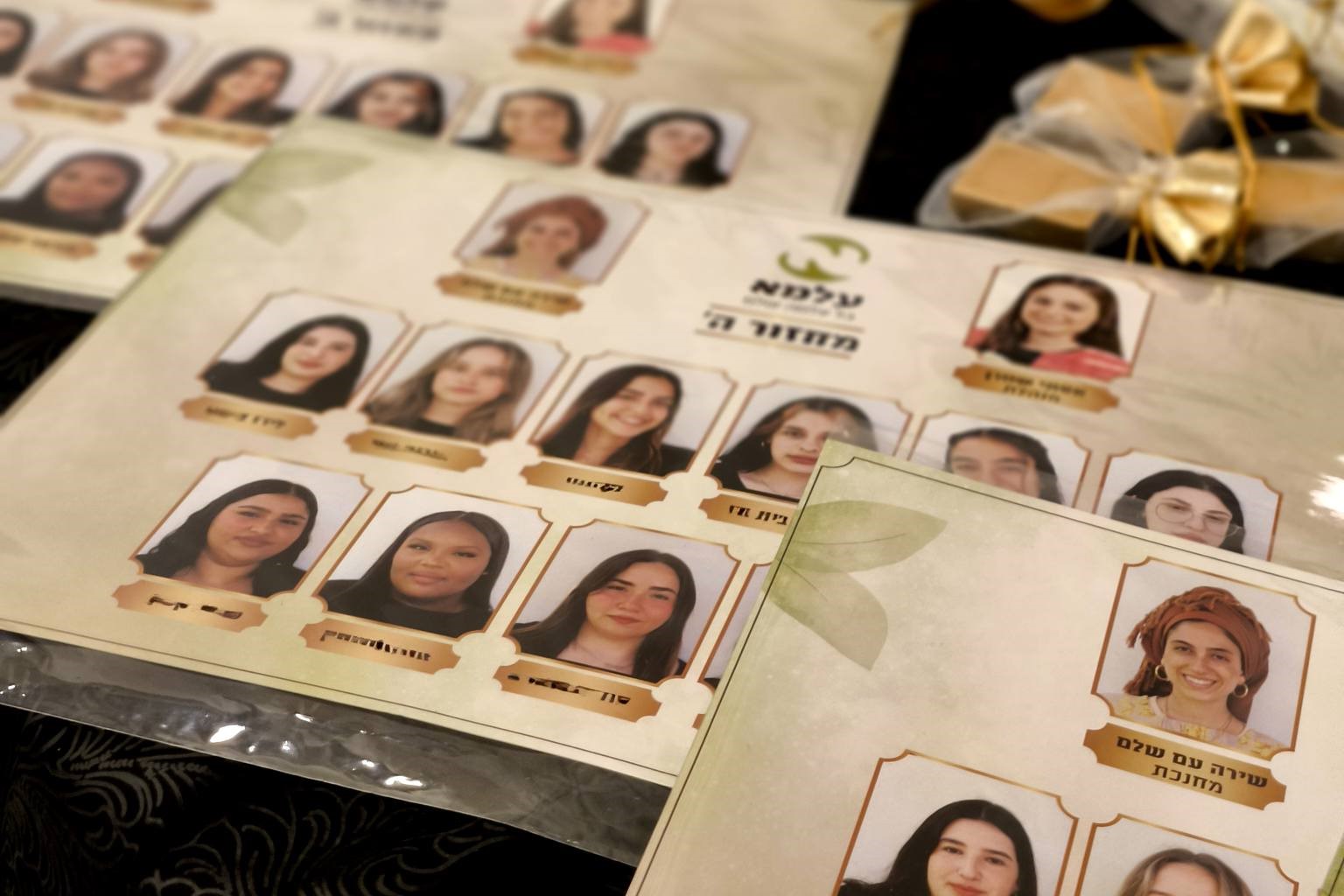
Then the story of 'Alma High School' landed on our table.
2.
The month of Sivan 5783, a year ago today.
The celebrations in Haifa were great. 'Alma - Torah High School for Sciences and Arts' for girls was awarded the award. The praise for this was rightly heaped on Michi Alper, who, as we recall, was the right-hand man of Mayor Einat Kalisch and some even called him 'the ultra-Orthodox mayor of Haifa' in the previous term.
17 council members supported the allocation, zero opposed. Elements who tried to thwart the vote failed, with the legal advisor also rejecting their claims.
Rabbi Peretz Meir, the man behind the establishment of the high school, arrived at Alper's office the day after the vote, and the two drank "cheers": Finally, the students - not Haredi, most of whom come from homes far from any Haredi sign, and sometimes even any religious sign - will be able to enjoy an institution defined as "close", a spacious, beautiful place with a proper legal allocation.
3.
A year of joy came to an end on June 4 of this year, when the Haifa City Council convened again, devoid of ultra-Orthodox coalition members, and canceled the allocation.
Let's start with the municipality's response: "Out-of-state students are admitted to Haifa municipal schools on a space-available basis, according to an assignment decided by the local authority, with over 901% of them being residents of the city of Haifa. This is done in accordance with the provisions of the registration regulations and the transfer regulations. In the case in question, it concerns the allocation of a school to out-of-state students. In addition, even after a hearing process held for the school administration, it was found that the student lists were not submitted legally, do not match the existing report in the Ministry of Education system, and that there is a suspicion of false registration in corporate documents.".
I contacted Alper, and he explains that the municipality claims that there are students who are actually registered at two institutions, even though they passed the municipality's eligibility committee and even received an assistant - meaning the municipality is aware that they are "with us.".
He admits that there are female students who do not live in Haifa, "but there are other schools in the city that are of regional school standard." The mayor himself, incidentally, solemnly announced on election night that he would return the children of Usfia to study in Haifa. The municipality also supports the bilingual school attended by students from Dalit El Carmel and Usfia, so it is not clear what the fuss is about when it comes to Alma High School.
[gallery]
However, when I returned to the municipality's spokesman with these comments, he refused to continue responding to me, and advised me to be content with his initial response, the one that was presented to you here verbatim.
So I have no way to go through the list of students one by one and prove who is registered in another place, who comes from out of town, who is registered and did not come to school. It is possible that the conflict will reach the court, as it will do thorough work to get to the truth.
In the meantime, I return to the feeling of the Haredi public in the city: we are being persecuted, for no wrongdoing on our part.
It's hard to argue with feelings. The facts are clear: the municipality headed by the previous mayor Einat Kalisz-Rotem granted an allocation to Alma High School, the municipality headed by the current mayor Yona Yahav is canceling the allocation.
And the most difficult feeling that accompanies me, personally, is the feeling of missing out. How Haifa also fell into the secular-ultra-Orthodox struggle.
4.
The tone at the council meeting discussing the allocation was heated. There were harsh exchanges between Michi Alper and the mayor. Then, as mentioned, a vote was taken that canceled the allocation.
Alper did not give up, he turned to legal advisor Yamit Klein - and demanded: a re-vote. Yesterday, at 6:00 PM, a second vote was held - and the allocation was again rejected.
According to Alper, "The student data that the municipality presents is misleading and false. It is a matter of political persecution, and there is no issue here of students or of yards. It is an attempt to bring about the closure of the school.".
He claims, "The issue of foreign students is irrelevant. This is an allocation that was legally given to a Haifa-based association. 'Where the students are from' is not a criterion in the allocation criteria, and the allocation committee's decision was made with the knowledge that this is the association's activity.".
He further claims: "The association invested about three million shekels in the building, there is an issue of reliance here. There is a decision here that is valid for five years. If anyone thinks today that we should act differently - when the allocation period ends, they will act differently. We are a metropolitan city and as long as there are not enough students to receive a full class standard, there is no obstacle to accepting children from outside Haifa. This issue has never been up for discussion as an obstacle to allocation, certainly not in retrospect, when an allocation was given and the school is operating there.".
As I mentioned, it is possible that the conflict will reach the doorstep of a court, which will have to examine whether the 'outside students' principle precludes allocation and whether the issue of reliance should be taken into account.
And in the meantime, the students, the parents, and even the city's ultra-Orthodox residents will continue to feel a sense of deprivation. Rightly or wrongly, but with feelings, as we have already said, it is difficult to argue.
5.
And there were also the videos, which gave me a difficult feeling.
The doors of the city council hall are locked, a security guard stands at the entrance, parents are not allowed in. Even though, by law, council meetings are supposed to be open to the public, certainly to parents of students at a school whose issue is being discussed at the meeting.
The door opens for a moment, a quick glance into the hall reveals that it is not crowded. "We came to express the pain of the students and parents, it is a violation of the law not to let us in," says one of the mothers.
Then the police arrive at the building and announce: The meeting is open.
Isn't it a shame that the Israel Police are needed to enable a legal and necessary action like opening a council meeting in a democratic country?
Only when the mothers go inside and take pictures do I realize how 'sparse' the place is - and it wasn't overload that led to the decision to stop them at the door.
6.
I thought I had already heard everything, until I received a phone call this morning from the mother of an 11th grade high school student. The clerk from the municipality's education department: "I'm from the municipality's education department, I'm asking, where has the girl studied until now?""
The mother: My daughter attends Alma School.
Clerk: What grade is she in right now?
Mother: 11th grade
"The Clerk" goes up to "Alma"?
The mother: She's going into twelfth grade, yes.
Clerk: Now, unfortunately, we were asked to inform you that this school is going to close, and we are here to help you look for another suitable setting, so I don't know if you heard about it...
The mother: What does it mean to close? To close when? Immediately?
Clerk: Yes, they're closing it, as if there won't be a school next year. That's it. Anyone who studied, graduated now, won't have a place next year. So we have a proposal here for a 'Tehilla' school...
The mother: What do you mean? Where is Tehilla School?
Clerk: This is Tehilla School in Carmel.
The mother: What is Carmel?
The clerk: In Carmel (Yaniv, where in Carmel is 'Tehilla'? Approximately...) near Horev...
The mother: But if my daughter attended an 'alma' school, and my daughter was educated in the way of an 'alma' school, why can't I continue there right now?
Clerk: Look, these are the instructions, the mayor's decisions, that this facility will be closed, I just, I don't have much information, we were simply asked to inform you and if you would like us to help you find a facility, the current one is the 'Tehilla' school.
And here is the continuation of the Haifa Municipality's response, this time to the issue of closure:
""In light of the fact that this is an educational institution where the vast majority of its students are not residents of the city, the city council made a decision that a municipal building cannot be allocated for its continued operation. The education administration offered female students living in Haifa the opportunity to register at educational institutions in the city. The education administration will continue to support the Haifa students and their families until they are optimally absorbed in the Haifa institutions that were offered to them.".
Haifa. Situation. So sad.