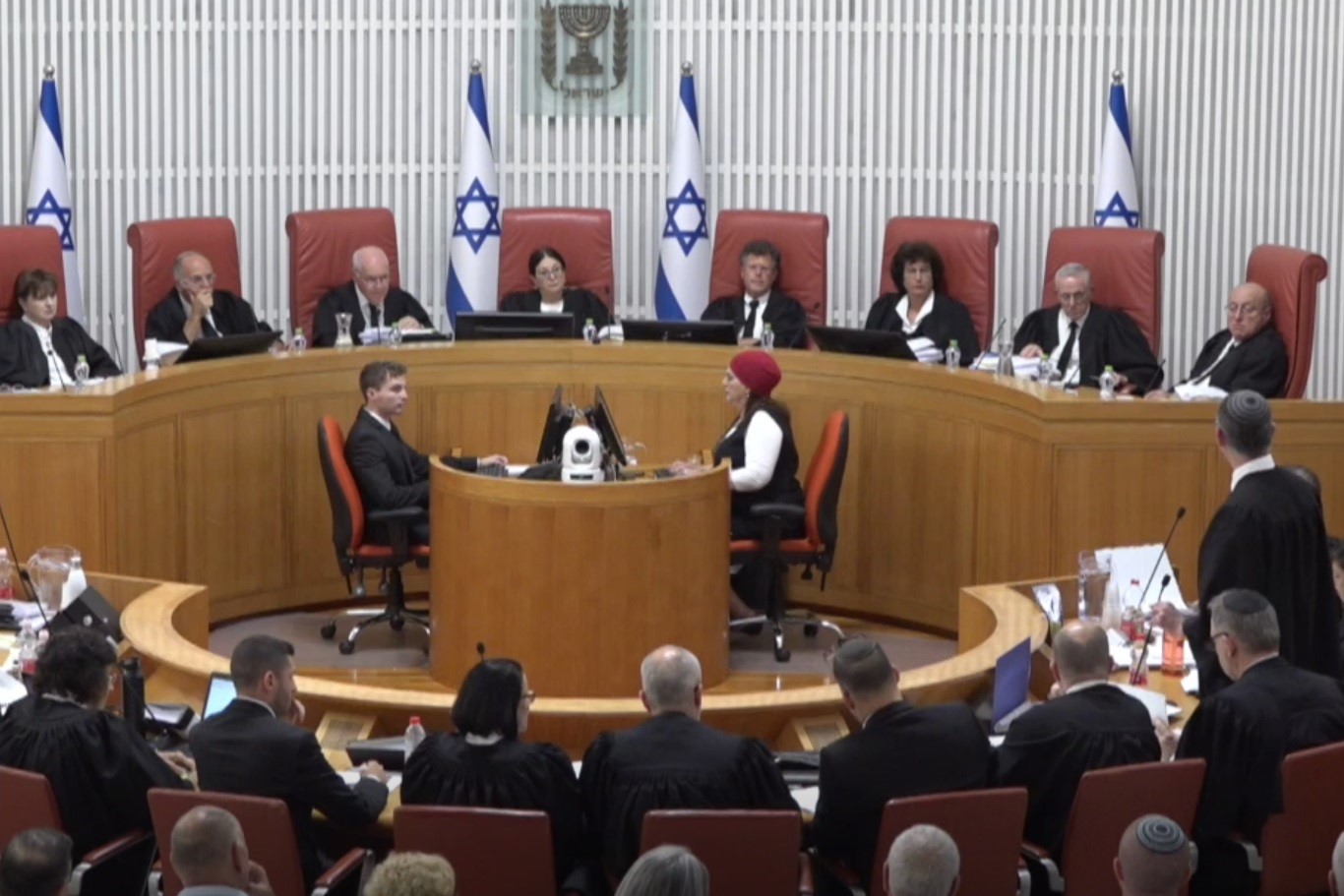
News 12 commentator Amit Segal announced this evening (Wednesday) that for the first time in the history of the state, the High Court is about to invalidate a Basic Law.
According to the report, in recent days, 15 High Court judges completed the ruling on petitions against the law to repeal the reduction of the reasonableness ground, which spans hundreds of pages.
Eight justices, led by retired President Esther Hayut, wrote a decision in favor of invalidating the law. Seven justices opposed the invalidation.
 Want more news, videos and stories? Join the Haredim 10 WhatsApp channel >>
According to the report, in principle, there is little chance that the outcome will change, because now each judge reads the rulings of his 14 colleagues and responds. Such changes have occurred in the past in several cases.
Invalidating the law would constitute a precedent-setting step in which the High Court would take away the authority to invalidate basic laws enacted by the Knesset.
President Hayut wrote in the draft ruling: "The Basic Law constitutes a significant deviation from the 'Constitution in the making' and therefore it must be accepted by broad consensus and not by a narrow coalition majority." Justice Ofer Grosskopf agreed: "The requirement to apply to those at the top of the pyramid is at the core of the imperative; no person is not subject to the rule of law.".
Justice Yechiel Kasher criticized the wording of the law, but argued that the court does not have the authority to invalidate it. "This is not a 'light blow to the wing.' Those who fought and those who opposed this amendment fought for no small matter. However, the task of enacting basic laws lies within the authority of the Knesset, not this court.".
Judge Noam Solberg also opposed the repeal of the law: "Most of the judges and presidents of this court stand with me in my opinion (not to invalidate basic laws).
Supreme Court justices sharply criticized the retiring President Hayut, who they said pushed them to an impossible deadline by which she could issue a ruling, three months after her retirement, which will take effect in two weeks.
Their criticism intensifies in light of the fact that without the dissenting opinions of Hayut and Anat Baron, the result would have been 7-6 against the disqualification.
The majority opinion in the draft verdict:
Esther Hayut
Yitzhak Amit
Anat Baron
Ofer Grosskopf
Khaled Kabub
Uzi Fogelman
Dafna Barak-Erez
Ruth Ronen
Minority opinion in the draft verdict:
Yechiel Kasher
Noam Solberg
Yosef Elron
Alex Stein
Yael Wilner
David Mintz
Gila Kanfi-Steinitz
The law to abolish the reason for reasonableness was approved by the Knesset at the end of July. The law was enacted as part of an amendment to the "Basic Law: Judiciary," and it effectively deprives the court of the ability to intervene in ministerial decisions that were made with "extreme unreasonableness." The court's intervention in such cases is intended to invalidate decisions that were made irrationally, unequally, or in the presence of a conflict of interest.
Finance Minister Bezalel Smotrich responded: "Hundreds of thousands of soldiers and commanders in the regular and reserve forces are giving their lives for the common good now on all fronts, 2 million people are afraid of the knock on the door, and there are those who insist on taking us back to October 6th.".
""The rejection of a Basic Law for the first time in the history of the state, by a narrow majority, is regrettable and further deepens the division and controversy and the lack of understanding of the magnitude of the hour. Just as the Knesset is not currently promoting controversial laws, so it is appropriate and expected of the other institutions of government. A time for victory and unity.".
Constitution Committee Chairwoman, MK Simcha Rotman: "These days, when my colleagues and I in the Knesset are passing all laws by agreement and consensus in order to preserve the unity of the people and the unity of the fighting forces, issuing a precedent-setting ruling that changes the fundamental principles of the State of Israel at the stroke of a vote is an act devoid of national responsibility.".
""I call on the Supreme Court and its judges to come to their senses and connect with the spirit of unity and responsibility that pulsates throughout the public sphere, and to refrain from creating unnecessary controversy among the people. My friends and I will continue to do everything to ensure that the lessons of the 7/10 are internalized and that the necessary and necessary changes in all systems of government and the judicial system will be implemented by the people's elected representatives, with broad consensus, as befits a democratic state.".
Attorney Nati Rom attacked President Hayut's intention to issue the ruling during the war: "The 'gift' that President Esther Hayut left in the form of invalidating a Basic Law is a change of regime in Israel for the second time and undermines the democratic foundations of the State of Israel. To cook up this coup with a majority of one judge, during a time of war when soldiers are fighting, families are burying their dead, shows why reform of the judicial system is so necessary.".
""I don't understand what went through Hayut's head when she saw that everyone was restraining themselves and decided that it was time to light this match again and tear our battered and bruised people apart.".
The Movement for Governance and Democracy responded: "While the State of Israel is fighting for its life, and its best sons are giving their lives in Gaza, the former Supreme Court president insists on stoking the fire of controversy and publishing the most political and polarizing ruling ever published here. The court places itself in the ruling as the supreme legislator, above the Knesset that enacted the Basic Law, above the public that elected the Knesset, and above the law itself.".
""The astonishing lack of self-awareness that allows judges to demand from the Knesset a 'special majority' requirement that does not appear in any law, while invalidating a Basic Law with a coincidental and negligible majority, which, according to the judges themselves, would have been overturned if the verdict had been given two months earlier. Hayut and her colleagues are proving to be irresponsible in the most difficult hours for Israeli society. The journey to reform the judicial system will continue."'