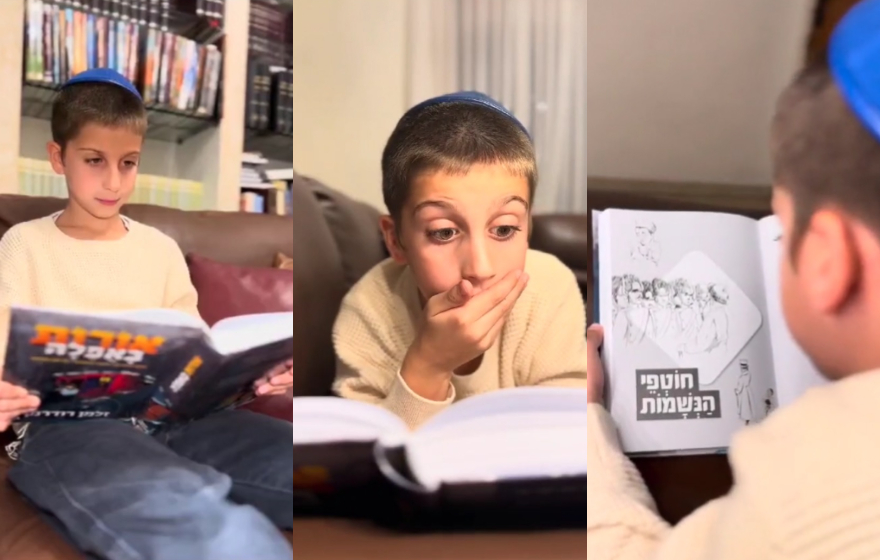
Rabbi Zalman Ruderman. When the month of Tevet arrives, it means that a new book by you has also been published. What is it about this time?
This time, a book with three ancient Chabad plots that I reconstructed and reworked, adapting them for the younger generation.
The first story – 'The Blind One' – is from the time of the old Rebbe, the author of the 'Tanya', and his son Rabbi Dovber, the second Rebbe of the House of Chabad. This is a plot centered on Rabbi Yosef, a learned and high-ranking Hasidic disciple, who, at the astonishing command of the old Rebbe, the author of the 'Tanya', becomes a 'cart owner' one bright day, traveling the roads. On one of his trips, he meets an assimilated Jew who has regressed to the lower lay class. He converts him to complete repentance, and then it is revealed to him from heaven, through the second Rebbe, Rabbi Dovber, that with this his mission is complete and his role as a 'cart owner' is complete. Rabbi Yosef returns to being a Torah figure and 'influential' in his city of residence.
 Want more news, videos and stories? Join the Haredim 10 WhatsApp channel >>
The third plot deals with six young American men who travel from New York to the Polish town of Otowcz in the late summer of 1939 to study with the previous Rebbe, Rabbi Yosef Yitzchak Schneerson of Lubavitch, who was living and working in Poland at the time. Two weeks after their arrival, World War II breaks out, Poland is occupied by Nazi Germany, and the men are forced to flee for their lives back to the United States, experiencing a arduous and dangerous journey along the way.
I intentionally skipped the second plot – 'The Soul Kidnappers' – and saved it for the end of my answer, because it is the central one in the book: In this plot, which spans several dozen chapters, I build and describe the entire period of the Cantonists and the terrible decree on Jewish children in Tsarist Russia, alongside the story of the part played by the Rebbe, the 'Tzemach Tzedek', the third in the Chabad dynasty, against the decree and its initiators. A heroic struggle that placed him in real danger of death on a daily basis.
I called the book 'Lights in the Dark' because these two words are a common denominator for the three plots.
The books are always published in honor of the Lord of Tevet. What exactly is the story of this day?
Indeed. In Chabad, this date is considered the 'Holiday of Books', because of an event that occurred over 35 years ago (in 1987). Several dozen ancient and valuable books – both financially and mainly sentimentally – were stolen from the Chabad World Library in New York, and began to be sold on the open market to the highest bidder. Behind the affair was a private individual who presented himself as the heir of the previous Rebbe (Reza) of Lubavitch, and in light of this, claimed ownership of those books.

But the last Lubavitcher Rebbe, Rabbi Menachem Mendel Schneerson, passionately argued that this was not a 'private' property of his father-in-law, one that could be referred to in terms of an 'inheritance', but rather a spiritual asset of the Chabad movement, intended to serve the entire generation. The Rebbe saw this as a symbol of spiritual catechism for the continuity of Chabad, even after his father-in-law's departure.
The matter escalated and reached a federal court in the US, with on the one hand financial claims of the type accepted in courts being presented, and on the other hand deep spiritual ideas being raised about the significance of the Rebbe of the Rayatz as a 'righteous generation' and 'leader of all Israel'.
To his surprise and joy, the gentile judge delved deeply into Hasidic-Chabad philosophy and was convinced of the righteousness of the spiritual claims in the face of the financial ones. The Rebbe saw this as the removal of a spiritual category and turned the date of the legal decision (5th of Tevet) into the 'Holiday of Books'. From now on, he decreed, every year on this day, public libraries as well as private individuals would enrich their Torah literary assets. And this is indeed the practice in Chabad. Every year on this day, all the Hasidim - men, women and children - flock to bookstores and fulfill the 'mitzvah of the day' - purchasing new books. The adults buy actual Torah books, while the young children purchase educational reading books. I hope I was able to explain the idea...
How many books of yours have been published to date?
With divine help, more than 50. But I'm not counting anymore, because as we know, "the blessing lies neither in what is weighed, nor in what is measured, nor in what is counted"...
The main story in your new book deals, as you mentioned, with the Cantonists, a painful episode in the history of the Jewish people in Tsarist Russia. What was the decree actually?
This is an affair that began about 200 years ago and lasted three decades. Tsar Nicholas I decided that the Jews were not sufficiently involved in the life of the Russian nation and he decided to act forcefully to re-educate them and assimilate them into general Russian society. Thus was born the 'Cantonist Order' - the recruitment of young children into a pre-military system and then their integration into the fighting army, with the whole affair spanning 30 years. In other words, children who were recruited into the same pre-military framework at the age of 12 left it at the age of 42. Throughout all these years, they were cruelly separated from their families, separated from their Jewishness, and subjected to excessive physical pressure to convert. As a result, many of them ended this 30 years of forced recruitment while separated from their families and their Jewishness.
This is of course just the gist. When you go into higher resolutions, you discover that there were more and more harsh and cruel aspects to this. It starts with the fact that the children were kidnapped into this military service by 'kidnappers', 'chafers' in Yiddish. Some of these kidnappers were Gentiles, but many of them were Jews from the social margins. Heartless and unscrupulous people who literally snatched children from the bosom of their parents and families. Innocent children were walking down the street or playing in their yard, and suddenly cruel hands grabbed them, loaded them onto carts, and brought them to 'cantons', military buildings, hence their name, the 'cantonists'. These kidnappers did this of course for money, as they were rewarded for each kidnapped child they brought.
[gallery]
Furthermore, if the official 'Cantonist Law' stipulated that only children from the age of 12 would be recruited into the cantons, the evil kidnappers were not particular about such small details and would also kidnap children aged seven and eight. When they unloaded these children at the 'cantons', they told those responsible for absorption that they were 12-year-olds. Beyond the Jewish-religious aspect of the affair, entire families were torn apart and destroyed in light of this decree.
The kidnappers were actually acting in collaboration with the community leaders. Testimonies from that period say that they mainly kidnapped orphans who had no one to protect them, while the wealthy paid a ransom to the community treasury and thus removed the danger from their heads. Have you found any such evidence?
Very true. In fact, part of the evil of this decree was in imposing the obligation to provide Jewish children on the Jewish communities themselves. There were 'quotas' of children that had to be provided to the Tsarist army. As a result, the heads of the communities found themselves in extremely difficult and cruel dilemmas. Here came into play the rules of 'survival' accepted in nature, when the strong prevail and the weak perish.
The leaders of those communities did not want to deal with the rich and the public officials, and hand over their children. It was much easier for them to capture the orphans, the children of poor, disadvantaged families, and 'deliver' them to the army. But they would not go and capture these children themselves... So they employed - usually secretly, behind the scenes - kidnappers who did the work for them and allowed them to remain with 'clean hands.'.
This, of course, did not happen in all communities. And in this aspect, the vigorous activity of the Rebbe of the 'Tzemach Tzedek' was also reflected. He sent special emissaries to the Jewish communities throughout Russia, in order to eradicate this phenomenon. In addition, he worked to excommunicate and boycott the Jewish kidnappers. In certain cases, they were even treated as the halakhic law instructs to treat 'musrim', who "reprove and not abet"...
Is there an estimate of how many Jewish children were kidnapped?
There are no exact numbers. I came across a number of 70 thousand. So it seems to be in that range – a few tens of thousands.
And how many of them nevertheless returned to the fold of Judaism?
A minority of them managed to maintain their Jewishness throughout the years of forced conscription. Brave children and young men who were willing to pay for it with physical and mental suffering. However, the unfortunate fact is that most of them nevertheless broke down and succumbed to the pressure to convert their religion.
But here too there are several types and shades: some did it only for show and some decided to follow this course 'to the end'. But many of these, and also of those, regretted it after a while and returned to their Judaism. The thing is that after so many years of complete disconnection from all Jewishness, they remained ignorant and ignorant peoples of the lands and until the end of their lives did not know how to realize their Judaism...