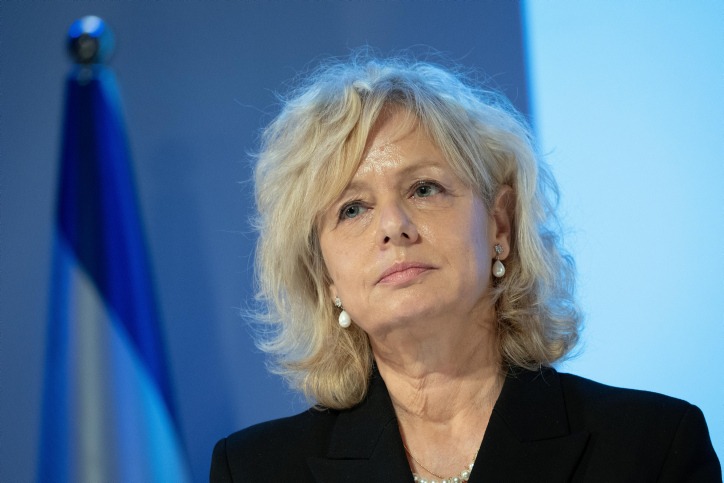
Legal Advisor to the Prime Minister Gali Baharav-Miara announced this evening (Thursday) to Defense Minister Benny Gantz that it is possible to proceed with the appointment of a new Chief of Staff - during the election period.
The Attorney General's statement reads: "Although the continuation of the process of appointing the Chief of Staff during an election period involves significant legal difficulties, in the specific circumstances of the case, and after examining all the relevant professional factors, she has come to the conclusion that these difficulties do not amount to a legal impediment.".
In the opinion of the Attorney General, although "the continuation of the process of appointing the 23rd Chief of Staff of the IDF during an election period involves significant legal difficulties, in the concrete circumstances of the matter, and in particular in light of what is stated in the confidential professional-security opinions that were presented to her, concerning the unique and exceptional security challenges that the IDF is currently facing, and after examining the entirety of the circumstances of the matter with all relevant professional elements in the Legal Advice to the Government and the State Attorney's Office - she came to the conclusion that these difficulties do not amount to a legal impediment.".
 Want more news, videos and stories? Join the Haredim 10 WhatsApp channel >>
A Haredim 10 reporter notes that shortly before the announcement of the early elections, the Minister of Defense requested the position of the Legal Advisor to the Prime Minister on the question of whether it is legally possible to continue the process of appointing the Chief of Staff that began several months ago.
The Legal Advisor to the Prime Minister asked the Minister of Defense to examine the possibility of extending the term of the current Chief of Staff, exceptionally, for a period exceeding four years, in light of the unique laws that apply during this period to appointments of a transitional government.
After considering the matter, the Minister of Defense requested to continue advancing the process of appointing the Chief of Staff. This was mainly due to his position that replacing the Chief of Staff at a later date would significantly harm the IDF's ability to prepare for the unique security challenges it faces in the coming years.
The advisor's office stated that she "conducted an orderly process, which included, among other things, a dialogue with the Minister of Defense and the legal counsel in his office, an examination of past precedents in which appointments were considered during an election period in the IDF or other bodies, and ended with consultations with the relevant parties in the Legal Counsel to the Government and the State Attorney's Office, in which everyone was unanimous that despite the legal difficulties, in light of the unique circumstances presented, there is no legal impediment to advancing the appointment process.".
It was further stated: "In accordance with the professional-security position presented, a delay in appointing a replacement for Lt. Col. Kochavi will significantly harm the IDF's ability to function effectively, given the challenges it faces in the coming years, bearing in mind that the IDF must prepare for unique security challenges expected in 2023 and in the years following." In this context, and as also indicated by the opinions of senior professionals in the IDF and the Ministry of Defense, the year 2023 is expected to be the beginning of a new strategic period, requiring preparation and dealing with unique and exceptional security challenges. This state of affairs requires immediate and continuous preparation in the coming months leading up to the beginning of 2023, for the purpose of the required preparation. It was further clarified in this context that it is of great importance that the Chief of Staff who will deal with the security challenges in 2023 and in the years following assume his position as early as possible, so that in the first months of 2023, the position of Chief of Staff will be held by someone who will lead the IDF in actually dealing with these challenges.".
stunning
1. Saar from the mouth of the eater
2. Saar joins Gantz
3. The House of Representatives approves Gantz to appoint a Chief of Staff.
4. Corrupt people, you are fed up.— Yinon Magal (@YinonMagal) July 14, 2022
In her letter to the Minister of Defense, the Legal Advisor to the Prime Minister notes that the process of appointing the Chief of Staff at this time raises tension between two sets of considerations: the first - which supports the appointment of a Chief of Staff at this time - is based on the professional position of the Minister of Defense regarding the unique circumstances that exist at this time, according to which there is a real need to appoint a Chief of Staff at the date set by the government decision, and alongside this the importance of implementing the principled decision of the Israeli government that the term of office of a Chief of Staff shall not exceed 4 years; the second - which supports extending the term of office of the incumbent Chief of Staff - is based on the requirement of restraint and restraint during the election period, as determined and implemented over the years in Supreme Court rulings.
""The aforementioned tension in the context of appointing senior officials during an election period has been examined more than once in the past. An examination of these cases shows that applying the principle of restraint and restraint with respect to these appointments does not prevent them a priori. In the case in question," the attorney general writes in her letter, "there are two alternatives at issue, both of which are not optimal and are not free from legal and practical difficulties. In light of election law - the alternative of appointing a Chief of Staff now already raises legal difficulties." However, considering all the circumstances of the case, she does not find that there is a legal impediment to continuing the process of appointing a Chief of Staff at this time, and this is first and foremost in light of the challenges that the army will face in 2023 and beyond, and the determination of the Minister of Defense, the minister in charge of the IDF, according to which there are exceptional circumstances of necessity and urgency for the appointment of a Chief of Staff who will begin serving in January 2023.
""Additional considerations that support the conclusion that there is no legal impediment to continuing with the appointment process are the fact that this is a professional appointment, for which the candidates are part of a limited group of generals serving in the General Staff (two of whom are past and present Deputy Chiefs of Staff); and the fact that the position of Chief of Staff includes many executive powers, without powers that must be exercised directly with the political echelon that appoints the Chief of Staff. This is in contrast, for example, to the position of Commissioner, who heads the body responsible for law enforcement. These aspects are capable of reducing the concern about the influence of political considerations on the appointment.".
Also taken into account was the Minister of Defense's announcement that he would hold an orderly consultation process, prior to making a decision regarding the candidate he would ultimately choose to bring to the government's approval, with the Prime Minister, with past Ministers of Defense, and with past Chiefs of Staff.