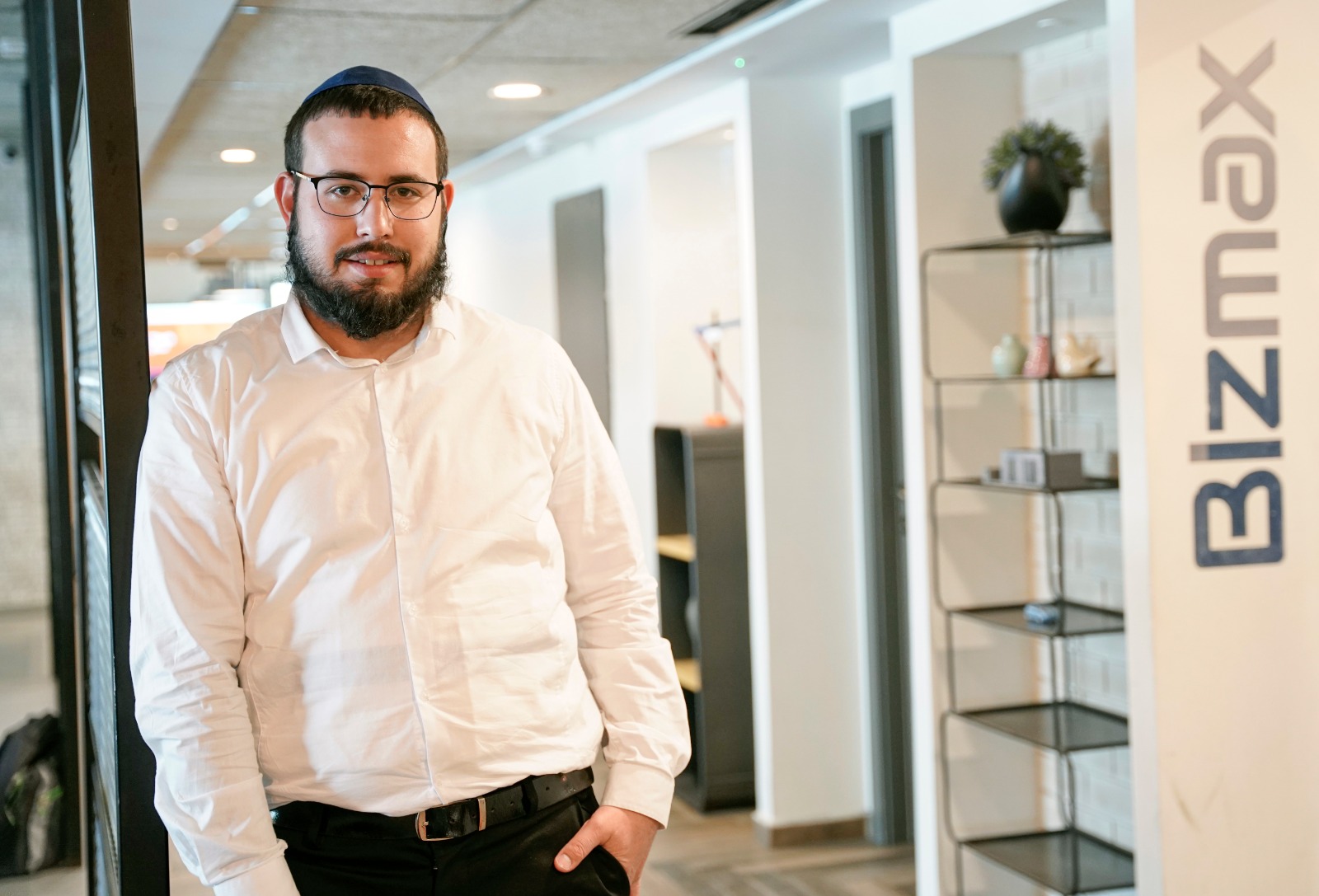
High-tech man Itzik Crombie, 35, a resident of Kfar Chabad, until recently served as CEO of Bizmax and head of employment at the Haredi Institute for Policy Studies. He is currently working on a new, groundbreaking project to train thousands of Haredi men for high-tech.
Crombie holds a rabbinical qualification, studied information systems at the Technion, has a bachelor's degree in Jewish thought, and is a graduate of Harvard University's Executive Program.
After studying at the Technion, he worked for 7 years as an employee at several high-tech companies, founded a startup in the field of sales optimization, and in 2016 sold the company to ExecuTech and moved on to found and manage 'Bizmax'.
 Want more news, videos and stories? Join the Haredim 10 WhatsApp channel >>
At the same time, he was a partner at Bain Systems, which developed ERP systems for factories, and a founding partner in the technology incubator in Bnei Brak, which was established in 2015 in collaboration with Rachip and the Innovation Authority.
Who is the 'next big thing'?
Eliyahu Dinowitz, CEO of Bizmax - the Haredi Innovation Center. CEO of Bizmax, the Haredi Innovation Center in Jerusalem, where he began his position in January.
Why him?
About six months ago, after five years as CEO of Bizmax, I informed the board of directors of my desire to move on and appoint another CEO in my place. The choice was not easy, but when Eliyahu proposed his candidacy, it was clear to us that he was the right man.
Eliyahu is a living example of the model of the ultra-Orthodox high-tech person, a talented and creative software engineer from the Lev Institute, with management and creative abilities, who at the same time is careful to maintain the ultra-Orthodox lifestyle and combine the sacred and the secular in an inspiring way.
I have no doubt that in the coming years, Eliyahu will lead Bizmax to new achievements and himself reach key and leadership positions in the global high-tech industry.
•
Eliyahu Dinowitz, 28 years old, a Chabad follower, lives in Givat Zeev, is married and has two children.
He was educated at the Chabad 'Haydar' in Jerusalem. Then at the small yeshiva 'Tomchei Temimim' in Or Yehuda and at the large yeshiva in Safed. After that, he enlisted in the IDF, serving in the Air Force at Tel Nof.
After his marriage, five years ago, he began working at a startup, until he moved to Bizmax three years ago. At the same time, he is a second-year computer science student at the Lev Institute. Since January, he has served as CEO of Bizmax.
""Five years ago I joined a startup company. I was part of the development, we had a team of developers in India - who developed the product. I've been in this for quite some time. During the Corona period, I decided that even though I work in the field and am busy, I want to get a degree in computer science - and so I did.".
What is 'Bizmax'?
""'Bizmax' was established and operated by the KMAH Foundation, the Jerusalem Development Authority, and the Achim Global Foundation. This is a non-profit place, but a philanthropic place. Our goal is to promote Haredi employment through entrepreneurship. Deal with training, degrees, at lower levels, because most of the public needs this help.
""In 2017, they thought about how they could touch on the field of entrepreneurship. Many ultra-Orthodox business owners, in fact most ultra-Orthodox business owners, have never met a business consultant, and don't think they need one - they are less connected to meetings, lectures or workshops on how to run a business, how to manage time. A place that many business owners are connected to - and that was the goal of the place.
""At the same time, the place was established along with shared workspaces, and it is intended only for ultra-Orthodox men, business owners who are residents of Jerusalem. The goal is to promote the business owners we meet, those who sit with us - we take care of them with a business consultant, lectures and workshops and other things. If it's business owners who come from outside for an Excel course, a time management course, a digital course. Everything related to business owners - we provide a solution on site. Rent an office and learn how to work properly.
“Beyond that, we operate a startup incubator. This is the best and only incubator that exists for ultra-Orthodox entrepreneurs, and it is among the best in the country in terms of content and scope. It is a six-month period, with entrepreneurs who have raised at least $250,000, who have a company, a team, a product, coming two days a week. We promote them. Partners in this are high-tech figures.
""We have a strong foot on the gas, promoting ultra-Orthodox high-tech entrepreneurs. Today, there are not many ultra-Orthodox high-tech people in the terms I spoke about, there are 40-50 of them. There are not many ultra-Orthodox startups. Our thinking is that every such startup is a role model.
""He has an environment, he comes to the synagogue, he comes to the neighborhood, and if you work in a high-tech company, you create and give many young people a role model, to say, 'I want to be like that.' You can also be Haredi and be in high places. There are many Haredi real estate people because it doesn't require a high entrance fee, compared to places that require a degree. A degree in computer science, or a bachelor's degree in software engineering or working for a few years in a high-tech company - we try to push these few people who exist to success and give them emphasis and expression in order to attract the Haredi economy and the Haredi world of employment.
""Before the coronavirus, we held the 'Haredi High-Tech Conference,' with over 1,000 guests. Government officials, everyone involved in employment, came and tried to solve the question: How do we get more Haredi men to integrate into the high-tech market? Today, one percent of Haredi men are in high-tech - that's 3,000 Haredi men in high-tech. The goal is to show that it's possible.
[gallery]
""Anyone who has a venture and a company and a startup - we promote them. We don't do training, we promote companies. We opened five cycles. Each cycle is seven companies.
What are you actually doing today?
""I promote entrepreneurs at Bizmax, not necessarily high-tech entrepreneurs. There is a department that deals only with high-tech, for which I am responsible by virtue of my position.".
""There are thoughts of launching an entrepreneurship program for startups, people who are in the idea stage, but they have nothing. There could be people who are programmers, and they have an idea. They work at a high-tech company and they want to move forward with it and they don't know anything, they don't know anything about what to do next.".
""Ultimately, for a venture to succeed - the very initial part is the idea, the product. After that, there are many processes. It's building a team, a company, doing marketing, going to market, bringing in investors, etc. We do all of this for advanced entrepreneurs, and we also want to make a program like this for beginner entrepreneurs.".
""A company doesn't break out that quickly. After a company raises the initial money, and people believe in the product - over 50 percent close in the first year. In the Haredi community, we did a study, over 90 percent close in the first year, even though they received investments, even though their product is good.".
What is the reason?
""Not because they are less good at the product, because they didn't study Lib. That's not true. Because he got to a place where he was doing a startup and they invested money in it, he bridged those gaps. The difficulty is moving on to the next stage. They don't have friends or acquaintances, they weren't in Unit 8200, they don't have connections that can connect them to investors.".
""They are not connected, so there is no one to put them into a system that will help them advance to the next stage, find additional investors, collaborate, hear their life story from other strategists.".
""An ultra-Orthodox entrepreneur, his entire family does not come from the world of high-tech, so he lacks knowledge and connections. Even when it comes to managing the company, ultra-Orthodox strategists have more difficulty.".
""A Haredi student, the last time he did an assignment or wrote a summary - it was in a small yeshiva or in a khaidar. There is a lack of skill in submitting assignments, meeting deadlines, being part of an orderly and organized system. A lack of knowledge with financial concepts exists in every entrepreneur, but especially in the Haredi public.
""You don't learn this in a degree, concepts of money or business management. A secular guy doesn't learn this in a degree either, but because he is surrounded by a society that works and deals with money and talks about money, somehow these gaps are narrowed. We are making progress in these areas.".
""Over 25 of our entrepreneurs have made it through the first year and beyond.".
Is there a demand for this?
""There is enough demand, but not enough supply. 3,000 Haredi men work in high-tech, they prefer to be employees than to go independent. It's scary. A Haredi guy who got a degree, after going through all the difficulties, joins a high-tech company, brings in 30,000 shekels net after a few years - he has no real reason to become an entrepreneur. It's an internal drive: I have some idea, I want to conquer the world. There is a drive, an entrepreneurial drive. It's a dangerous and difficult path.
""We understand that there are very few Haredim who are in Haredi places, and there are Haredim who are in the initial stages and don't know how to start - they work for a company, earn a living, they don't have enough connections, they don't have enough people they know from school who meet them and find out that they are also programmers or entrepreneurs or have money - and can connect together. That's how things like this happen.
""When you're in the synagogue - you're the only one who programs, you're the only one in your class, you're going to a wedding - you're the only programmer... It greatly reduces your chances of being able to create a collaboration that will eventually lead you to start a startup.".
""In contrast, a secular guy, who has friends from the army, friends from 8200, friends from childhood, friends from school, and a matriculation major in computers - he has a much better chance of succeeding in creating collaboration and getting started with a project. That's why our challenge is to find precisely the people who are at the beginning, and we're working on that these days.".
What are your plans after graduation?
""After I graduate, I definitely want to go and integrate into society, learn and experience high-tech from the inside.".
To be an entrepreneur?
""It's possible, but the chances of success are lower if you don't come from within. You need a background. I have a lot of knowledge but not enough. I like to program. At some point I'll start working as a developer. The goal is not to be a programmer all my life, but also to work with people and manage.".
In the world of Haredi marketing: Moishe Levinger, a 33-year-old digital expert from Ashdod
In the world of Haredi radio: Ari Hamnik, presenter and broadcaster, 32 years old from Beit Shemesh
In the world of music: Yohanan Bleich, arranger and music producer, 26 years old from Betar