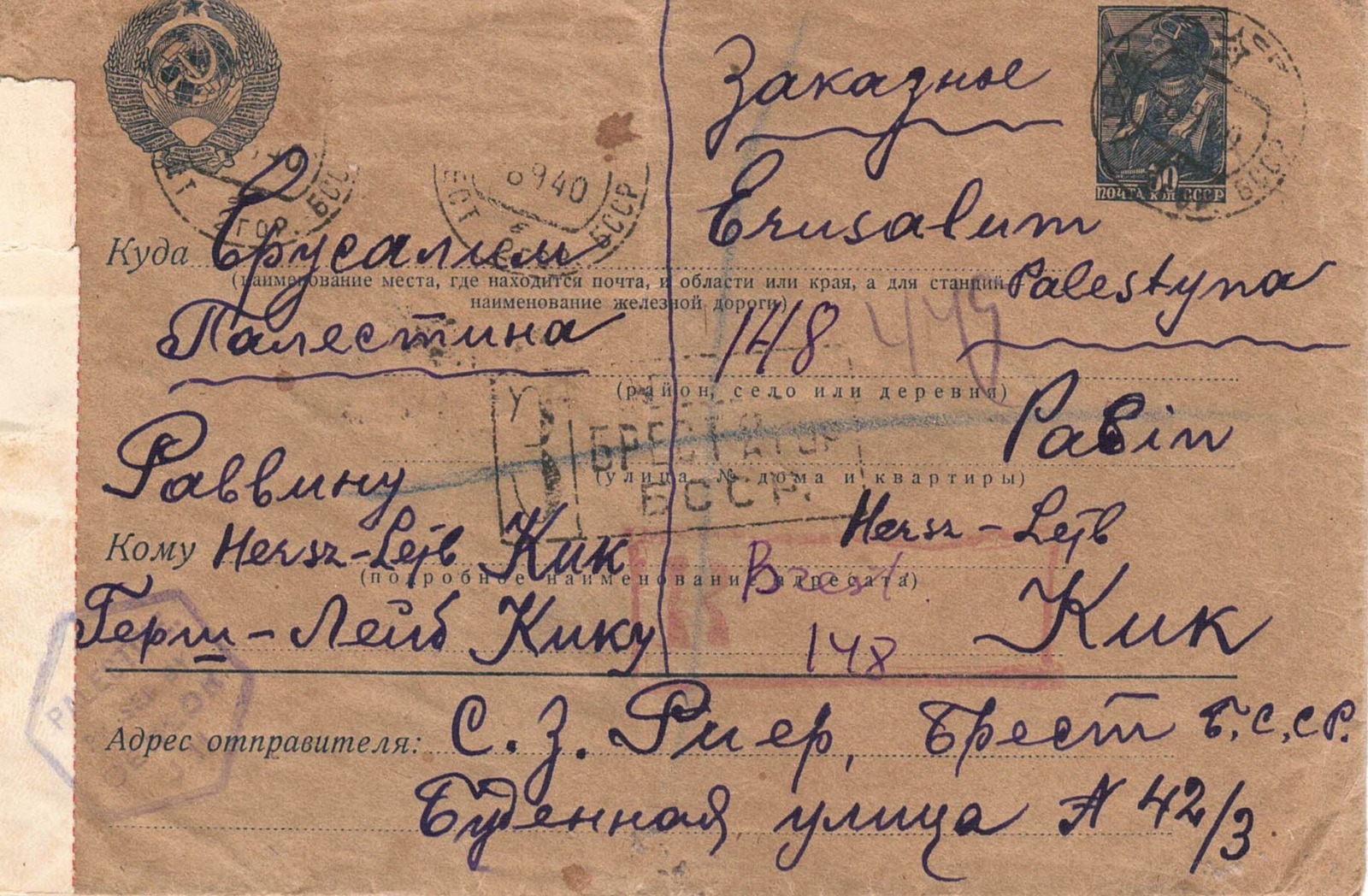
A special letter that came into the possession of the National Library tells the bitter story of the members of the Jewish communities in the Diaspora, who tried to preserve their religion even in times of trouble for Jacob: In the month of Elul 1940, an extraordinary letter was sent from the city of Brisk, one of the Torah centers in Eastern Europe, to the Land of Israel.
Experts clash? The convoluted storm surrounding the coronavirus vaccine
In the midst of the Soviet occupation, Rabbi Simcha Zelig Rieger, the last rabbi of Brisk, approached Rabbi Zvi Yehuda Kook with an extraordinary request. As part of his role as acting rabbi of the city, since the official rabbi had already left in time, Rabbi Rieger was asked to help a woman who was suffering from aguna (a condition of being sick) whose husband had left the city six years earlier and immigrated to the Land of Israel.
 Want more news, videos and stories? Join the Haredim 10 WhatsApp channel >>
In the letter, held by the National Library, Rabbi Rieger explained that "due to the laws of the kingdom" - due to the decision of the Soviet authorities, the couple cannot be reunited in the Land of Israel, and now the woman is demanding a divorce from her husband in order to be able to continue her life.
Two major problems stood in her way of obtaining the get, for which Rabbi Rieger sought help from Rabbi Zvi Yehuda Kook. First, the husband had been missing since he arrived in Eretz Israel, and so it was necessary to locate him. Second, although there was halachic permission for sending a get from a distance, local authorities could tear up the get as soon as they opened the letter to inspect its contents.
Rabbi Rieger proposed a creative solution based on a precedent tried decades earlier in Brisk itself, during the Russo-Japanese War, by Rabbi Raphael Yom Tov Lipman Heilfrin, author of the responsa "Ong Yom Tov," when somewhere in 1868, a Latvian Jew was sent to life imprisonment in one of the Tsar's prisons in Siberia.
Initially, it was proposed that his aguna wife be sent to him so that she could live by his side "as is the custom of the whole land," but the possibility of an innocent Jewish woman spending long months on the road in the company of Tsarist officers was rejected by the city rabbi, who proposed another solution - the husband would authorize the city's court clerk to issue a divorce in his name, and thus "the woman who is tender in years, aguna from her husband is worth fourteen years" would be permissible for any man.
Similarly, writes Rabbi Rieger, Rabbi Chaim of Brisk also ruled in the 'Yapainya War' - that is, the Russo-Japanese War (1904-1905). Rabbi Rieger suggested the same idea to Rabbi Kook. Therefore, he attached a prepared text to the letter, which the husband had to approve and send back to the Brisk Beit Din writer.
Despite the special permission granted, it is not known whether Rabbi Zvi Yehuda Kook was able to locate the husband in the Land of Israel, whether the husband bothered to send consent to the divorce in his name, and whether the woman remarried as a result.
About six months after the letter was sent, the massive German invasion of the Soviet Union began. Rabbi Rieger, like most of the Brisk community, was murdered in the Holocaust, and the fate of the agunah is unknown. Rabbi Rieger's grandson, who is also named after him, Simcha, is the basketball coach and commentator Shimi Rieger.
Dr. Yochai Ben-Gedaliya, Director of the Central Archives for the History of the Jewish People at the National Library: "These treasures, held and preserved by the National Library, which nurtures the treasures of knowledge of the State of Israel, shed some light on the situation of Jewish communities throughout Europe during the Holocaust. In a human and tragic story, we experience a unique example of how, even in moments of low, members of the Jewish community worked to find a multitude of ways to maintain a sense of life while preserving Jewish law.".
[gallery]