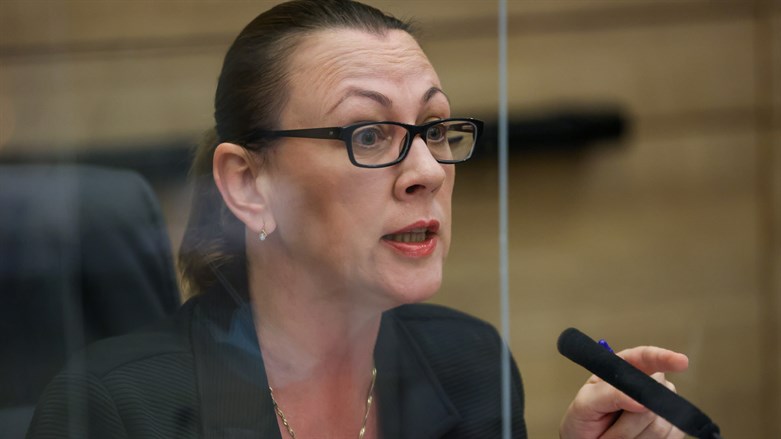
The Committee on Special National Infrastructure Projects and Jewish Religious Services, headed by MK Yulia Malinovsky, met today (Monday) to discuss the management and operation of Jewish holy places in Israel by the National Center for the Development of Holy Places. The chairwoman of the committee, MK Yulia Malinovsky, said at the beginning of the discussion: "I was surprised to discover that the entire issue of the conduct of holy places in Israel has not been raised for public discussion in all the years in the Knesset. When I delved deeper, I discovered that there are no reports from the State Comptroller on the subject or any other general information. "The state invests a lot of money in the issue of holy places and we need to see that there is order there like in any other public place. There is the National Center for Holy Places, the Western Wall Heritage Foundation and the Civil Administration - these are the bodies that maintain the holy places. It is absurd that Rabbi Shmuel Rabinowitz is the rabbi of the Western Wall and on the other hand he is the supervisor of the holy places - he has been in office for twenty years and there is no term limit. "How in law can a person be both the rabbi of the Western Wall and the supervisor of the holy places? In addition to that, he is also the head of the Western Wall Heritage Foundation. It is impossible to understand how he serves in three different positions, the purpose of each of which is to supervise the other position." The director general of the National Center for the Development of Holy Places in Israel, Yossi Schweinger, responded in a debate on the claims: "The issue of the holy places has been raised in the Knesset several times in the Internal Affairs Committee and many discussions have been held on it every year by MK Eichler in the Public Inquiries Committee. I don't know of any body that is audited as much as the holy places." In response to the question of why the financial reports detail the expenses and income of only 20 sites, which is a small part of all the sites maintained by the center - 130, Schwinger replied: "The twenty sites we listed are because there are events there and there are many visitors there and that requires maintenance personnel. There are dozens more sites in the Galilee and other places that can barely be reached, but there are maintenance personnel who go from site to site and do what is needed from time to time, but there is no ongoing maintenance." Schwinger added: "I want to answer all the hints here and not to make it understood that there is silence here about this accusation: There are no political appointments at the center. Everything is approved through a tender committee and in an orderly manner. This is a plot.".

 Join the Haredim 10 Facebook page >>
 Join the X page of Haredim 10 >>
 Want more news, videos and stories? Join the Haredim 10 WhatsApp channel >>