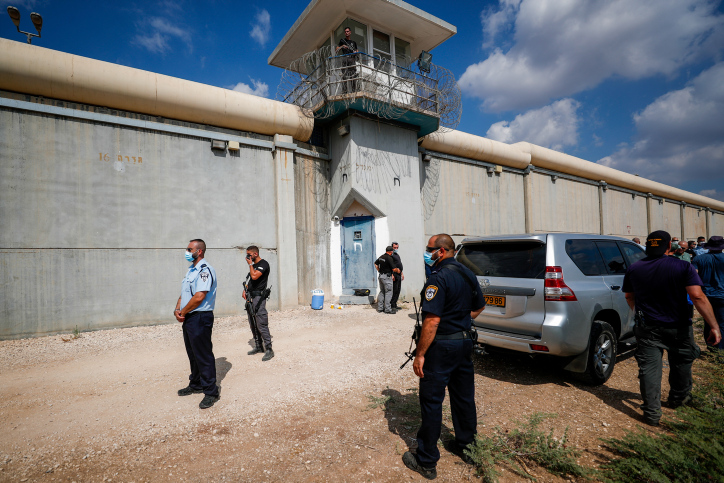
The State Attorney's Office filed an indictment with the Nazareth Magistrate's Court this morning (Sunday) against the 6 prisoners and security detainees accused of escaping custody from Gilboa Prison about a month ago, and against 4 prisoners and another detainee accused of aiding the escape.
According to the indictment, the escaped prisoners are not accused of security offenses or terrorism - but only of escaping from legal custody.
Those accused of escaping from custody are Mahmoud Aarda, Yaqub Qadri, Ayham Kamamji, Mundal Infi'at, Muhammad Aarda and Zakaria Zubaidi. Those accused of aiding in the escape are Mahmoud Abu Ashrin, Katzi Mar'i, Ali Abu Bakr, Mahmoud Abu Bakr and Iyad Jaradat - all Palestinians from the Jenin Governorate.
The indictment, filed through attorneys Addit Amir-Lewinstein and Roy Alfasi, alleges that at the end of 2020, Mahmoud Aarda decided to dig a tunnel from his cell in order to escape from prison.
He approached defendants Qadri, Kamaji, and Infi'at and offered them to take part in digging the tunnel and escape from prison - and they agreed. In March, Muhammad Aarda, Mahmoud's cousin, also joined the escape plan.
From the end of 2020 until the day of the escape, defendants 1-5 dug a tunnel with the opening under the cell's shower. The defendants removed a marble slab from under the sink, dug under it, and replaced the marble slab daily in order to hide the excavation.
The defendants carried out the excavation work on a daily basis, in shifts that were adjusted to the prison's daily schedule, in order to prevent the escape plan from being exposed, and while using improvised digging tools.
In order to help the diggers carry out the escape plan, defendants 7-11 also took part in digging the tunnel. Some also sat in the cell and their role was to warn of the arrival of staff members and to ensure that other prisoners did not enter the cell. Some helped remove sandbags from the tunnel to allow the diggers to exit it into the cell.
Towards the end of digging the tunnel, cousins Mahmoud and Muhammad Aarda and the defendant Jaradat decided to approach Zakaria Zubaidi and offer him to escape from prison with them, so that Zubaidi could take advantage of his position and connections in the Palestinian Authority and ensure that after the escape, the escaping prisoners would be granted protective custody in the Authority.
Zubaidi agreed to the escape plan and submitted a request to be transferred to Wing 2.
On September 5, Zubeidi moved to a cell, and on that day, the excavation of the tunnel, which is about 30 meters long, beyond the prison walls was completed.
That night, the six defendants escaped through the tunnel, equipped with a change of clothes, food, and radios to monitor the progress of the search and the location of the security forces. The prisoners' escape was discovered about an hour and a half later, when an extensive search began to locate them.
The six escapees arrived in the village of Na'ura, when Mahmoud Aarda asked his brother to come with a vehicle to flee them to the Palestinian Authority. When that didn't help, they decided to split up into pairs to make it harder to locate them. In the end, all six were captured.
The prosecution is seeking to detain all the defendants until the end of the legal proceedings against them.
The six terrorists escaped from Gilboa Prison on the eve of Rosh Hashanah. Upon receiving the report, an extensive manhunt was launched led by the Shin Bet, the IDF, the police, and the Prison Service. After a few days, four of the terrorists were captured - Mahmoud Arada and Yaakov Kadri in Nazareth, and a few hours later, Zakaria Zubaidi and Muhammad Arada in the Mount Tabor area. About two weeks later, Iham Kammji and Monadel Infi'at were also captured in Jenin by the YAM fighters along with Shin Bet and IDF special forces who entered the eastern part of Jenin and arrested the terrorists without resistance. An initial report following the terrorists' failed escape from Gilboa Prison estimated that the terrorists had broken up the concrete on the cell floor using acid or Coca-Cola. The terrorists dug 29 meters of tunnel and 6 meters were empty space. The report, commissioned by the IPS and published in Kan News, also indicates that the prisoners' escape route included lifting a marble slab in the shower stall and digging a tunnel shaft through layers of steel and concrete to the space below. On the question of how the terrorists dug into the concrete, the IDF's Yahyalam unit writes: "Concrete can be weakened and crumbled over time by using various acids; without dedicated means, cola can be used." The report details how the terrorists reached the space under the cell: "The prisoners' escape route included digging a tunnel shaft under the marble slab in the shower stall, passing through the upper sheet metal (5 mm steel) and through the ground floor (20 cm concrete) to the underground space." The report reveals that the terrorists were forced to dig 29 meters: "The length of the escape tunnel is approximately 35 meters, with 29 meters of it dug, with an average diameter of 0.5 meters, meaning a quantity of 5-6 cubic meters of soil. The excavated material was used to line the route dug inside the spaces of the connecting beams, eliminating the need to evacuate the excavated material into the prison.". Join the Haredim 10 Facebook page >>
 Join the X page of Haredim 10 >>
 Want more news, videos and stories? Join the Haredim 10 WhatsApp channel >>