1.
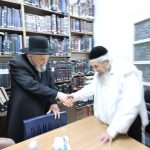
The anti-Semitic terrorist on duty chose Monsey this week as a target for hatred. He entered the home of Rabbi Chaim Leibish Rotenberg, in the midst of a Melva Malka meal on the evening of the Hanukkah Sabbath, and in an ecstasy stabbed one Jew after another. At that time, the kitchen was preparing a strait for the barking. If they hadn't thrown a table at him, he would have continued stabbing all the Jews of the world.
The previous Saturday we had the privilege of being in Monsey. If there's a place with Jewish pastoral, it's there.
 Want more news, videos and stories? Join the Haredim 10 WhatsApp channel >>
Huge villas, endless expanses of grass, Hasidim walking leisurely with colorful towels on their shoulders on the way from the mikveh. A kind of Haredi soapbox. The only thing that can threaten the peace of life of the residents here is the thermostat of their (private) mikveh. If, God forbid, it breaks down and the water is not at the exact temperature, it would be truly terrible. But don't worry, it doesn't break down. Everything is perfect.
Then that black monster came and started cutting up Jews.
2.
The rising wave of anti-Semitism is shaking the Jews here, who until recently thought they were living in the most comfortable exile since the destruction of the Temple. Something in this worldview is cracking.
But I don't have anything smart to add to everything that has been said and will be said about the shocking anti-Semitism this week. Maybe I even prefer to suppress it a little. I didn't think that when we lived on assignment in the United States, we would be constantly asked if the attack was close to our neighborhood and if they had already caught the terrorist. So I want to focus specifically on Monsey itself, and tell about a special community that I was exposed to there.
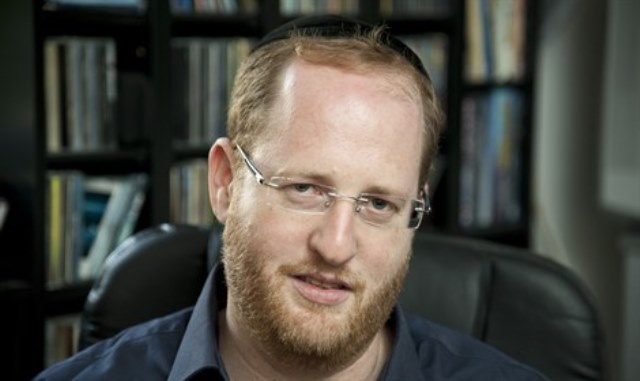
Uncle Farkash (45) grew up in Jerusalem. He is the son of a Chabad family with 17 children (yes, that's not a typo). Most of them have become emissaries who spread Torah and Hasidism around the world: he has a brother in New York, two brothers in Washington, two in Buenos Aires, a brother in Los Angeles, a sister in Australia, a sister in Cyprus, a sister in Moscow, a sister in the Normandy region of France, a brother in Jerusalem, and even a sister who established a Chabad house with her husband in one of the most challenging places in the entire world from a Jewish perspective right now: Ramat Gan.
Each of the Parkash, they and their spouses, are an empire of mission in their own country. When they see each other with family joy, the meeting becomes a mini-conference of the world's shluchim.
But my uncle chose a different path in life. He is a businessman, ostensibly. Why ostensibly? Because you can never take the mission out of a true Chabad man. His and his wife Hani's house on Olympia Street in Monsey has become a kind of unique Chabad house, bringing one of the most complex populations closer to Torah and Hasidism: young people who grew up in Hasidic courtyards and abandoned them.
3.
Shabbat, 9 a.m. My uncle sits at the table at the end of the spacious kitchen, surrounded by Hasidic books and cheesecakes, and enthusiastically studies a conversation by the Lubavitcher Rebbe with one of the first worshippers who arrived early. Prayer here, in the home synagogue, will begin at 10 a.m. But for some, that's too early. They'll arrive only for Musaf. You know, that part of the prayer that comes before Kiddush.
It doesn't bother Farkash. The door to the house is open at all hours. Open physically, not figuratively. You never know at what time someone's Jewish soul will wake up and urgently need prayer or a sermon.
One of the charming moments in this unusual minyan is Farkash's "who blesses." The host is also the rabbi, the cantor, the gabbai, and the assistant gabbai. One man minyan. And all with grace, humor, and a lot of charisma. Everyone who comes to the Torah receives personal and special attention from the one who blesses. Farkash wishes exactly what needs to be wished for, and reinforces where it needs to be reinforced, and compliments and even stings - and nammmmmm, amen.
Let's be clear: this is not a rabbinical figure. We said, a businessman. We said, cheesecakes. But everything with a great spirit of love and care for every Jew. Not only if he is completely secular, a bald man who doesn't wear tefillin, tattooed with an earring, but also for a Jew who until recently wore tefillin of Rabbeinu Tam. Even if he is the grandson of an important rabbi. Even if he is the grandson of Rabbeinu Tam himself.
4.
There's something touching about these small communities of young people who had a list of excuses to leave, from here to Williamsburg, but they chose to stay. They chose to take responsibility for their Judaism, even their Hasidism. Farkash tells me that this is a phenomenon here in Monsey, and in the United States in general. Guys who grew up inside the big Hasidic courtyards, but the framework didn't suit them and they didn't fit into it.
After a short or long period of searching, they realized that they shouldn't cut out, they had to find their own way.
In the afternoon we walk about forty minutes to the community that was inspired by Farkash's minyan and invited him to speak at their place. "The truck drivers' minyan," they call it.
I enter a synagogue located inside a large tent – and it is enchanted. How good are your tents, Jacob, your dwellings, a truck driver. They designed the synagogue with their ten fingers, printed and hung on the walls colorful posters with sayings and proverbs of various figures who inspire them: Rabbi Nachman, the Lubavitcher Rebbe, Rabbi Shlomo Carlebach, Rebbetzin Jungreis and even just encouraging texts that circulate anonymously on WhatsApp.
5.
Farkash begins his sermon with a story: A man walks into a bar and orders a drink. The bartender hands him a glass, the guy says thanks, drinks, and then smashes it on the stunned bartender's head. "Oh, sorry, sorry, I don't know what happened to me today," he apologizes from the bottom of his heart, "It was really out of my control. I'm really ashamed," and walks out of the bar in embarrassment.
The next day he comes back again, orders a drink again, drinks again, and again smashes the glass on the barman's head, who this time is showing much less patience. "Listen, sir, if you do this one more time, I'll order you a car. There's a limit to all behavior." And the smasher, again, is filled with shame, and apologizes with the utmost sincerity: "I'm so uncomfortable. I don't understand how I got into this situation. I'm simply ashamed and embarrassed," and leaves the bar in tears.
You can guess what happens next: the next day he comes back again, orders, drinks and smashes. Well, here the bartender doesn't talk too much anymore. He calls the security guards of the place, and they call a police car. The police handcuff the offender, he is taken into custody, tried and sent to forced mental treatment.
After six months of intensive treatment, our friend is released from the hospital, and on the very first evening he goes to the same bar. He enters, approaches the same bartender who is still standing there at his machine, and says to him: "Hey, do you remember me?".
""Of course, how could I forget you," the bartender replies, scratching his head. "Listen, I just came to say thank you. Thanks to your determination, six months ago, I was taken for psychiatric treatment, and what can I tell you? My life has changed completely. Thank you very much. Say, can I have a small drink?".
The bartender smiles and serves the guy his drink. He drinks, takes the glass and smashes it, yes, smashes it on the bartender's head, proudly declaring: "That's it, now I'm done with the treatment! Now I understand myself, I know where in the soul this comes from and what childhood traumas it's based on. I've learned to stop being ashamed!".
6.
Everyone laughs in understanding, and then Farkash tells his personal story in one short sentence that says it all: "By the age of 17, I had gone through 7 schools, and not because we moved apartments... At the age of 17, I was already outside the system.".
And here he moves on to talk about the hero of this week's parsha, the righteous Joseph: "Joseph had every reason not to remain faithful to the path. He was an orphan from a young age. His brothers laughed at him, then they wanted to eliminate him, and in the end, as a compromise, they sold him. He was falsely accused and thrown into prison for many years. He has every excuse to take off his kippah. His life is in shambles. But Joseph understands that problems with his home and with his community are no reason to deviate from the path.
""So it's true, he wasn't exactly like his brothers, he didn't stay with them in the same piety, but his faith was strong. His direct connection to God was real, and that's the main thing, more than any other sector. He didn't let the mistakes made by the people around him make him give up on the Lord of the world. He didn't let the difficult place he came from, the treatment he received from his environment in his youth, destroy his present and future.".
7.
I'm not an anthropologist, but I have a feeling that this Hasidism that I saw in Monsey, the Hasidism of Hasidic ex-Chassidics, will only grow. At the huge Shiner minyan on Rosh Hashanah in Uman - the annual gathering of Hasidic followers without a court who do not give up on Hasidicism - I saw with my own eyes thousands of them. Praying like they have never prayed before. Connected like they have never been. Singing for long minutes with immense intention over and over again, "I connect myself, my spirit and my soul...".
This week, Muncie made headlines that were not in its best interest. All the media outlets in the world covered the town. The devout Hasidic communities, the large, old courtyards, the rebbes.
And I also thought about one small Hasidic yard, for truck drivers.
• The column is published in the newspaper 'Bisheva''