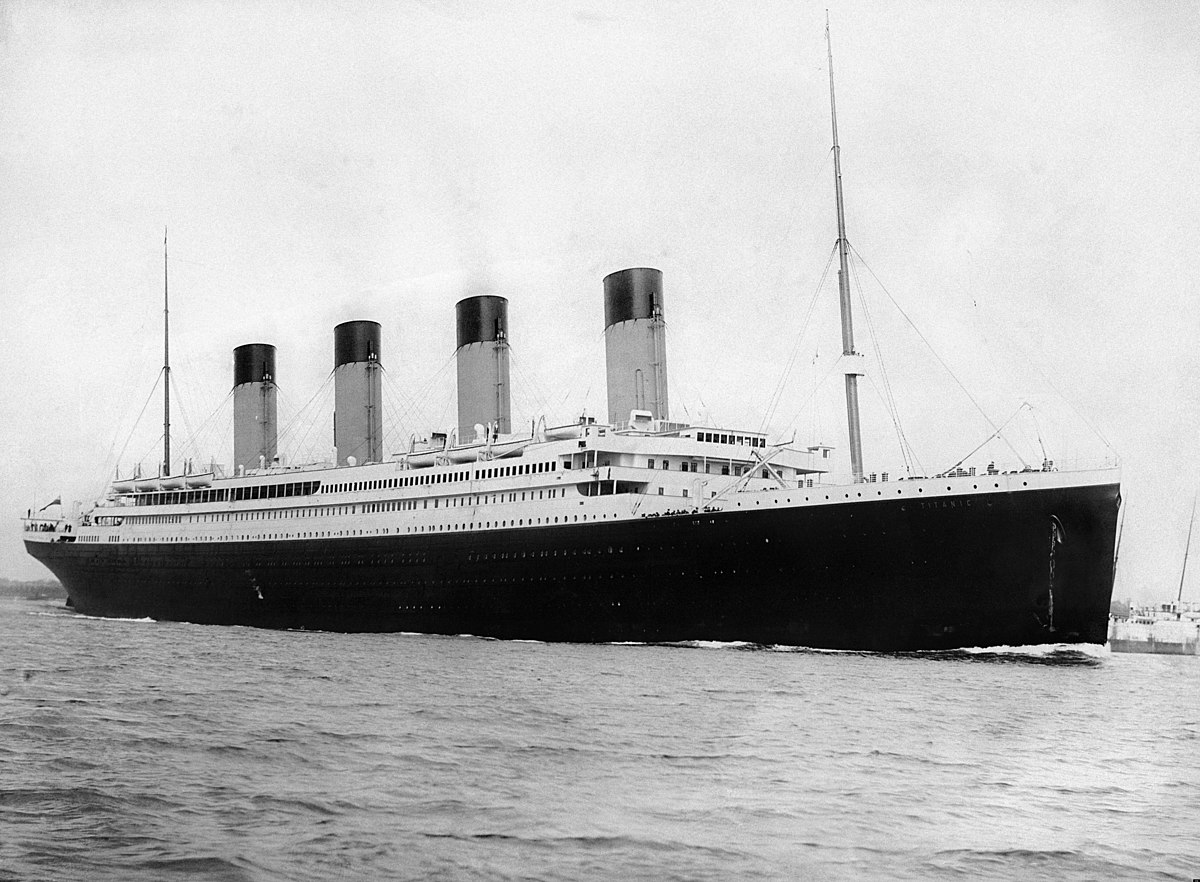
Everyone seems to know the story of the Titanic. A magnificent ship - probably the largest of its time - sank on its maiden voyage in 1912 from England to New York after hitting an iceberg. The sinking of the ship, which everyone believed to be immune to damage, as well as the deaths of 1,517 people, made the story of the ship one of the most important historical events of the last century. However, in recent years, quite a few questions and doubts have arisen around the famous myth, and various journalists around the world have raised doubts about the narrative that is familiar to every history buff in general and maritime history in particular. The HIX website [from the Mako House] has compiled these questions and they are presented to you. 1. According to one theory, the ship that sank was not the Titanic at all, but a ship called the Adam Olympic. According to the conspiracy, the Olympic was damaged a year earlier as a result of an accident, but in order to increase the claim against the insurance, the owners of the ship - who are the same owners of the Titanic, registered it as the Titanic and sank it intentionally. So it's true, there are many doubts about this theory, but the Olympic's identification numbers were found on parts of the Titanic that did not sink. So maybe there is something to this theory after all? 2. Was the cause of the sinking the iceberg at all? A documentary film offers pretty solid evidence that the Titanic was damaged by a coal fire that started 3 weeks before the ship set sail. The damage from the fire weakened the entire belly of the ship, which accelerated the sinking of the ship after hitting the iceberg. 3. Why did the captain sail at excessive speed in the iceberg area? What was burning him? For decades For a long time, people believed that the captain of the ship was sailing at too high a speed through the iceberg-filled waters of the North Atlantic Ocean to "beat" the Olympic, which was considered the Titanic's twin. But in 2004, the Geological Survey of America published an academic paper written by an engineer named Robert Essenhey, with a completely different theory. According to Essenhey, the real reason the captain was sailing at such high speed was to use up the coal as quickly as possible and to try and control the coal burning as much as possible (mentioned in the previous section). 4. How did the ship break in two? Until 1985, the prevailing opinion was that the ship had collided with an iceberg and simply sunk to the bottom. It was only after the remains of the ship were found that experts realized that the ship had broken and split into two parts. This discovery led to the theory that the hull breaking, which only made the disaster worse, was the result of poor planning and/or an attempt to save on raw materials by the owners or workers. 5. Did the ship actually hit an iceberg or was it hit by a torpedo? Another conspiracy theory claims that the ship was not hit by an iceberg but by a torpedo fired from a German submarine. This theory may sound ridiculous, but only 3 years later, in 1915, a German submarine actually sank a passenger ship called the Lusitania. In addition, a year before, the Olympic itself was hit by an accident with another military vessel. In general, the presence of other ships and vessels around the place where the remains of the Titanic were found leaves several questions open. 6. How could it have been an iceberg? According to marine expert Captain L.M. Collins, if the ship had collided with an iceberg it would have sunk within minutes. According to Collins, the Titanic ran aground on a floating iceberg that had reached the ocean, a theory supported by several eyewitnesses who survived and saw ice around it. 7. Where were the binoculars? Another unsolved mystery is why the crew didn't have binoculars. They are mandatory equipment on any vessel that could, for example, see a distant iceberg, and they were certainly on the ship. The reason is that the binoculars were locked in a locker and the key was with a crew member who had been transferred to another mission before the voyage. So did he really forget and why did they set off if the safety equipment was not at hand? 8. Why wasn't the warning from the iceberg passed on to the captain? Even without binoculars, the Titanic might have had enough time to change its course if only they had been warned of the ice the ship was approaching. And it turns out that there was indeed such a warning. An hour before the collision, a vessel called the SS Californian radioed that it had stopped due to a congested area. In the ice. But it turns out that the message that reached radio operator Jack Phillips was not passed on to the captain of the Titanic. Some claim that the message was not passed on intentionally, or that Phillips did not think the message was urgent enough. In any case, we will never know why the message was not passed on, because Phillips also died in the disaster. 9. How did the call for help go unanswered? If we are already mentioning the Californian, the question arises as to why those crew members did not help all those poor people who drowned on the Titanic. There is an opinion that the crew members simply ignored the call for help. The crew, for their part, claimed that they did not receive the SOS because the radio operator was not on duty. 10. And who else ignored the call? Among those defending the Californian crew members, there is an opinion that there was a ship even closer to the Titanic that ignored them. The Norwegian "Samson" was located nearby but ignored the call for help to avoid prosecution for illegal hunting Of seals - at least that's what those trying to protect the captains of the Californian claim. 11. The Strange Miracle - J.P. Morgan was one of the owners of the company that owned both the Titanic and the Olympic, and he was considered an extremely rich and powerful man at the time. Morgan was also supposed to be on the Titanic, but at the very last second he and his family did not board the ship. Following the disaster, he made another respectable fortune from the insurance money on the ship and immediately became one of the most important people in the world, owning huge financial corporations. His success and the profit he made from the disaster led a few conspirators to think that Morgan was somehow involved in the tragedy. Other questions and other embarrassing speculations have been published surrounding the sinking of the Titanic, but it seems that the answers to them will never be known. As mentioned, over 1,500 people drowned in the great disaster, and over 700 survived. The last survivor of the Titanic died at the end of the The last century.

 Join the Haredim 10 Facebook page >>
 Join the X page of Haredim 10 >>
 Want more news, videos and stories? Join the Haredim 10 WhatsApp channel >>