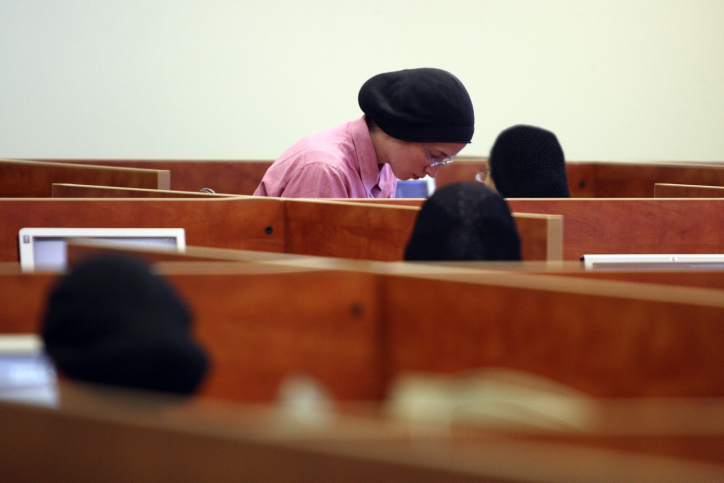
The Science and Technology Committee discussed today (Monday) the wage discrimination against Haredi women employed in the high-tech industry.
Committee Chairman Uri Maklev: "Whether this is structural discrimination or the result of contradictory data - it is imperative to address and solve the problem. There is a shortage of high-tech workers, and it is imperative to utilize the nearby workers and their abilities - and not import programmers from abroad. There is clearly a difference in this matter between the private and public sectors. In the latter, there is no discrimination, but there is still a problem in creating jobs and adapting them to the ultra-Orthodox.".
Maklev warned that despite government training programs for Haredi women, the public sector requires experience after training and is not satisfied with training. Sometimes, regulations prohibiting early start times and allowing early departures block mothers from being accepted and advancing in public sector jobs.
 Want more news, videos and stories? Join the Haredim 10 WhatsApp channel >>
Ilan Gilon from Meretz: "In the private sector, there is capitalist exploitation of Haredi women, who are the weakest proletariat that needs to be protected. An Haredi woman today earns about 5,500 shekels in high-tech, while her non-Haredi counterpart receives almost double, when decency is such a basic value.".
Yoav Ben-Zur from the Shas: "My two daughters are programmers, and I've heard of masses of Haredi women who are desperate for a different job, at a great distance, in servile conditions, for a meager salary, amidst the blatant abuse of their employers - and they are afraid of losing their jobs, and continue only to gain experience and move on.".
MK Aliza Lavie of Mish Atid warned of a shortage of state scholarships for these women.
MK Michael Malchieli accused "the Ministry of Education, which refuses - through the Council for Higher Education - to recognize the computer studies of the Haredi seminaries as an academic degree. Either they will recognize the studies as academic education or they will prohibit companies from requiring such a degree.".
According to Nitza Kleiner-Kassir, vice-chair of the Haredi Institute for Policy Studies and a former researcher at the Bank of Israel, the overall employment rate of Haredi women in Israel is approximately 751%, higher than in other OECD countries.
One in four Haredi women is integrated into academia, although lower than the rest of the population, but on an increasing trend.
According to her, about 700-800 Haredi women study programming vocational training every year, and several hundred more in seminars. About 51% of Haredi women are employed in high-tech, but these figures are on the rise. 44% of Haredi women in high-tech earn over 10,000 shekels, but the average salary of Haredi women in the field is about 25% lower than average.
According to her, they have difficulty negotiating their wages because they do not know who they can and should contact about the matter, and because they are afraid of losing their jobs.
According to Dr. Gilad Malach, head of the Haredi program at the Israel Democracy Institute, approximately 101% of Haredi women are currently studying computer science – a figure identical to that of women in Israeli society, and therefore within a few years the salary problem will worsen.
Ruthie Sirota, from the Tamek Association, spoke about programs tailored to ultra-Orthodox women to advance them to management positions.
Eviatar Peretz, Director of Communications at the Accountant General of the Treasury, spoke about many government programs that require training rather than an academic degree.
Moshe Friedman, CEO of Kamatec, presented professional, prestigious, fast-paced, non-academic training courses, with graduates of these training courses being recruited more than academic graduates.