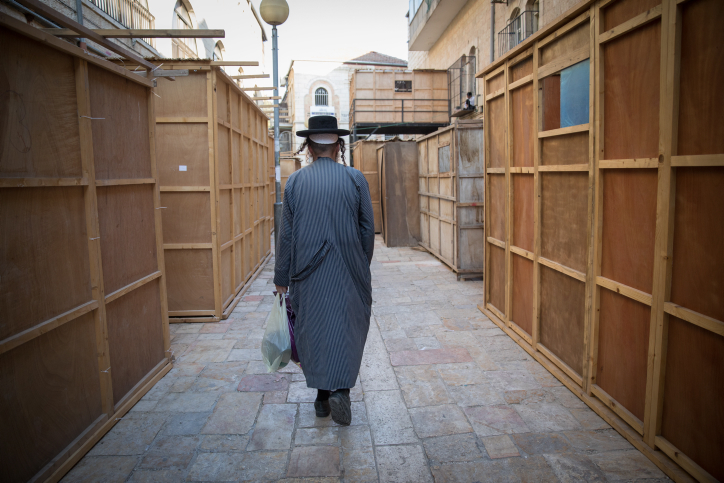
The atmosphere of the Sukkot holiday is evident in every corner. Jews walk around carrying the four fresh species they bought. Sukkots are erected in the courtyards of houses and on the balconies. In a few days we will leave our spacious homes and move to live in a sukkah for seven days, as it is written: "You shall dwell in a sukkah for seven days.".
The main reason for the sukkah commandment is stated in the verse itself: "So that your generations may know that I made the children of Israel dwell in booths when I brought them out of the land of Egypt" – the sukkah is a memorial to the booths in which God, the Blessed, made the children of Israel dwell when they left Egypt.
The reference is not to Sukkot in the literal sense, but to the clouds, as the Midrash says: "There were clouds of glory surrounding them and covering them"; but we remember this when, precisely with the arrival of autumn, when people usually return from vacation homes to their homes, we go out to live in Sukkot.
There is no separation of domains.
Chassidism adds a special touch to the essence of the sukkah commandment. All year round, a person needs great spiritual effort to reach the level of "in all your ways know Him" - to feel the presence of the Creator in every action and deed. It is not easy to think about God when you eat, work, rest, and sleep.
During the holiday of Sukkot, this task becomes very easy.
On this holiday, God showers us with such great love, by giving us a mitzvah in which we do nothing different from what we do every day: eat and drink, rest and talk, but on this holiday, eating and drinking and other ordinary needs become a mitzvah, when they are done in the sukkah. Because what is the mitzvah of the sukkah? To do in the sukkah the same ordinary things that we do at home. These very things are done on the holiday of Sukkot inside the sukkah – and here they become a mitzvah.
From the holiday of Sukkot we derive the ability to breathe a spirit of holiness into our mundane lives as well. Sometimes people tend to think that there is a separation of spheres between the life of holiness – prayer, Torah study, observance of the commandments – and ordinary everyday life. This is a mistake. God is also present in our daily lives.
On the contrary, Judaism teaches that the purpose is to sanctify everyday life and infuse it with holiness.
We receive the strength to do this from the mitzvot of the sukkah. When we observe the mitzvot of the sukkah according to its rules and get down to its meaning and content, we receive the strength to do even our mundane actions for the sake of Heaven.
One association
The second main message of the holiday of Sukkot is related to the commandments of the four species, which wonderfully express the idea of the unity of Israel.
We are all familiar with the Midrash that attributes the four species to the people of Israel: the etrog symbolizes those who have both Torah and good deeds; the lulav symbolizes those who have Torah but do not have good deeds; the myrtle symbolizes those who have good deeds but do not have Torah; and the willow symbolizes those who have neither Torah nor good deeds.
If we just look at the meaning of the commandment – the need to unite all species and types into one community – we will emerge with a deep and meaningful message about the attitude towards all parts of the Jewish people, about the way in which a Jew who thinks and behaves differently from me should be viewed, and about the depth of the commandment to love Israel.
 Join the Haredim 10 Facebook page >>
 Join the X page of Haredim 10 >>
 Want more news, videos and stories? Join the Haredim 10 WhatsApp channel >>