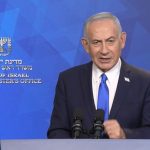
At the start of a cabinet meeting this morning (Sunday), Prime Minister Benjamin Netanyahu addressed the implosion in talks with the Palestinians. "Unilateral steps by the Palestinians will be met with unilateral steps by us," he said, referring to the Palestinians' appeal to 14 international treaties, while violating the understandings reached with them during talks with Israel.
""The threats to turn to the UN will not affect us, the Palestinians have a lot to lose from a unilateral move," Netanyahu added. According to him, "the Palestinians will achieve a state only through negotiations and not through empty declarations.".
As we already reported last night, a meeting will be held today between the government's chief negotiator, Justice Minister Tzipi Livni, and Palestinian representative Saeb Erekat and American envoy Martin Indyk. Two meetings were held last week, but dozens of additional talks were held under American mediation, in an attempt to reach a conclusion whereby the parties would return to the negotiating table.
On Friday, Secretary of State John Kerry delivered a harsh message, according to which the US would re-examine its role in the peace process. The message led the Palestinians to soften their messages. Fatah Central Committee member Nabil Shaat was quick to declare that Abbas did not want to upset Kerry by signing to join international treaties.
Later, the head of the Palestinian negotiating team, Saeb Erekat, met with the American envoy Indyk and made it clear to him that the Palestinians do not intend to blow up the negotiations or sabotage the Americans' efforts for peace. According to him, Abu Mazen will fulfill his commitment not to join the remaining 48 treaties, agreements, and bodies to which they have not yet joined, provided that Israel takes the fourth step.
At the same time, unofficial sources were quick to clarify that there is no way to back out of joining the 14 organizations, even if Israel releases the prisoners it promised to release.
In Israel, people believe that "this time the crisis is serious, it's not a show," and that a formula must be found to get out of the crisis that has arisen.
In the background are the sanctions that Israel imposed as a 'punishment' for the Palestinians' accession to international treaties. Israel claims that this is a cancellation of benefits and concessions that were approved or were about to be approved. Among other things, the approval for the establishment of 3G infrastructure for Palestinian cellular networks in the West Bank was canceled, the approval for the expansion of the Palestinian cellular company "Watania" to the Gaza Strip was canceled, all meetings at the level of ministers and directors-general of government ministries in Israel with their Palestinian counterparts were frozen, 19 outline plans that had already been approved for Palestinian communities in Area C, which are under full Israeli control, were frozen, and a plan made in cooperation with international organizations to allocate 14,000 dunams in Area C and convert them into agricultural land was frozen.
The meetings held at ministerial levels, as well as the professional committees headed by the Coordinator of Government Activities in the Territories, Major General Poli Mordechai, will continue to proceed as usual.
 Join the Haredim 10 Facebook page >>
 Join the X page of Haredim 10 >>
 Want more news, videos and stories? Join the Haredim 10 WhatsApp channel >>