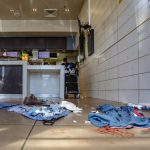
How joyful. It is certainly understandable that there is anger at the yeshiva student, who was arrested on charges of desertion while hanging out in "Sin City," when his image - at least according to the publications - lacks any religious connotations.
What is difficult to grasp is the pure evil of those who rushed to mock the young man, publicize his name, call him a wide range of condemnations, and whitewash his face and that of his family.
Where is the fairness, the ethics, the compassion for a young man who stumbles? How many of the mockers studied seriously in their final years in the yeshiva, and in the long months they spent in the kollel in lively discussions about the performance of the head of the council, while slowly sipping their cups of coffee?
I met some of them in Eilat while they were vacationing for their own pleasure. I was there, of course, to visit Rabbi Elbaz's yeshiva, and I provided the bearded students with siddurim and holy vessels.
They will have no difficulty remembering those endless days, or the unkosher experiences in the many cities near the coast, when they are among themselves.
Wouldn't they, according to the wording of the law, be draft dodgers anyway?
And in general, where did the happy cynics get the permission to lash out at family members, at the head of the yeshiva where the boy studied? At his parents, at his brothers and sisters, where, for God's sake, did this cruelty come from?
And here is another ugly and sickening appendix to the disgusting Lithuanian war.
Why them? The third day of Chol HaMoed. The extended family escapes the scorching sun to gather at the mall, and the fast food plaza is bustling with activity: everyone comes with their children to play in the Gymboree facilities (30 shekels per child, dad gets in free), and the tables are fully occupied.
And the children? They jump and have fun, trying to catch their parents' eye with some trivial stunt, and after a short period of time they complain: Dad, I'm hungry, Mom, buy us something.
My uncle, the younger brother, patiently explains to his children: 'We don't eat outside the house on Passover, on Passover you have to be careful.' But the children point to the multitude of people gathered around the tables and ask with childish self-righteousness: 'Why them?'
''Because they're not Haredi,' my uncle replies. 'Haredi don't eat the kosher food from the mall on Passover.'.
It seemed like everything was falling into place peacefully, and we were back to gossiping about our families, when a loud shout was heard from the south of us. We all looked up and saw the little boy, my uncle's son, standing in front of a table where a Haredi family was sitting, with plates from one of the fast food chains.
'"'Dad,' the boy cried, pointing at the embarrassed Haredi family with all his might, drawing the attention of everyone sitting in the area, including the guards at the other end. 'You said that Haredi people don't eat the kosher food from the mall on Passover, why do they do?'"
Who predicted the Holocaust? We were meeting at the home of one of the elders of the yeshiva, and one of those present brought up the myth of the Chofetz Chaim and the Holocaust. According to the famous Haredi narrative, the author of the Chofetz Chaim had already foreseen the severe Holocaust of the Jews in the 1930s, and to the Haredi attendees who feared that this would bring disaster to world Jewry, the rabbi reminded them that 'there will be a refuge on Mount Zion.'.
And indeed, just as the great man of the generation had predicted, the army of German General Erwin Rommel was defeated on the border of the Land of Israel in the Battle of El Alamein, and in the Land of Israel the Jews breathed a sigh of relief.
But then the man raised a simple question: If the Chafetz Chaim had known about the terrible Holocaust, why didn't he warn about it? Why didn't the leader of the generation plead with his flock to flee while they still had their lives to Mount Zion, to the Holy Land?
No one answered the man's difficult question.
This week, on Holocaust Remembrance Day, senior Haredi Holocaust researcher Esther Perbstein (who is rumored to have given up her PhD for ideological reasons) was interviewed by the Kol Hai radio station, and she shattered the myth: "The attempts to attribute the 'greatest generation' to the anticipation of the Holocaust are very painful to me. The claim that they anticipated the horror places a serious burden on them.".
""These are half-stories that are not verified. No one predicted the Holocaust, and no attempts were made to rescue Jews before the war broke out.".
Perbstein adds another interesting argument: It was precisely the rabbis, the moral and noblest people in Jewish society, they were the last to imagine or assume that such an illogical, inhuman reality could be created by an unexpected monster that suddenly appeared from Germany.
 Join the Haredim 10 Facebook page >>
 Join the X page of Haredim 10 >>
 Want more news, videos and stories? Join the Haredim 10 WhatsApp channel >>