Over 66 years ago, there was another unified list, which some Israeli citizens certainly don't remember, but a larger number haven't heard of either. In the current elections, it was clear that the "Mazrozhnikim" were running alone, the Agudais alone, and of course, since 1984, the Sephardic Haredim alone.
But in the elections for the first Knesset, there was a "United Religious Front." It was the first (and last) time that Mizrahi, Hapoel Hamizrahi, the Association, and the Association's activists united to run in the elections.
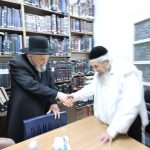
This list obtained 16 seats. One of the representatives of the association was Rabbi Yitzhak-Meir Levin, grandson of the True Language and later chairman of the World Association. Rabbi Levin was among the signatories of the Declaration of Independence and can certainly be described as one of the founders of the state.
 Want more news, videos and stories? Join the Haredim 10 WhatsApp channel >>
In the newspaper "Davar" from 1944, Levin was quoted as calling for the establishment of a state for Jews in the wake of the European Holocaust. Rabbi Levin was among the prominent people involved in rescuing Jews during World War II.
Would this happen today? Unfortunately, it is difficult for me to see a reality in which a senior representative of the association would sign the scroll.
Divisions upon division
To some extent (or even a great extent) we have been experiencing divisions on various grounds since then. The religious front did not survive beyond the first Knesset, and against the backdrop of the conscription of girls into the IDF, a rift was created between the association and the Zionists.
Even within the communities themselves, more and more divisions have emerged. These have been expressed in political representation, but of course not only. The divisions between Hassidim and Lithuanians, between Haredim, Sephardim and Ashkenazim are familiar to us all.
The national religious world is also experiencing divisions, for and against Gush Emunim, for and against the refusal of a command, and most recently between loyalists of the Merkaz HaRav and loyalists of the rabbis of the Har HaMor Yeshiva.
Over the years, there have been attempts to find ways to combine forces, especially at the political level, and the effort in the national religious world in recent years to create unity through the Jewish Home has been evident.
It seems that an attempt to "force" such unity cannot succeed, especially when leadership of one kind comes from a place of condescension towards other groups.
Heterogeneity on the Haredi street
In the Haredi world, there is an increase in the number of different voices that led to phenomena in the election campaign to which we are not accustomed.
For example, the split in Shas, following which Eli Yishai joined a group of religious nationalists (Hardeliim and Kahanists) on the one hand, and the Jerusalem faction's strong desire to show political muscle against the association on the other.
The attempt to appropriate Maran Ovadia Yosef zt"l by both Deri and Yishai also caused the destruction of Rabbi Ovadia's legacy. We will see the damage later, even without addressing the success or failure of either of them.
In the Lithuanian camp, the picture is also bleak. The war between the Lithuanian groups undoubtedly puts a big question mark on the ability to uphold the concept of the 'greatest generation in the next generation. There is no doubt that breaking the acceptance of authority of the great generation on the altar of power struggles will affect all of Haredi society.
Heterogeneity in the Religious Zionist Camp
The disconnect between the Mustards and the rest of religious Zionism has exacerbated the ongoing identity crisis within religious Zionism. Are they a stream from general society, and therefore closer to secularists than to the Haredi, or will the state-sponsored ones slowly lose power to those who want to get closer to the Haredi world?
But one can also look at these developments from another angle. I have never been an advocate of unity out of uniformity. Rather, a plurality of voices is the way to advance steps, also from within the religious world, and in connecting religious and ultra-Orthodox society with the general public. Furthermore, the Jewish tradition has always known how to support disputes and on the condition that they are for the sake of heaven, while wanting to explore the right way to fulfill our mission as Jews in the world. It is precisely from differences of opinion that the search for truth and great ideas can exist.
The strength of the religious parties is declining in these elections. It will take time to analyze all the reasons, but it is clear that the trends I mentioned are part of the background to this decline. In the Jewish Home, Naftali Bennett's clear attempt to create Likud B also failed, and he should think more deeply about what real added value he brings to the public arena.
The leaders of the religious and ultra-Orthodox community have a lot to think about, and the path to religious or ultra-Orthodox unity is probably not the direction to go. Therefore, we must think in different paradigms in order to continue to influence the Jewish part of the equation of a Jewish and democratic state that Rabbi Levin called for over 70 years ago.