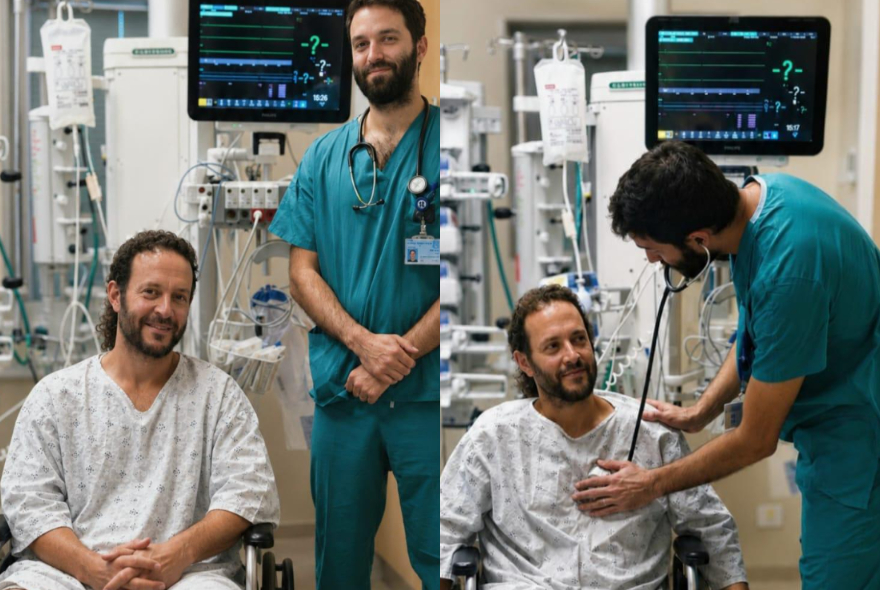
Moshe Koblenz, 38, works in logistics and event production in the Judean Desert. He is married to Hadar and has an eight-and-a-half-month-old son, Kerem.
Is 100,000 NIS right for you before Shavuot? Last hours for the big lottery!
On Saturday night, when he arrived at their home in Shattuka from a long trip in the desert, he got out of the car wearing open-toed sandals - and stepped on a snake that bit him.
He said that in a panic he threw the root sandals very far forward. In the first few minutes he felt nothing, but to be on the safe side he quickly went to the neighbor's house and knocked on the door, where he began to collapse. He said that he felt the poison starting to spread in his veins: "I literally collapsed as soon as I managed to call for help.".
The neighbor immediately called a nurse from the settlement and when she saw the bite, she called an ambulance, which quickly transported him to Hadassah Ein Kerem.
Moshe says he was conscious the whole time, suffering excruciating pain. "I felt the poison overpowering me. I suffered from shortness of breath, I was gasping in the ambulance and I didn't know what would happen to me.".
At first, he assumed that even if it was indeed a snake bite, he would receive antibodies and be fine, but he did not know that it was an Ein Gedi snake - for which there is no antidote in Israel or the entire world to its venom.
Dr. Roy Kofman, an internal medicine specialist and cardiologist at Hadassah Ein Kerem who treated Moshe, says: "We received a notification from MDA about the arrival of a patient who had been bitten by a snake and was in critical condition, and we received him at the trauma unit at Hadassah Ein Kerem. In the initial tests and assessment we performed, I was impressed that the heart damage was the main component of his serious condition, which immediately led us to suspect the type of snake that bit him - the Ein Gedi snake.
""This is the only snake whose bite is characterized by a cardiac background. The location where it was bitten also corresponded to the geographical area where the snake can be found, whose venom is the most deadly of all venomous snakes found in Israel. Along with this, the heart activity as observed in the echocardiogram was very weak, demonstrating a severe decrease in heart contractions, and in light of the clinical picture, it was decided to hospitalize him in the cardiology intensive care unit.".
At the same time, Moshe's condition continued to worsen, and the team was even prepared for the possibility that he would require a heart-lung machine (ECMO) connection if his body systems collapsed. "In consultation with the National Poison Center and Prof. Kobi Assaf, an emergency medicine specialist at Hadassah who specializes in venomous animal injuries, it was clear that there was no serum available in Israel or anywhere else in the world for the type of snake that bites.
""At Hadassah, we have serum for venomous snakebites and we of course use the substance, especially in the summer months. It is critical for saving lives, but it does not cover the toxin of the Ein Gedi resin snake. Therefore, we began intensive treatment of connecting to high-dose oxygen and administering medications that strengthen the heart's contractions and even dilate the blood vessels that have contracted due to the arsenic.".
""This is a serious physical condition and a real danger to life," emphasizes Dr. Kofman. "The next 6 hours were critical. We were prepared for any worsening, of course, and maintained full monitoring of his body systems, but the immediate treatment and the great efforts of the unit's staff bore fruit. Within a few hours, his condition began to improve and he is now out of danger.".
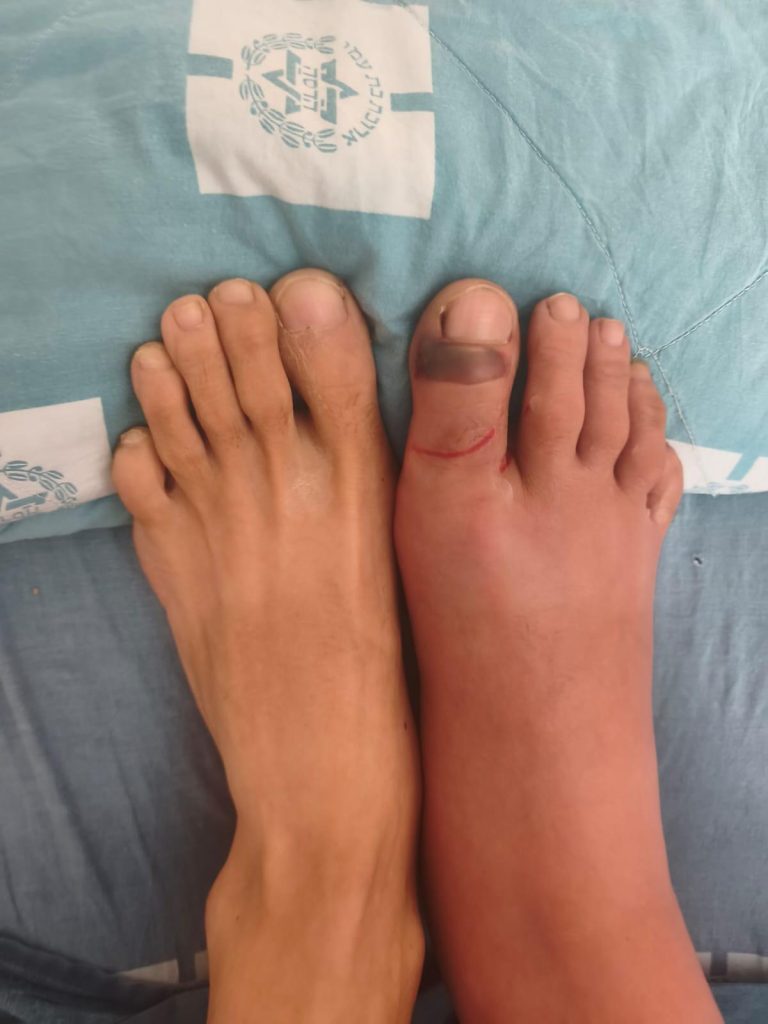
Prof. Kobi Assaf, an emergency medicine specialist at Hadassah, who specializes in treating venomous animal injuries, emphasizes that the bite of the Ein Gedi snake is rare, not encountered often in emergency rooms, and certainly not with such a severe injury to the heart.
"This is the second case I have known throughout my career. Moshe was lucky to receive treatment from the Heart Unit team, it was exactly the right treatment and they did it excellently. In cases where the person feels the bite and does not know which animal it is specifically, it is possible to find out through various tests what it is. We ruled out that it was a snake, and at the same time the "sharpotoxin", from the snake's venom, is the known cause of its damage to the heart, so there was no longer any doubt that it was an Ein Gedi snake.".
Moshe's wife, Hadar, has been by his side since the moment she was called by the neighbor. "We didn't know then that it was a real life-threatening situation. It wasn't until I arrived that I began to understand the seriousness of the situation. According to the medical team, Moshe's functioning in the first few minutes was very critical. Otherwise, he would be in a completely different place.".
Moshe and Hadar summarize the experience as shocking, but thanks to the sensitivity of the team, they got through it safely and with a warm embrace, even worrying about their baby son. "I was blessed with a team that saved me at Hadassah - just in time. In a situation like this, it's very important to act as quickly as possible, even when there's doubt about the bite," he emphasizes.
"As of today, Roy's heart is recovering and functioning normally. He is still being treated in the cardiac intensive care unit, but is getting stronger," concludes Dr. Koffman. "There is no doubt that in such exceptional and difficult cases, where mortality rates are high, immediate access to the cardiology department at Hadassah and intensive care saved his life.".
 Join the Haredim 10 Facebook page >>
 Join the X page of Haredim 10 >>
 Want more news, videos and stories? Join the Haredim 10 WhatsApp channel >>