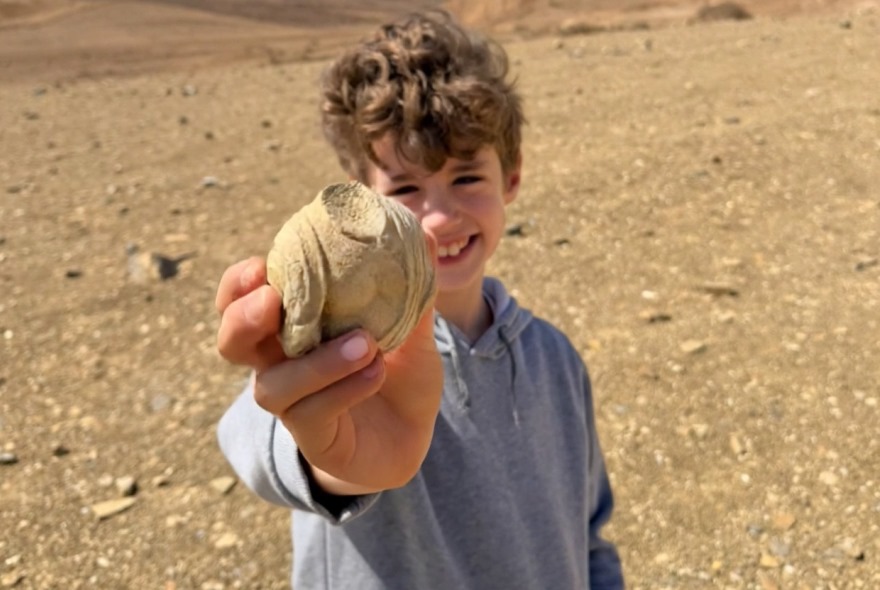
During a weekend trip by members of the paratrooper reserve team with their families in the Ramon Crater area, 8-year-old Dor Wolynitz from Rehovot discovered a spectacular fragment of an ancient statuette that is more than 1,700 years old.
What is diabetes and prediabetes, how do we avoid them, and what are the warning signs? • Promoter
“During the trip, I was looking for special things on the ground that I could show in class. Suddenly, I noticed an interesting stone with stripes lying on the ground, and I picked it up. It seemed like an unusual object to me, so I showed it to Akiva, an archaeologist and a friend of Dad’s, who was participating in the trip.
“At first I thought it was a fossil,” said Akiva Goldenhirsch, a supervisor in the Robbery Prevention Unit at the Israel Antiquities Authority, “but then I noticed the sculpted folds of the garment - and I was very excited.”.
This is a small figurine fragment, approximately 6×6 cm in size, depicting part of a human figure with carefully sculpted folds of fabric, which create the appearance of a cloak that wraps the body in soft, flowing lines.
An examination of the material from which it is cast in the Israel Antiquities Authority laboratories by Dr. Nimrod Wheeler revealed that it is a light mineral of the phosphorite type, common in the Negev region.
""The fact that the statuette is made of local material may indicate that it is a statuette made in Israel, and not imported here," says Akiva Goldenhirsch of the Israel Antiquities Authority. "The style of clothing and sculpture is appropriate for the Roman period. The figure is depicted wearing a robe (himation), with no visible undergarment. The way the folds were sculpted and the choice of such a delicate material indicate a very high level of skill on the part of the artist.
The route of the Spice Route passes through the Ramon Crater area, and served as a major traffic route during the Roman and Nabatean periods. The statuette fragment joins the evidence of human activity that took place along the route.
Dor handed over the intriguing find to the State Treasures and received a certificate from the Israel Antiquities Authority for his good citizenship.
“Every archaeological find is part of our heritage. Handing it over to the state treasury allows us to research it, preserve it, and make the knowledge accessible to the general public," says Goldenhirsh. “The responsible conduct of Dor and his family is an example of proper civic responsibility and the preservation of the country’s cultural assets.”
 Join the Haredim 10 Facebook page >>
 Join the X page of Haredim 10 >>
 Want more news, videos and stories? Join the Haredim 10 WhatsApp channel >>