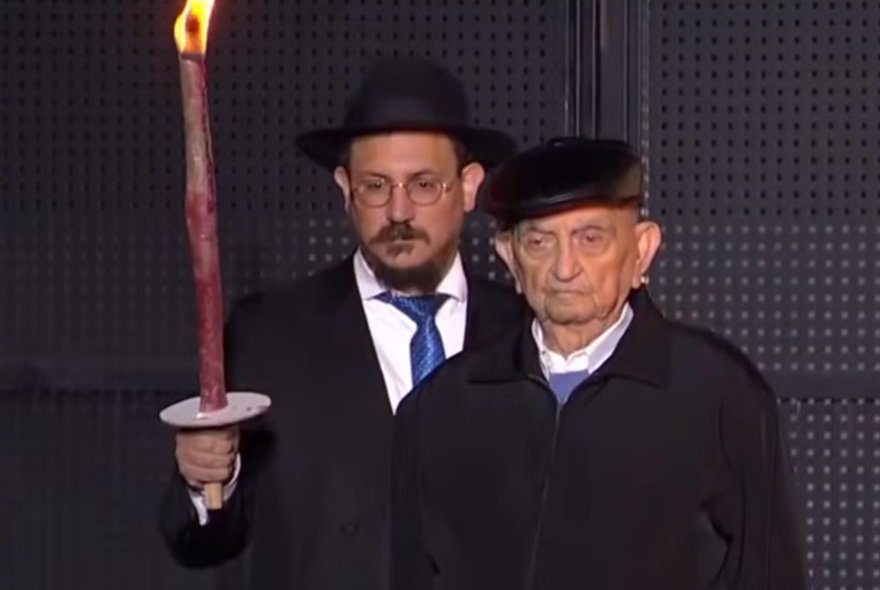
Avigdor Neumann, 95, was born in Celis, Czechoslovakia, to a Hasidic family. He was sent to a death camp - and survived • Tonight is the highlight of Yad Vashem's Holocaust • Watch the moving story of a Holocaust survivor who was blessed to start a family - and is blessed with dozens of Chabad Hasidic grandchildren, great-grandchildren and great-great-grandchildren
Avigdor Neumann was born in 1931 to Menachem Mendel and Beila of the Satmar Hasidic sect in the town of Selish in Czechoslovakia - today Vynohradiv in Ukraine, the fourth of seven brothers and sisters. His father was a merchant and philanthropist.
Avigdor attended a state school and a cheder. In 1939, the town came under Hungarian rule, and its name was changed to Nodsolus. His father helped forge Hungarian citizenship documents and helped save stateless Jews from deportation to Poland.
In March 1944, the Germans invaded Hungary, and on Passover, police officers expelled the family from their home. The father was arrested, interrogated, and tortured. Avigdor, his mother, brothers, and sisters were transferred to the ghetto, and a few weeks later they met their father again, shaved and bruised. They were told to pack for the journey, and Avigdor was entrusted with a basket of food, but he dropped it in a panic when a police officer hit his mother.
He later testified that for years he felt a pang of conscience because they didn't have enough food on the train.
Avigdor Neuman tells his story in detail. Video: Channel 14
The family was put into a cattle car that held about ninety people. Air only entered through a narrow porthole. The train arrived at Birkenau. One of the Jewish prisoners separated Avigdor from his mother and transferred him to the men's column. Avigdor resisted, and the prisoner said: "One more word and that's the end of you.".
Avigdor told Mengele that he was a 15-year-old mechanic and had passed the selection process. The next day, Avigdor was told that his mother, brother, and sisters had been murdered. His father and surviving brother perished some time later in other camps. Avigdor worked and endured hunger and violence. "From the moment they tattooed a number on me, I no longer had a name," he said.
He was assigned to the garbage unit and relieved his hunger by eating leftovers from the garbage. Across the fence he discovered his older sister. One morning he shouted to her: "Today I am thirteen, I am a bar mitzvah!""
Sinai Adler and other Jews risked themselves to get him tefillin.
He was selected for death. He said that once Mengele removed him from the group of those going to die, and another time the condemned were returned to the barracks on the threshold of the gas chambers.
On January 18, 1945, Avigdor was taken on a death march. He arrived at the Mauthausen camp and from there to Gunskirchen, where he was liberated by the United States Army.
Avigdor returned home and found his older sister. They arrived in Budapest, and there he joined the Bnei Akiva youth movement. He and his sister boarded the illegal immigrant ship "Theodor Herzl." The British captured the ship and imprisoned them in a detention camp in Cyprus, from where they arrived in Israel.
Avigdor participated in all of Israel's wars until the Yom Kippur War, in which he was wounded. In the 1990s, he began telling about his experiences in the Holocaust, and he is participating in a project that brings together Holocaust survivors with survivors of the October 7 massacre.
Avigdor and Rivka have a son and a daughter, seven grandchildren, 45 great-grandchildren, and great-great-grandchildren.
 Join the Haredim 10 Facebook page >>
 Join the X page of Haredim 10 >>
 Want more news, videos and stories? Join the Haredim 10 WhatsApp channel >>