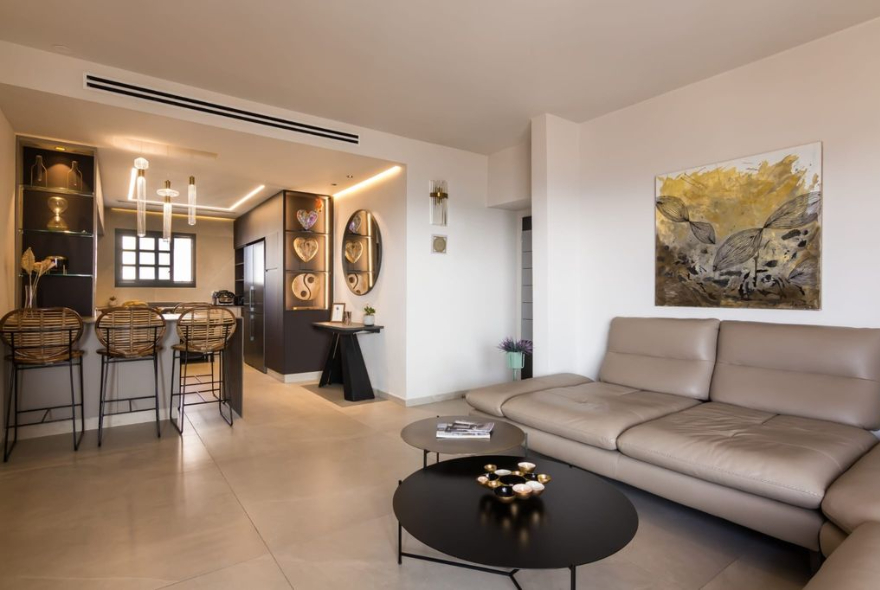
After renovating a private home, many people discover that the real work isn't finished yet. True, the walls are already painted, the flooring has been laid, the lighting has been connected, the kitchen is in place and the entire house looks new, but now begins the phase that determines how the home will truly feel on a daily basis.
The living room is the best example of this. It is the central space in the house, the place where you entertain, rest, sit with the children, watch TV, meet at the end of the day and sometimes also work, read or simply enjoy the quiet. Therefore, designing a living room after renovation is not just a matter of choosing a sofa and table, but a precise process of creating the right space, balanced, pleasant, practical and impressive.
When designing a living room in a private home after a renovation, the most common mistake is to rush to fill the space. Many homeowners are excited about their renovated home and quickly start purchasing furniture, rugs, light fixtures, and accessories, without stopping for a moment to consider what the space really needs. In practice, a good living room is not a cluttered living room, but a planned living room. You need to understand the dimensions, the directions of the light, the connection between the living room, the kitchen, and the dining area, the location of the display cases, the seating angles, the passages, and the feeling you want to create - more formal, more family-like, luxurious, warm, minimalist, or richer in materials and layers.
One of the most important principles in designing a living room after a renovation is to first understand the architectural framework that has been created. After a renovation, sometimes the plaster ceiling has been changed, new openings have been opened, large windows have been added, walls have been covered, or the flooring has been replaced. Each of these elements directly affects the design of the living room. For example, if a new power wall is created, it may be the natural location for a library, a fireplace, a screen, or custom joinery. If a large opening is opened to the garden, space should be given to this in the seating plan, so as not to block the sense of space and not to fight the landscape but to work with it.
Instead of first asking which sofa to buy, it's more appropriate to ask how the living room is supposed to work. Where will the focus be, how will the movement in the space be, from which area do you enter, what do you see first, and where do you want to create a sense of intimacy. Only after you understand this do you begin to choose the items themselves.
A successful living room is not one that looks good in a photo, but one that fits the real life of the household members. A private home with small children, frequent entertaining, or a direct connection to the yard requires completely different decisions than a quiet private home of a couple who rarely entertains. Therefore, one of the most important tips is not to design according to trends alone, but according to the nature of actual use.
If it is a very active home, it is worth choosing more durable fabrics, rounded corners, easy-to-maintain surfaces, and furniture that will not require excessive care. If it is a living room that is also intended for entertaining, it is important to create diverse seating areas - not just one large sofa, but sometimes also armchairs, a footstool, or flexible seating solutions. If the living room is also used for prolonged daily viewing, seating comfort, back angles, and viewing distances are just as important as the appearance.
after Apartment or house renovation, Many homeowners want to introduce color, but sometimes they do so without any real connection to the materials already incorporated into the home. A well-designed living room must speak to the flooring, carpentry, kitchen, doorways, and natural light. Therefore, the color palette should be derived from the home itself. If the renovation created a calm, clean envelope, you can build a living room with a natural base, and add depth through textiles, art, wood, lighting, and accessories. If the home has taken on a warmer character, for example with shades of stone, wood, or cream, it is worth maintaining continuity and not breaking sharply with cold or overly aggressive colors.
The important tip here is not to overload the main colors. Often, a truly impressive living room relies on a quiet and precise foundation, and on subtle layers that create interest. This way, the space remains elegant over time and does not tire quickly.
After a renovation, homeowners tend to think that the lighting is already "closed," because they have installed spotlights, lighting strips or a central fixture. In reality, in a good living room, lighting does not end with the electrical plan. Decorative and complementary lighting is one of the most powerful tools for creating atmosphere. A floor lamp next to an armchair, a delicate wall fixture, lighting hidden in the carpentry or a table lamp on a console - all of these give the living room depth, softness and character.

Yaki Adir, a senior construction supervisor with experience in interior design and architecture. Photo: Press release
A living room after renovation should look good both during the day and in the evening. During daylight hours, we enjoy the windows and openings, but during darkness, the space needs to be enveloping. Too much lighting will create a cold feeling, and too little lighting will impair functionality. That's why it's very important to create different layers of lighting, to allow for adjustment to every hour and every use.
In a private house after renovation, there is often an opportunity to incorporate custom joinery, and this is one of the decisions that can significantly boost the living room. Good joinery is not only beautiful - it solves problems. It can hide systems, unify the TV area, create a library, introduce storage spaces, integrate decorative elements and strengthen the connection between the living room and the rest of the house.
The big advantage of custom carpentry is precision. Instead of inserting generic items that don't always fit correctly in the space, you create a solution that is built specifically for the home. This way, the result looks complete, high-quality, and truly belongs in the place.
One of the most common mistakes in designing a living room after a renovation is trying to "design" every corner. A covered wall, a TV wall, shelves, pictures, mirrors, a console, a special color, unique lighting - and so the space begins to disperse. A strong living room is one that has a hierarchy. You need to choose the central element, and let it lead. The other walls and items should support it, not compete with it.
It is precisely the right restraint that creates a sense of luxury. When you know where to stop, the living room looks more confident, more precise, and more pleasing to the eye. This is an important difference between a space that looks "designed" and a space that looks planned to a high standard.
After the entire base has been built correctly, comes the stage that adds character: carpet, pillows, curtains, decorative objects, pictures, books and plants. Here it is very important not to rush. The mistake many make is choosing accessories too early, before they even understand the final language of the living room. It is better to first place the main furniture, examine the space, understand what is missing in it and only then complete the layers.
The right rug, for example, can tie the entire seating area together, adding softness and reinforcing the feeling of the living room as a defined area. Curtains can soften the architectural envelope and provide height and elegance. Cushions and textiles can add interest without being overwhelming. All of these should be precise, not accidental.
Renovation gives a house a new look, but proper design gives it an identity. A living room of a private house after renovation should feel as if everything in it is in the right place, not by chance but by design. When you work correctly - from the space, through the furniture, colors, lighting, carpentry and accessories - you get a living room that is both beautiful, comfortable, precise and durable over time.
This is exactly where Yaki Adir's experience comes into play. Thanks to a combination of Architecture, interior design, supervision and management of construction projects, the living room can be examined not only as a decorative space, but as part of the entire system of a private home. Such an observation allows you to make better decisions, avoid costly mistakes, and create a living room that not only looks great immediately after the renovation, but continues to serve the household properly for years to come.
 Join the Haredim 10 Facebook page >>
 Join the X page of Haredim 10 >>
 Want more news, videos and stories? Join the Haredim 10 WhatsApp channel >>