
Shlomo Filber, the pollster and trend analyst - whose predictions about the election campaigns were the most accurate - explains in a long post he published today (Wednesday) on social media that the ultra-Orthodox public is the State of Israel's trump card.
""There are mistakes that take a generation to correct and there are advantages that take a generation to change," writes Filber. "That's how it is with the demographics of countries - the generation entering adult life today was born 18 years ago. Why does it matter? Because the Haredim are the trump card of the State of Israel for the coming generation. Sounds crazy? Come with me for a moment on a journey about those who 'have children' and those who don't.
• Once there was talk of a global population explosion, in the next generation we are talking for the first time about a shrinking world. How does this happen? To maintain replacement, every family in the world needs to have 2.1 children, who will replace their parents when they die.
This is important to preserve the workforce, growth, profits, and pension support when parents stop working. The current generation pays the pensions of the previous generation - that's how it's worked until today, and that's also the story in Israel with the budgetary pensions for Jews, which are paid from state revenues today.
• In most of the industrialized and advanced Western world, the birth rate has dropped to less than two children per family - meaning the modern world is shrinking. Even in China and India with birth control policies, there will be a problem in the next generation. The places where there is a positive birth rate are the underdeveloped African countries.
Oh, and there is one more country in the world - the only one in the modern Western world, and in first place among OECD countries in terms of birthrate - Israel, with an average of about 3 children per family.
• By the way, in the past they liked to warn us about a demographic problem among Israeli Arabs, but it turns out that the average birth rate among Israeli Arabs has dropped dramatically, and in 2024 the trend has reversed. The percentage of Jews is growing, and the Arabs are shrinking (but this will be more relevant to the 2044 elections).
• Two sectors that contribute mainly to Israel's demographic growth are the national religious (yes, including the Smotrichs) and the Haredim. And this is already relevant for the 2026 elections - in each new year there is a larger percentage of religious and Haredim.
• And how does all this relate to the draft law? Life is stronger than any populist MK competing to see who will be the toughest policeman of the ultra-Orthodox and impose the most sanctions on them, in the next two years.
The draft law opens the gates for young Haredi men not only to enlist (and ease the burden of the reserves), but from there to go to work, acquire a profession and integrate into the labor market. This may happen more slowly than for the average Israeli - but it is happening. (Employment of Haredi men has increased in recent years from 50% to 58% - and this is just the beginning).
• Every additional Haredi and national-religious person who enters the labor market contributes to the country's growth, and this will probably not stop in the coming decade. While it will take the entire world at least a generation to correct the situation, Israel is poised for a surge in growth following the demographic growth that has occurred in the last generation. An increase of about 100,000 net residents per year (excluding those who pass away).
So even if some of the ultra-Orthodox recruits need to complete their education, we are still at a great advantage over the world. This is a population with rapid learning abilities, motivation, and the ability and desire to fill gaps at a relatively high speed.
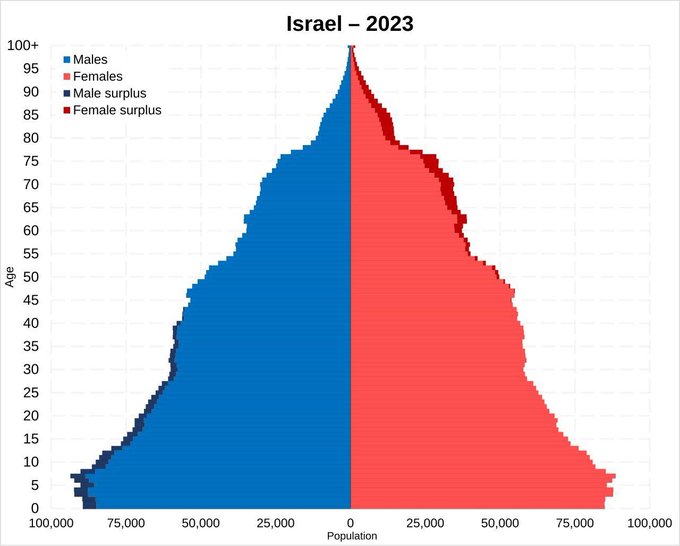
In the slide - the demographic growth pyramid of Israel - the only one in the Western world, which stands out for the race of life more demographically prepared than any other country in the world.
By the way, in the dark margins below, you can see that there is a slight excess of men over women, unlike the ages of 65-100, where there is a surplus of women.
 Join the Haredim 10 Facebook page >>
 Join the X page of Haredim 10 >>
 Want more news, videos and stories? Join the Haredim 10 WhatsApp channel >>