The first public menorah was lit at Independence Mall in Philadelphia 50 years ago.
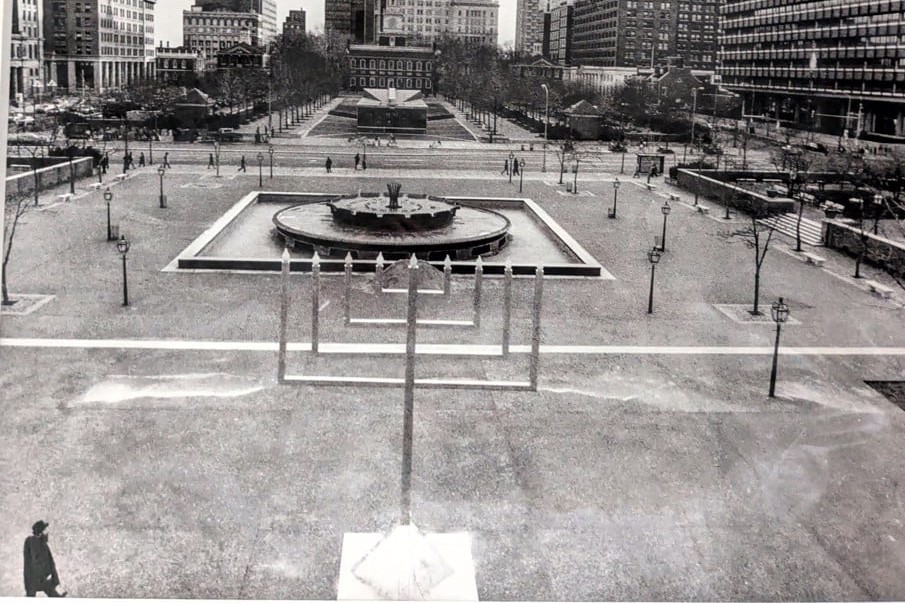
On a cold Hanukkah night in the winter of 1974, five Chabad members raised a small wooden menorah onto Independence Mall in Philadelphia. They didn't do much advertising, but after a few hours of educating passersby about the holiday of Hanukkah, they sang the blessings and lit a single candle on the menorah - marking the first night of the holiday.
Thus, 50 years ago, the world's first public menorah was born. Today, Chabad emissaries erect some 15,000 giant menorahs in public squares from Washington to Vienna, from Siberia to Melbourne.
 Want more news, videos and stories? Join the Haredim 10 WhatsApp channel >>
In an article on the Chabad Oreg website, David Margolin recounts the history of the menorahs that are flooding the entire world today - from the moment the idea emerged, through the legal battles of liberal elements - to the surprising admission by opponents of placing menorahs in city centers: "We were wrong, the Rebbe was right!"'
•
""The whole idea of placing a menorah like this came directly from the Rebbe's inspiration to illuminate the world," says Rabbi Avraham Shemtov, Chabad emissary in Philadelphia since 1962. .
The Lubavitcher Rebbe had just launched a global awareness campaign for the holiday of Hanukkah, calling for lighting a Hanukkah menorah in every Jewish home, and encouraging other Jews to do the same.
""There is a special advantage in the commandment of the Chanukah lights," the Rebbe explained, "for when a Jew lights a Chanukah menorah, real light emanates from it. And illuminates the street.".
In the months following the Rebbe's reading, Chabad activists took out ads in the New York Times, produced and distributed tens of thousands of tin menorahs alongside candle boxes, and printed countless booklets detailing how to properly light the menorah. "Every little flame counts," the booklet read. "Now more than ever, join Jews around the world in lighting the lights of Hanukkah!""
But the public menorah did not exist - until the wooden menorah was erected in Philadelphia. Rabbi Shemtov made sure to have a camera on hand to capture the moment - which became historic. The photo shows him and four young men posing with the menorah, with the 'Hall of Independence' in the background - home of the 'Liberty Bell' and the place where the Declaration of Independence was adopted and the American Constitution was drafted and ratified. The photo was published a week later in the local Jewish newspaper.
""It wasn't a big menorah, but it was moving," says Rabbi David Golovinsky, who was then active in the Chabad house in Philadelphia - and who built the menorah. "The main thing is that it was done. Today, when I see menorahs everywhere, I think back to that initial moment. I'm proud to have been a part of it.".
It didn't take long for this small wooden menorah to grow into something bigger.
A year later, Rabbi Chaim Icha Drizin, Chabad emissary in San Francisco, placed a 7.5-meter-high menorah in Union Square. By 1976, Rabbi Shemtov had erected a similar steel menorah - which was placed next to Independence Hall. That year, the United States celebrated its 200th anniversary, and the menorah in Philadelphia became an official participant in the city's 200th anniversary celebrations.
•
Today, a Chabad emissary looking to place a menorah at the entrance to a city or in a central square has a variety of suppliers to choose from: giant menorahs are available in all styles and sizes. But back then, recalls Rabbi Elchanon Lisbon, a Chabad emissary in Baltimore who was part of the Philadelphia Chabad House team in the late 1970s and early 1980s, you needed connections in the steel business to make a giant menorah.
Philadelphia Mayor Frank Rizzo joined the Hanukkah celebration in 1976, and in the years to come he would prove to be a great ally of the public menorah. When in 1979 the local ACLU attacked the Liberty Bell menorah, claiming it violated the principle of separation of church and state, Mayor Rizzo instructed City Attorney Sheldon L. Albert to respond unequivocally: "Not only will the City of Philadelphia not order the removal of the menorah," Albert told the media, "but in fact, it will be bigger and brighter than ever.".
While the vast majority of the Jewish community welcomed Chabad's public menorahs and the Jewish pride and light they fostered on winter nights, the leadership of parts of the organized Jewish community came out strongly against the menorah. The ACLU was joined at that time by liberal Jewish organizations, such as the American Jewish Congress, the Anti-Defamation League, several local Jewish Community Relations Councils, and the umbrella organization of the Reform movement.
•
That winter of 1979, Rabbi Shemtov chose to respond to the ACLU's fury with laughter - literally: He brought Philadelphia-raised Jewish comedian Joey Bishop (born Joseph Gottlieb) to the menorah lighting ceremony as the guest of honor.
Any local opposition to the Chabad menorah in Philadelphia had dissipated by the mid-1980s. However, elsewhere in the United States, opponents thought the effort to remove the menorah lights from public view was important enough to file a lawsuit - culminating in a U.S. Supreme Court ruling in favor of the menorahs.
Jewish opponents of public menorahs - and almost all of them were Jews - argued that placing menorahs would threaten Jews by eroding the separation of religion and state.
""Had I received your letter years ago, when this was first being done, I would have had a more difficult task in defending it, for the simple reason that the expected positive results were then a matter of conjecture," the Rebbe wrote to Dr. Joseph B. Glazer, one of the leaders of the Reform movement, in 1978. "But now, after the results have been observed for several years, my task is easy, for the general assessment and beneficial results have far exceeded our expectations. The fact is that countless Jews throughout the United States have been impressed and have received the inspiration of the spirit of Chanukah that has been brought to them - for many of them for the first time.".
Currently, many of those who opposed the placement of menorahs in the past are now sponsoring their own public menorah displays.
Toward the end of his life, the leader of the American Jewish Congress, Arthur Herzberg, admitted that he had been on the wrong side of the battle. 'We thought you had to be a Jew at home and a citizen on the street,' he said. "The Rebbe thought that by being a Jew on the street you would be a better Jew at home. He was right and we were wrong.".
•
What began in Philadelphia, the birthplace of American independence, and in San Francisco, the home of liberal culture, did not stay there.
Chabad placed New York's first public menorah in 1977, outside the Plaza Hotel located at Fifth Avenue and 59th Street. Since 1986, the world's largest menorah, designed by sculptor Yaakov Agam, has been located there.
[gallery]
The same year that Rabbi Shemtov brought in comedian Bishop to lighten the mood in Philadelphia, he spearheaded the establishment of a public menorah in Lafayette Park in Washington, D.C.
What better way to light the menorah, the ambitious Chabadnik thought, than to invite the President of the United States himself to participate? With the help of White House domestic policy advisor Stuart Eisenstadt, that's exactly what happened: On December 17, 1979, the fourth night of Hanukkah, President Jimmy Carter emerged from the White House and lit the sun, before Eisenstadt's young son recited the blessings and lit the menorah.
On the fourth night of Hanukkah 1979, Jimmy Carter joined Rabbi Avraham Shemtov and became the first American president in history to publicly light a Hanukkah menorah, starting an annual tradition in Washington, D.C.
"I felt it was important for our country to fulfill its commitment to religious pluralism by lighting the menorah on U.S. park land," Carter told The Washington Post in 2020. "I hoped it would help elevate this Jewish holiday — to a holiday for all Americans, and I am grateful that this annual event has grown so much more over time.'.
The phenomenon did not remain in the United States. In the 1980s, public menorahs were erected in Buenos Aires, London, Paris, and Milan. With the fall of communism, these places were joined by Berlin and Moscow.
At this point, it would be difficult to find a city or country without a public Hanukkah.
Lois Yampolsky has worked as an administrative assistant at the Chabad of Philadelphia since 1982. Yampolsky, now 80, was the one who helped prepare for the annual lighting event. Although a lot has changed since Rabbi Shemtov first hired her to work in the office 42 years ago - Chabad now has nearly 40 branches in the Philadelphia area - her excitement about lighting the menorah has remained constant.
""The Liberty Bell menorah is very magnificent, especially at night when they light it," she said. "I still get goosebumps when I see it.".
The public menorah, she said, allowed Jews to be more open and proud of who they are, and shared with everyone the universal message of Hanukkah—freedom over tyranny. And it’s no coincidence that it started all those Hanukkahs before me in Philadelphia. "This is the cradle of freedom," she said. "If not here, then where?"
•
And there is another amazing development.
The writer of the article, David Margolin, tweeted its promotion on his Twitter account. Elliot Kaufman of the Wall Street Journal echoed it on his Twitter account and presented the following quote from the article: "Toward the end of his life, the leader of the American Jewish Congress, Arthur Herzberg, admitted that he was on the wrong side of the battle. 'We thought you had to be a Jew at home and a citizen on the street,' he said. 'The Rebbe thought that by being a Jew on the street you would be a better Jew at home. He was right and we were wrong.'".
The person who responded to him was Avraham Forsman, who served as the CEO of the Anti-Defamation League from 1987 to 2015 - one of the organizations that fought the placement of the menorahs - and since 2016 has served as the head of the Center for the Study of Antisemitism at the Museum of Jewish Heritage.
""Me too - I've been wrong all these years," he tweeted in response to Arthur Herzberg's comments.
Kaufman responded to Foxman: "Good to hear, thanks for sharing." The author of the article, Margolin, also joined in: "Thanks for sharing, Rabbi Abe!""
Rabbi David Eliezer, a Chabad emissary in California, responded and said: "Herzberg told me these things in an interview at his home, which was quoted in my book 'The Secret of Chabad.' What makes this more interesting is that he headed the 'American Jewish Congress,' when he led the legal effort against Chabad. In the twilight of his life, he became a supporter of Chabad.".