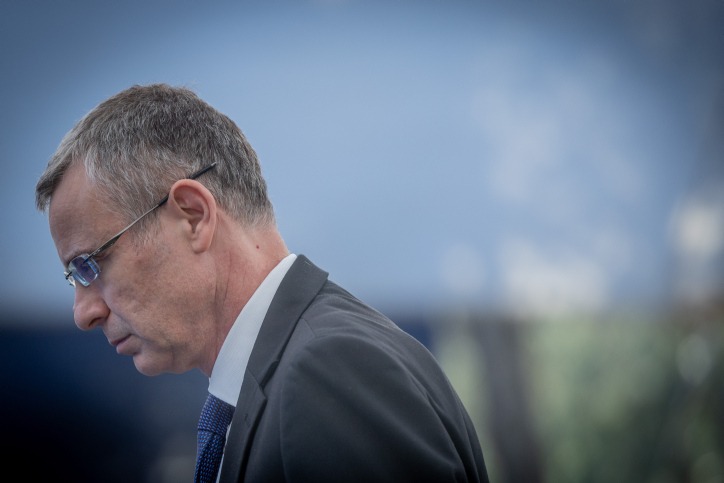
Failure to appoint a President to the Supreme Court: Justice Minister Yariv Levin responded today (Monday) in a letter to the High Court of Justice - through his attorneys, Attorney Zion Amir, Attorney Yinon Sartel, and Attorney Nir Lazar - and presented a compromise proposal, according to which Judge Yosef Elron will serve in office for one year, until his retirement in September 2025.
According to the compromise proposed by Levin, upon the end of Elron's term, a serving Supreme Court judge, who will be proposed by the representatives of the judiciary on the committee until his retirement, will serve as Justice Yitzhak Amit, the veteran Supreme Court judge.
Both appointments will be made at the same meeting of the Judicial Selection Committee.
 Want more news, videos and stories? Join the Haredim 10 WhatsApp channel >>
In response, Acting President of the Supreme Court, Justice Uzi Fogelman, announced that he was rejecting the compromise proposal.
Levin also proposed, as part of the compromise, to appoint three judges who are missing to the Supreme Court according to the following formula:
The first: Will be appointed based on the proposal of the majority of the representatives of the judicial system on the committee, who will propose two candidates. The candidate who will be elected will be the one preferred by a majority of the elected representatives on the committee.
The second: Will be appointed based on the proposal of the majority of elected members of the committee, who will propose two candidates. The candidate who will be elected will be the one preferred by the majority of the judiciary on the committee.
The third: will be appointed by consensus among all members of the committee from among the serving district judges.
In his response to the High Court, Justice Minister Yariv Levin wrote: "Given the minister's willingness to reach significant compromises, it cannot be ignored that accepting the petition (against the failure to appoint a president) is not only unjustified, but, as stated, will in fact prevent reaching binding compromises on other issues, including the appointment of the three justices to the Supreme Court.".
It also states: "The reality in which the honorable court is being dragged into deciding questions that affect the election of the President of the Supreme Court and its judges will severely damage the legitimacy of the decision that will be made, the public's trust in the system, and the status of the president, if he is appointed in this way.".
In response, as mentioned, Judge Uzi Fogelman rejected Levin's proposal and wrote: "The seniority system is intended to protect judicial independence and prevent politicization of Supreme Court justices and their presidents. This system has proven itself in the country's place, and you know that our position is that there is no justification for deviating from it. This is also the position of most members of the Judicial Selection Committee.
""In this sense, presenting a proposal based on the abolition of the seniority system does not represent any progress. Furthermore, even separately from the above, the proposal to simultaneously appoint two judges to the position of President of the Supreme Court who will serve one after the other raises considerable legal difficulties.".
""The proposal actually violates the equality between the members of the committee and makes the voice of some of its members redundant," Fogelman added. "I reiterate that the committee for the selection of judges will convene as soon as possible, as required by the provisions of the law.".
Close associates of Justice Minister Yariv Levin commented on the announcement of Judge Uzi Fogelman's rejection of the compromise. "The claims of the Deputy President are irrelevant and incorrect. First, in just the past two weeks, a president has been appointed to the Haifa District Court and vice presidents to several courts, and another series of appointments have been made that require joint consent and consultations between the minister and the Deputy President. All of this alongside the appointments of 162 judges in recent months, a record number that has never been equaled in a single year.".
They added: "What really bothers Deputy President Fogelman is one thing: Minister Levin's desire to diversify the composition of the court and ensure that it will have representation for different worldviews. The judges' hiding and their resistance to any compromise only prove to what extent the demand for diversity is justified. The Deputy President thinks that by virtue of judicial orders it will be possible to elect a president who will be acceptable to the public, and he will single-handedly bring the court to a low point in public trust.".
The High Court of Justice requested about a month ago that the Deputy President of the Supreme Court, Justice Uzi Fogelman, and Minister Levin try to reach agreements on the selection, in order to avoid ruling on petitions that requested the convening of the committee to select the president.
Legal Advisor to the Prime Minister Gali Baharav-Miara refused to represent the minister in the petition, arguing that his decision not to elect a permanent president of the Supreme Court violates the principle of separation of powers.
Levin, it emerged from the hearing on the petition, believes that the Supreme Court is not authorized to conduct judicial review of his discretion, while the court itself is concerned with the matter.