From dozens of suggestions received from the public, nine words were selected and put up for voting on the Academy of the Hebrew Language website. Thousands participated in the vote, and they decided what the word of the year would be.
Throughout the voting week, two words competed for first place: sinkhole and governance. The next word after them was hallucination. The other words offered to the public for selection were: compassion, climate, gender, the phrase 'full-on', spying, and mortgage.
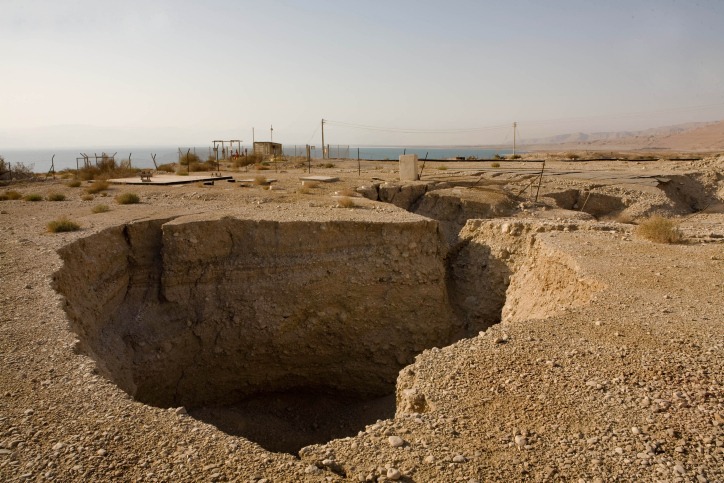
The chosen word of the year is the word Sinkhole. This word began to be used, as far as is known, in the 1960s, as an alternative to the foreign word "dolina," and replaced the term "baloea" that was established in the dictionary of geographical terms of the Academy of Language in 1959.
 Want more news, videos and stories? Join the Haredim 10 WhatsApp channel >>
A sinkhole is a large pit formed by the melting of the subsurface layer and the collapse of the ground surface into the resulting space. The phenomenon is familiar in karst landscapes (where there is a mass of limestone rocks and the like) and since the 1970s it has been familiar in the Dead Sea region (where the subsurface salt layers are dissolved by the retreat of seawater). Sinkholes also open up on roads and in other places where there is instability below the surface of the ground and endanger human life.
The word Governance - which came in second place - began appearing in the press in the first decade of the 21st century, and it indicates the action of someone who governs.
The word that came in third place is delusion. This word and the verb to deceive are based on a singular and obscure biblical word from Isaiah, "Those who deceive lie down, those who love to sleep" (9:10).
It was Shmuel Ibn Tibon, a translator of the Arabic "Mora Nebuchim" (a teacher of the confused), who gave the verb "hazhim" the meaning "to imagine false imaginations," following the Arabic. The verb "hazhit" (to hallucinate) and the verb "hazhi" (a delirium) began to be used in this meaning in general Hebrew at the beginning of the twentieth century. In recent years, the word "hazhi" has taken on an additional meaning: an unacceptable situation. It was preceded by the adjective "hazhi" (delusional) to describe something that is illogical, strange, and unfathomable.
Last year, the word "troll" won the title of Word of the Year, and the year before that, the word "matush" reached first place at the end of the first year of the coronavirus pandemic, when the public became familiar with a term that until then had only been known to medical teams.