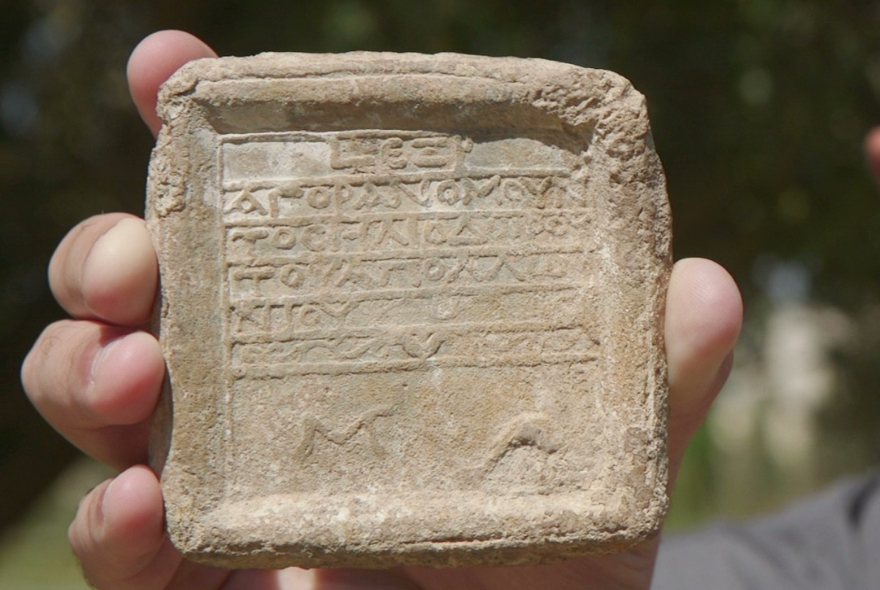
A rare lead weight bearing an inscription dating back approximately 2,150 years, in excellent condition, was seized this week in Jerusalem in an operation by the Antiquities Authority's Robbery Prevention Unit.
The inscription - "Heliodorus ben Apollonius Agronomus" mentions the name of the supervisor of weights and measures, and is dated to the year 165 of the Seleucid calendar - the year 147-148 BC - the days of Hellenistic rule in the Land of Israel.
Next to the inscription, there is also a drawing of a dolphin, the meaning of which is still being researched, in the hope of understanding which city the weight came from.
The scale was seized in an antiques store in Jerusalem following intelligence information received by the Antiquities Authority's Robbery Prevention Unit. Antiquities Authority inspectors questioned the store owner, with the aim of locating the middlemen and the robbers who removed the scale from the antiquities site.
The role of the agronomist was to supervise weights and measures and prevent fraud in trade - and indeed, the weight of the scale is accurate: one mina - the common unit of weight at the time, which was equivalent to one hundred Greek drachmas. It is possible that a sign resembling the Greek letter M, which appears on the seized scale, represents the first letter in the name of the mina (Mina).
Researcher Ido Tzangan from the Israel Antiquities Authority: "The Greek names of Heliodorus and his father - Apollonius - indicate a Hellenistic population. Both names are related to the sun gods in Greek mythology - Helios and Apollo - and suggest a cultural-religious connection to the Hellenistic culture, which dominated the country at the time. These names were especially common in Edom.".
The name Heliodorus was common in the city of Marsha in the Judean Lowlands, which was the capital of Edom during the Hellenistic period. It is interesting to note that other items related to the role of agronomus, bearing the same names, and dating to the years surrounding this weight, have previously been found in Marsha:
On a weight that predates the one now seized by 20 years, dating from 170-169 BC, the name of an agronomist appears as "Apollonius.".
The weight now seized, from 147/148 BC, bears the name of "Heliodorus son of Apollonius""
And on a scale and measuring instruments dating back five years after the captured scale (143-142 BC), an agronomist named "Antipater son of Heliodorus" appears.
""It is known that in the ancient world, government positions - including the agronomist - tended to be passed down from father to son," says Tsangen. "However, the positions were not always passed down from father to son. These names were not particularly rare in Marsha, and there is no absolute certainty that the weight comes from this site. We are currently examining this hypothesis at the Israel Antiquities Authority. If it turns out to be correct, then this is a rare and fascinating discovery regarding politics and government in antiquity.".
In the past, a well-known royal inscription was discovered in the Marsha area, carved in stone in the Greek language, dated to 178 BC, and mentions another Heliodorus – Heliodorus Diochethes – the treasurer, who headed the king's ministers, mentioned in the Book of Maccabees 2, Chapter 3: This Heliodorus was an envoy on behalf of King Seleucus IV, who was sent to confiscate funds from the treasury of the Temple in Jerusalem. Some attribute this activity to one of the reasons for the outbreak of the Hasmonean revolt in the Greeks.
Going for a walk in nature? Lost your way? Everything you need to know before you go • In advance
Ilan Haddad, the head of the Israel Antiquities Authority's oversight of the antiquities trade: "Removing an archaeological artifact from its site without an organized excavation results in the loss of valuable historical information. If we had found the find at a specific site, we could have enriched the historical information considerably. At the moment, unfortunately, we can only guess which ancient city the item was looted from and what its connection was. The law prohibits antiquities dealers from purchasing antiquities from an unknown source. This is a criminal offense. The Antiquities Authority is working to prevent looted archaeological artifacts from reaching antiquities stores, to capture antiquities looters in the field, and to bring them to justice.".
 Join the Haredim 10 Facebook page >>
 Join the X page of Haredim 10 >>
 Want more news, videos and stories? Join the Haredim 10 WhatsApp channel >>