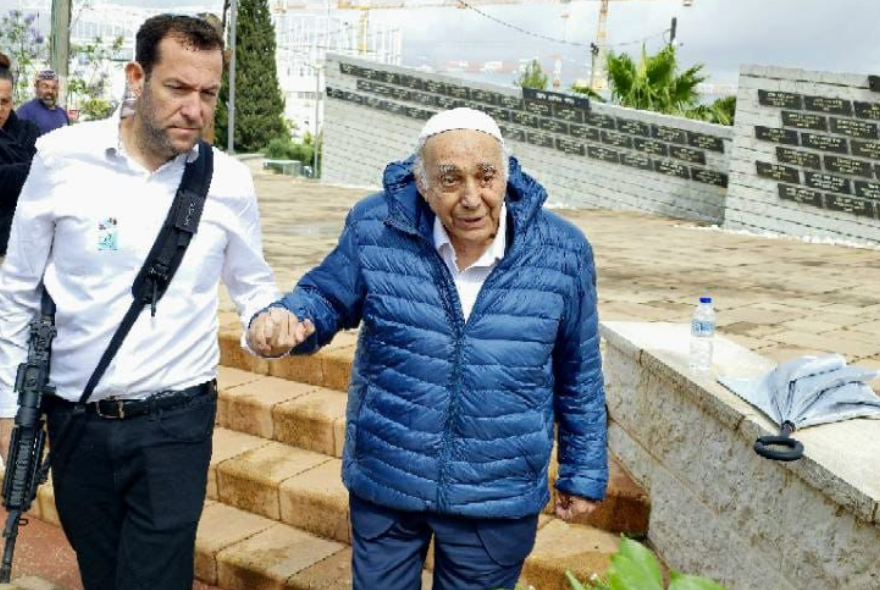
The late Moshe Zer, a man of settlement, one of the builders of Judea and Samaria and founders of Unit 101 and the paratroopers, passed away today (Friday) at the age of 88.
His funeral will take place on Sunday at 5:00 PM at Mitzpe Tza'aim, and he will be buried in a grave he prepared for himself in Ramat Gilad in Samaria.
The family's statement said: "The crown of our head has fallen. Woe to us, for we are broken. With a broken and painful heart, we announce the passing of the redeemer of the lands of Samaria and hero of Israel's wars, the head of our family, our husband, our father, our grandfather, our brother, and our brother-in-law, Grandfather Moshe Zer, zt"l.
 Want more news, videos and stories? Join the Haredim 10 WhatsApp channel >>
""May the clods of earth, the land of Israel, which he loved with all his heart and for which he gave his soul all his life, be glad. Look up to the heavens and count the stars, if you can count them. And he said to him, 'So shall your seed be, for all the land that you see I will give to you and to your seed forever.'".
The head of the Karnei Shomron local council, Yonatan Kuznitz, eulogized: "Moshe Zer was a role model in settlement, who acted out of a deep belief in the right of the people of Israel to return to their land.".
Zer was one of the founders of Karnei Shomron and initiated land redemption throughout Samaria. "His house on the top of the mountain became a symbol of steadfastness and Zionist determination. His legacy will continue to illuminate the path of lovers of the land and settlers for generations to come.".
The head of the Samaria Regional Council, Yossi Dagan, eulogized: "Moshe Zer was a legend. A hero of Israel, one of the founders of the settlement in Samaria, a bold warrior and a man without fear. He is a symbol of love for the Land of Israel, determination and action. The entire settlement bows its head to the passing of the man thanks to whom there is settlement in Samaria, and in many other places in the country. When I recently visited him in the hospital, he asked me for only one thing: 'Succeed.' We will hold on to our land even more, we will continue on his path, and we will succeed - for his sake and for the sake of the future generation.".
The Yesha Council issued a statement of mourning: "The Yesha Council mourns the passing of the redeemer of the lands and hero of Israel's wars, Moshe Zer. Moshe was one of the pillars of settlement and left behind a glorious legacy of pioneering, love of the land, and a tremendous contribution to the settlement enterprise in Judea and Samaria. We send our condolences to his family and relatives. May his memory be blessed.".
Following the establishment of Gush Emunim, Zer began purchasing land in Samaria and became a well-known land dealer among the Jewish and Arab residents of the region.
In order to register the land in the land registry, he established a Jordanian land acquisition company. Between 1979 and 1982, he purchased thousands of dunams in thirty Arab villages.
In 1983, he narrowly escaped assassination when an Arab landowner with whom he had a business relationship struck him in the face and throat with an axe, shot him, and seriously wounded him. Zer was hospitalized for a long time, but recovered.
A foreigner was the driver of the squad that planted the bomb in 1980 that caused the amputation of the legs of Bassam al-Shaqa, the mayor of Nablus, as part of the Jewish underground's activities.
Moshe and Lial Zer have eight children, all of whom live in Judea and Samaria and are prominent activists among the settlers of Judea and Samaria. Their son Gilad was murdered in 2001 by terrorists while fulfilling his duties as the head of the Samaria Regional Council; their son Rabbi Yondav serves as the head of the Har Bracha Yeshiva and is married to Atia Zer, the daughter of Rabbi Moshe Levinger; their daughter Anat is active in the Jewish settlement in Hebron, and their daughter Shlomit was also active, until she moved to the settlement in Samaria; their son-in-law, historian Gershon Bar Kochba, directed and was one of the founders of the Hebron Midreshet.
After the murder of his son Gilad, a foreigner purchased the land on which the Gilad farm was built, where his son Itai and his family moved to live, and today about 50 additional families live there.
With the outbreak of the Iron Sword War, he made rounds of visits to IDF bases to raise morale among dozens of his descendants, including his children, sons-in-law, grandchildren, and even a great-grandson - who serve as soldiers and officers in combat units.