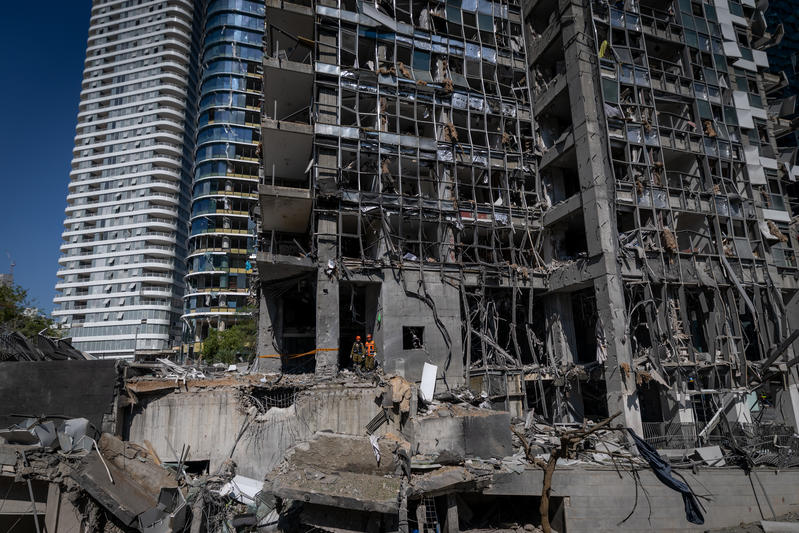
Two security sources confirmed today (Thursday) to IDF Radio that one of the missiles launched toward Gush Dan carried a warhead that split upon explosion - causing damage in several locations simultaneously.
This is a missile that disperses several small bombs while it is at a high altitude of about 7 km in the air.
At this altitude, the missile's warhead opens and splits - and about 20 small bombs fly from it in a radius of about 8 kilometers.
The Home Front Command says that each such small bomb that is dispersed weighs less than 2.5 kg. And these are bombs with a "impact mechanism" - meaning that when it hits the floor, it explodes.
The Home Front Command emphasizes that this is a missile that was previously well-known. The damage that each such small bomb causes is similar to that of a short-range Hezbollah rocket: "The threat is geographically broader, but it is much smaller than the warheads of ballistic missiles, which weigh an average of about 400 kg.".
The fragmentation of the missile occurred over the Gush Dan area. The Home Front Command notes that some of the bombs that fell this morning were unexploded, meaning they did not explode, and pose a serious danger. The public is asked not to approach them and to immediately call bomb disposal teams.
The Air Force, together with the Home Front Command, are investigating how the missile works and the nature of the armament.
Bomb disposal teams were dispatched to the various fallout scenes of the munitions scattered in the Dan Bloc - including in Or Yehuda, Jaffa, Savyon, and more.
After the incident, the Home Front Command launched a public information campaign today regarding the new threat of cluster bombs:
 Join the Haredim 10 Facebook page >>
 Join the X page of Haredim 10 >>
 Want more news, videos and stories? Join the Haredim 10 WhatsApp channel >>