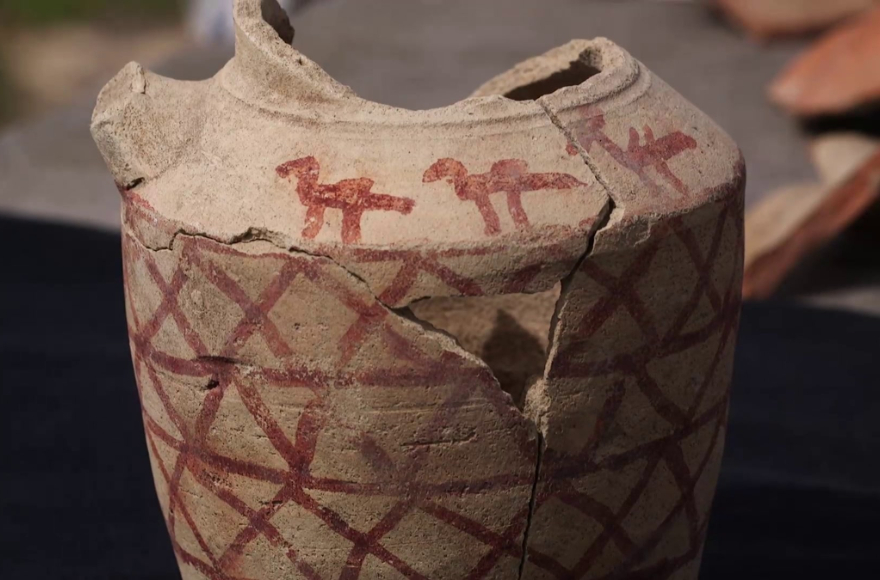
A rare and impressive red-painted clay jug for storing liquids, approximately 1,200 years old, with, among other things, camel decorations, was uncovered during excavations conducted by the Israel Antiquities Authority at the Horbat Anim site in the Yatir Forest.
""The fact that the creators chose to depict two camels on the reverse indicates their great importance during the Abbasid period – in the 9th-10th centuries AD. Camels were a major means of land transportation for transporting goods, and were therefore essential to the economy at that time," explain the authors of the article, Oren Shmueli, Dr. Davida Dagan and Dr. Anat Cohen-Weinberger from the Israel Antiquities Authority, and Dr. Katya Citrin from the Hebrew University of Jerusalem.
The article is being published today (Thursday) in a book as part of the Israel Antiquities Authority's 20th Southern Studies Conference, which is being held at Ben-Gurion University of the Negev.
The colorful jug was discovered during renewed archaeological excavations conducted by the Israel Antiquities Authority in a cave that was converted into a residence and which originally served as an impressive underground olive oil press. The excavations were conducted as part of the development of the site for visitors, initiated by the Israel National Foundation.
The oil press, and with it an ancient synagogue building from the Byzantine period that was previously discovered on the site, underwent extensive conservation work by experts from the Israel Antiquities Authority's Conservation Administration.
The synagogue building was discovered 40 years ago during excavations by the Israel Antiquities Authority and the Avshalom Institute. Among other things, remains of impressive mosaic floors were also found, testifying to the rich history of the place and the importance attributed to it by the community.
""About 1,500 years ago, the Yatir region was part of a region called 'Droma', where Jewish communities lived alongside Christian communities," explains Oren Shmueli of the Israel Antiquities Authority. "There is no doubt that the synagogue that was discovered served as the religious center of the Jewish population that lived there.".
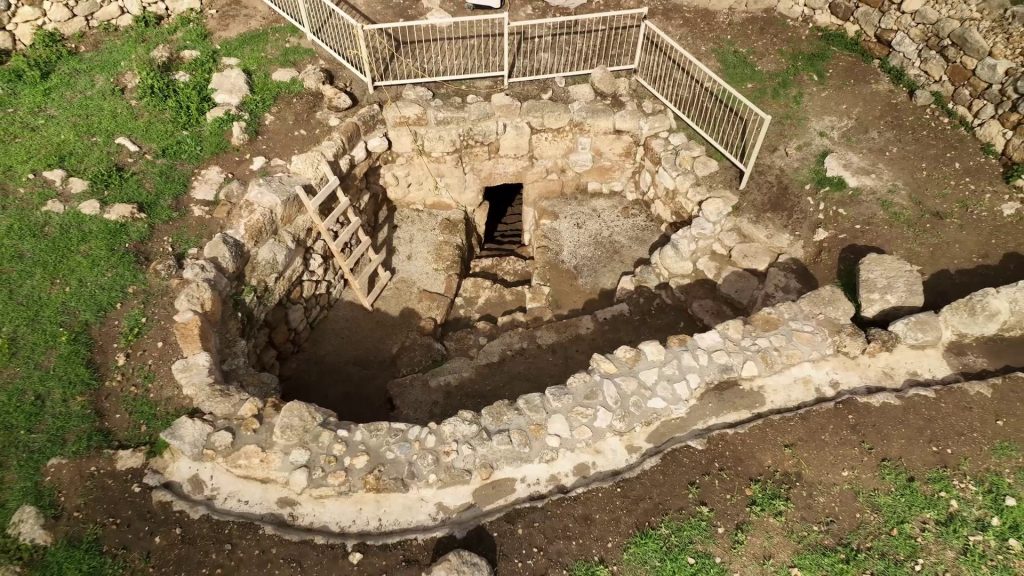
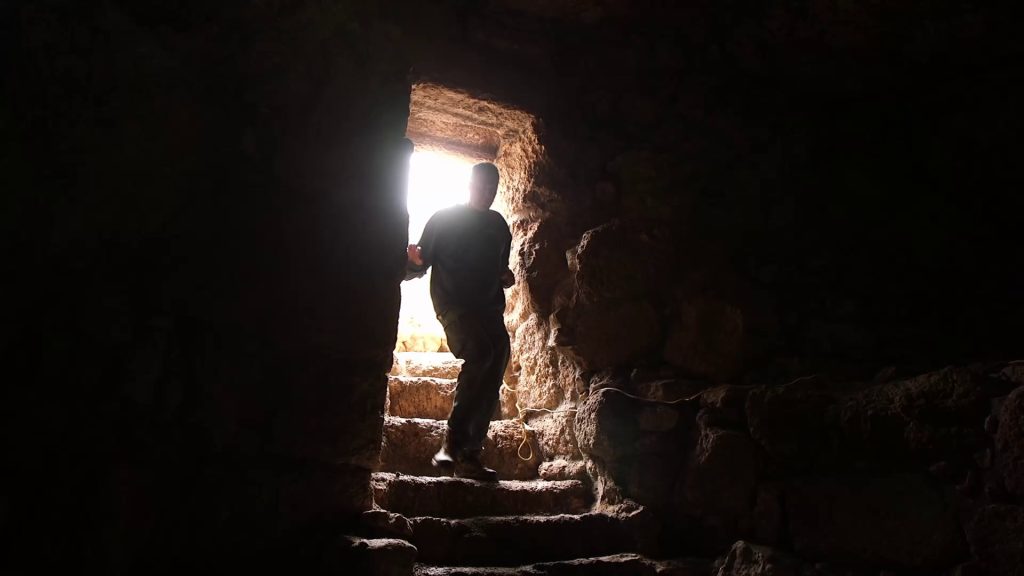
The oil press, built in a cave in the earth's crust and dating back about 1,300 years - the early Muslim period - was fully excavated last year. A pair of huge stones were discovered that served as part of the concrete for the huge pressing stones in it, known as the 'Yehudah presses'. Between them, in ancient times, a wooden screw was installed, which squeezed the olives and extracted oil from them. The oil that flowed out drained into a stone basin in the center of the facility.
""The uniqueness of the oil press in Yatir Forest is that it was built in an orderly and advanced manner for its time. In fact, it is an ancient factory, where a sophisticated and expensive machine for its time stood," said Shmueli.
The unique clay jug that was discovered was used to store liquids. It was decorated with red-painted geometric patterns, with drawings of a caravan of animals including a camel and perhaps even an ostrich - "the winged camel" or a donkey.
""In the early Muslim period, camels were the main means of transportation," explains Shmueli. "The fact that camels appear on the reverse of paintings indicates their great importance at that time. Camels transported goods throughout the empire, and were therefore essential to the economy. In the Roman and Byzantine periods, it was customary to transport goods by ship at sea and by chariot on land, and in the Muslim period, it was the camel that took precedence as a means of land transportation - the desert ship replaced the Roman ship.".
 Join the Haredim 10 Facebook page >>
 Join the X page of Haredim 10 >>
 Want more news, videos and stories? Join the Haredim 10 WhatsApp channel >>