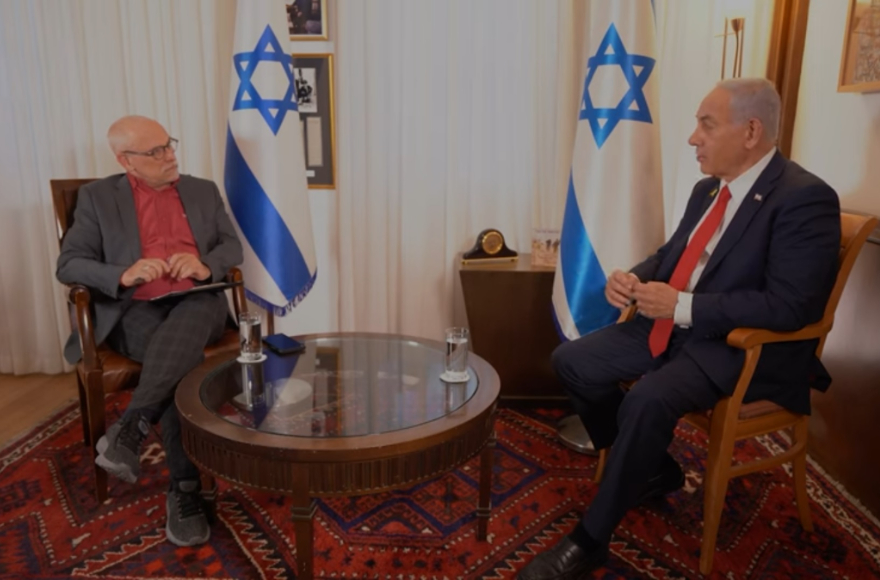
In a comprehensive conversation with media personality Gadi Taub on Shomer Saf, Prime Minister Benjamin Netanyahu reveals dramatic details about the war, and explains the rationale behind the strategic decisions during 'Iron Swords,' while noting historical changes in the Middle East and addressing the security and political challenges.
The interview dealt with a variety of topics: from the fighting in Gaza and Lebanon, the elimination of Nasrallah, through relations with the United States, to the resilience of Israeli society.
 Want more news, videos and stories? Join the Haredim 10 WhatsApp channel >>
Netanyahu began by describing the geopolitical changes in the region, emphasizing: "The war changed the face of the Middle East." He mentioned Jabotinsky's "Iron Wall" principle, according to which "the State of Israel must prove that it is a fait accompli that cannot be eliminated.".
According to him, normalization with Arab countries, such as the Abraham Accords, has solidified Israel's position, but the main threat remains Iran, which strives for "takeover of the Middle East through proxies like Hezbollah and Hamas.".
He explained: "Iran has created a land contiguity from Iran to Iraq, Syria, Lebanon and Gaza, with the aim of establishing a stranglehold around Israel. They operate systematically, with an extremist ideology, aimed at exporting the Islamic revolution. The fight against them is an existential fight.".
Regarding the war in Gaza, Netanyahu described the strategic decision to focus on the south, while actively defending the north: "On the second day of fighting, we realized that we had to eliminate Hamas. Some argued that we should also open a front against Hezbollah, but I thought that was a mistake. We should have concentrated our efforts in the south.".
Netanyahu detailed the pressures exerted on Israel, especially from the previous administration in the United States: "Biden told me explicitly - if you enter Rafah, we will stop your aid. I answered him - we will fight even with our nails if we have to.".
He emphasized that despite the pressures, Israel acted: "We withstood the pressures and decided to enter. Sinwar was sure that we would surrender. We returned to fight and dealt him a heavy blow.".
Netanyahu emphasized the IDF's success in reducing civilian casualties: "When we entered Rafah, the division commander reported that we had killed over 1,200 terrorists, while civilian casualties were close to zero. Hamas tried to prevent them from escaping, but the population realized there was no choice.".
The Prime Minister praised the spirit of the fighters and Israeli society: "We thought this was the 'me' generation, but we discovered extraordinary bravery. A fighter who lost a leg said, 'I want to return to the front line.' This is the essence of our spirit.".
""The people and the army have demonstrated extraordinary strength. We have changed the Middle East – from a weaker Iran to Arab countries that understand that Israel is an existing fact. We will continue to fight to ensure Israel's security for generations.".
He also addressed criticism from parts of the elite: "There is a minority with financial support from abroad that emphasizes personal pain, but the majority of the people understand that if we don't fight, we won't survive.".
Netanyahu described the campaign against Hezbollah as a change in perception: "We understood that they must be destroyed. We activated 'beepers' – suicide drones that damaged infrastructure. Then we destroyed their missile depots, and we eliminated Nasrallah.".
He emphasized that the assassination led to the collapse of the Assad regime in Syria: "Hezbollah was its backbone. Without it, the Syrian army would have collapsed within days.".
Regarding the confrontation with Iran, he said: "We must prevent them from having nuclear weapons. We have fought them in the past, and we will continue to do everything to stop them. They understand that we are ready for a confrontation.".
On the issue of the hostages, Netanyahu expressed a commitment to releasing everyone, but emphasized the complexity: "Sinwar believed that pressure on Israel would force us to stop the fighting. Only when we advanced to Rafah did he begin to cooperate." He described the struggle within the cabinet: "Some demanded that the fighting stop, but I knew that if we stopped, Hamas would survive. It is the combination of military and political pressure that brings results.".
On the plans for the day after: "After eliminating Hamas, we will allow the Palestinians in the Gaza Strip to leave voluntarily, under Israeli security control. Polls show that many are interested in this. The goal is a stable future, with security for Israel and growth for the region.".
He emphasized the importance of President Trump's support: "He understood the need for military and political pressure. This is a different orchestra than the previous administration.".
Watch the full interview.