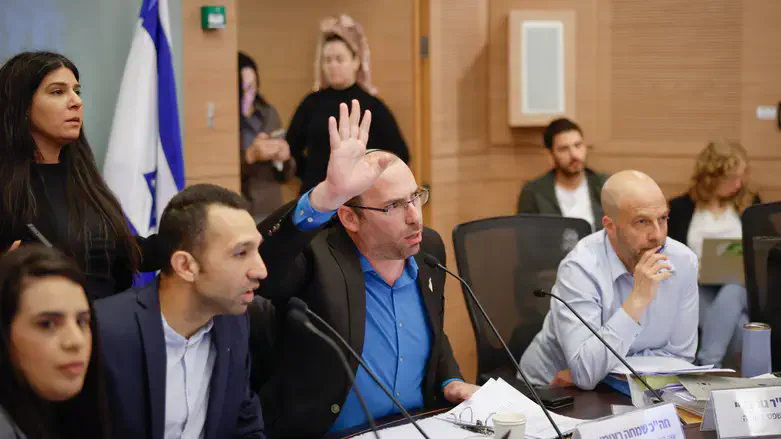
The Constitution Committee approved today (Wednesday) the bill to change the composition of the Judicial Selection Committee, with the support of 8 MKs compared to 5 opponents, despite opposition from the opposition, which included shouting and the submission of a counter-revision.
The proposal will be submitted for approval by the Knesset plenum in second and third readings ahead of the winter session.
According to the proposed outline, the committee for selecting judges will have 9 members: the President of the Supreme Court and two Supreme Court justices, to be elected by the membership of its judges; the Minister of Justice (who will head the committee) and another minister to be appointed by the government, two MKs to be elected by the coalition and the opposition on their behalf, and two public representatives who are lawyers with the qualifications of a Supreme Court judge - at least 10 years of experience as an attorney, to be elected by the coalition and the opposition.
 Want more news, videos and stories? Join the Haredim 10 WhatsApp channel >>
According to the outline, a majority of 5 out of 9 will be required to elect judges for all courts. In the lower courts, a majority will be required that includes at least a member elected by the coalition, a member elected by the opposition, and one judge. For a judge in the Supreme Court, a majority will be required that includes a member elected by the coalition and a member elected by the opposition.
A tie-breaking mechanism is also proposed, according to which if two Supreme Court justices are missing, one of whom is missing for at least a year from the end of the first justice's term, or from the beginning of the Knesset term (whichever is later), the coalition and the opposition can propose three candidates on their behalf, from which the other side will choose.
MK Benny Gantz said in the debate: "The State of Israel is in difficult times, a difficult period for two and a half years, which peaked after 7/10 when one great disaster befell us all, which occurred because of two or three layers - one is the operational intelligence failure that we are all ashamed of, and in front of it was the Israeli heroism that knew how to stand up through volunteers, grandmothers, alert platoons and many civilians and an army that is recovering. There was a strategic reason for Sinwar to do what he did and there was a reason for division in Israeli society when he identified a weak point as a modern Amalek, and here we are a year and a half later, giving the same gift back. Instead of uniting, we are returning to division. The strength in unity does not lie in - I think something, agree with me and we are united, but in the rapprochement of the two sides. That is how I have acted in the last year and a half as much as I could, when I came in the name of unity of fate and not in the name of political unity. Everything that preceded the war, what we called a coup d'état, and you called legal reform, was completely frozen.
""Unfortunately, we've returned big time to 6.10. On central and essential issues, such as political agreements, or what society looks like, you can't go by political force, and in order for there to be unity, the governors and the government have a responsibility to restrain themselves and not save themselves. What we see in this process is not self-restraint but the exhaustion of power, it's not majority rule but the tyranny of the majority, and in a democracy the only security the minority has is that it doesn't face the tyranny of the majority. The Prime Minister decides to fire the majority. You're taking us down a peg.
""Actions lead to talk and vice versa. In your case and that of the coalition, your actions are legislative, they create the other talk and that is a great shame. I understand that the electoral impact of my words is nothing because the members will vote for or against and there is really no real dialogue. Returning to 6.10 with all its clauses is national irresponsibility, it tears apart our people and does not lay a foundation for future agreements, but on the contrary, it distances them and what you do today will be recorded for generations.".
The law to change the Judicial Selection Committee was approved for second and third reading | Opposition members requested the right to make opening remarks, and the chair of the Constitution Committee, Simcha Rothman, continued the voting. Watch@rothmar @KarivGilad @YSegalovitz @FarkashOrit pic.twitter.com/jUEXjYnYB4
— Knesset Channel (@KnessetT) March 19, 2025
Rothman responded to Gantz: "Some of the amendments to the bill were made following suggestions from your party member Farkash HaCohen, and she was willing to introduce more amendments as long as this would lead to agreements, but unfortunately that did not happen - you called the outline of the agreements the end of the conflict, and I said that this was an excellent statement, but it requires that we know how to deal with today's scenario the next day.".
""All of us here in the Knesset will come to a conclusion about how we see the constitutional arrangements, and the next day the High Court of Justice or the Advocate General will throw a new goat into the discourse, and one of the most difficult problems in the event is that the summaries in this house are not the end of the story. This proposal is intended to deal with this, among other things.
""In the previous Knesset, we reached broad agreements on the citizenship law, with the exception of Labor, Meretz, and the Arab parties, and what did the High Court of Justice and the Attorney General do? They threw the agreements in the trash. You can't ask me to tie my hands. This is your responsibility no less than ours.".