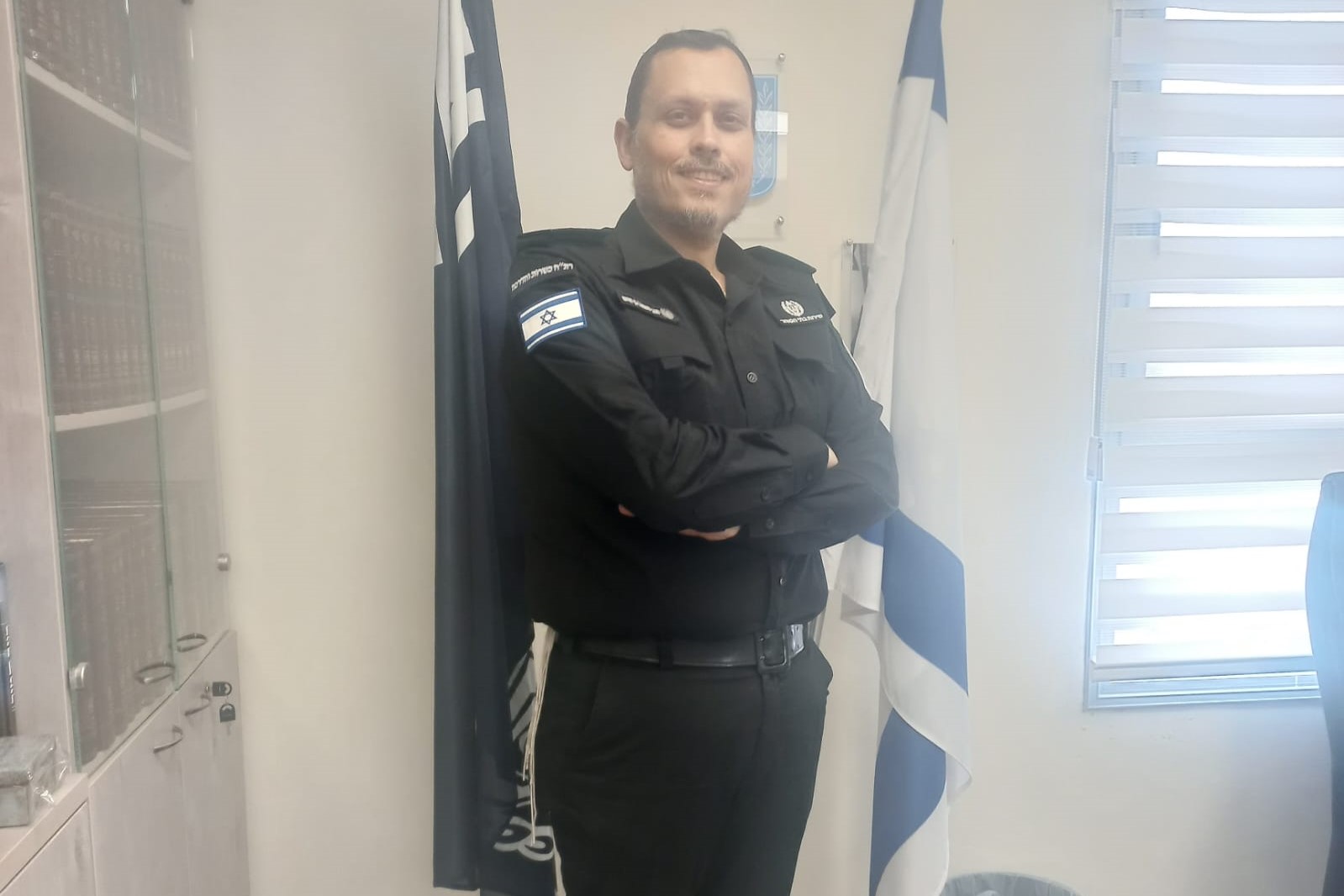
The story of Rabbi Shmuel Ben Harush begins as a typical silkworm, diligently completing his studies within the walls of the kollel, where he successfully passed the Chief Rabbinate exams and received a "Yora Yora" certificate and qualification to be a city rabbi.
He didn't expect the next offer to come to his desk: "The year was 2013 when the civil service track was first established," he says. "An acquaintance of mine offered me something unusual, to join the civil service track, which was foreign and unfamiliar at the time.".
The position offered to Rabbi Shmuel was: assistant to the rabbi of the prisons in the Central District, Rabbi Eyal Salman, who currently serves as the chief rabbi of the Israel Prison Service.
 Want more news, videos and stories? Join the Haredim 10 WhatsApp channel >>
He immediately recognized the great potential that the role held, but as someone who was used to being surrounded by books and scholars from morning until night, he struggled with himself about what was the right thing to do.
""In a situation like this, one goes to consult with the greats of the generation," he says. "So I went to receive the advice of Rabbi Edelstein, who instructed me to take on the mission without hesitation and translate the light of the Beit Midrash into acts of kindness for the common good and for the rehabilitation and advancement of the prisoners' recovery.".
To the rabbinate
This is how Rabbi Shmuel began his journey in civilian service within the Prison Service. After two years of significant volunteer service, his professional horizons were already open to him. "The moment you are recognized and your work in the system is recognized," he explains. "You have priority over other candidates for a variety of coveted positions in the organization in which you served. Since I held a Yore Yore certificate and rabbinical ordination, I found myself appointed to the position of rabbi of Kishon Prison near Haifa.".
Rabbi Shmuel leads the rabbinical service with a high hand, moving between prisons in various districts across the country, where he leaves his Torah mark. Until he reaches the senior position that dominates the rabbinical field in all prisons in Israel - head of the Kashrut and Religious Services Department.
""This is a position with enormous responsibility," he explains. "It's a huge kosher organization that oversees all the kitchens of the Israel Prison Service, both for prisoners and guards. There are 60 huge kitchens spread across 40 prison facilities across the country, and they are required to serve 70,000 meals every day, all year round.".
Rabbi Shmuel does not lead this position alone, of course. Under him work 25 kashrut supervisors and 120 kashrut trustees, who are actually prisoners who have received specialized training to assist in the ongoing supervision work. In addition to the human force, the kashrut organization under his leadership operates a technological control and monitoring center using 350 security cameras scattered at various points in the prisons and designed to ensure strict adherence to kashrut rules.
Being a Torah-observant Jew within prison walls is no easy task. Rabbi Shmuel's great mission is not limited to leading the kashrut system. In addition, he leads the entire religious services system for prisoners, designed to enable them to lead a proper religious life: sacred utensils, halakhic answers, and accompaniment during times of mourning and joy. Everything is provided by a well-oiled and sophisticated system of rabbis who are available to meet the prisoner's every need.
Prevent the next crime
The social impact of a rabbi in prison service is enormous and fateful. Many prisoners are in crisis and are looking to get closer to the Yisrael Saba tradition. Of course, in such a situation, the first address is the rabbi of the facility who is immediately available to them.
""Beyond that," he explains something amazing, "prisoners have the option of receiving rehabilitation baskets designed to allow them to rebuild themselves and get back on the right path - the program is led with dedication by the IPS social workers, but many times the rabbi enters the picture as part of a culture-dependent treatment group and takes an active part in the rehabilitation process.".
Now he stops and presents an amazing statistic: "Among the prisoners who go through the rehabilitation process, the statistics are that 38% ultimately return to the realms of crime, however, among those who went through the rehabilitation process with rabbinical involvement, only 14% returned to their roots. So in practice, it can be said that the work of a rabbi in the Prison Service dramatically reduces the crime rate in Israel.".
It should be noted that the employment opportunities in the civil service are many and varied; only recently did the Ministry of National Security launch a new program designed to empower ultra-Orthodox service members and integrate them into as many roles as possible in the diverse areas of responsibility that the ministry leads.
Call to the flag
Baruch Greenwald, regional coordinator for the "Chebrim" organization, which is designed to build a protective and adaptive environment for the Haredi service member, attests to the tremendous springboard that civilian service provides to young Haredi people.
[gallery]
""In order for an ultra-Orthodox member to be able to feel calm in the service, he needs to see that there is someone like him who sees the world in the same colors and with the same worldview and takes care of his unique needs in all service settings," explains Baruch. "I started my journey in the organization a year and a half ago, at that time the organization launched a huge plan to build an occupational and professional horizon for each service member in parallel with the ongoing service work, so that every Haredi who comes to be a service member will be able to leave with professional tools that are no less than anyone else in the various sectors.
""A service member receives close support from our coordinators who take care of their needs and the formation of professional tools that will serve them in the future, such as courses for English studies and resume writing. In particular, those who serve in the security forces receive a real employment horizon, because usually the organizations really want those service members to continue working for them after the end of their service period.".
Baruch concludes on a sensitive point and says: "We all know that there is a complex reality in the country regarding the entire issue of carrying the burden and the Haredi sector. The Haredi sector leads in volunteering in the many charitable organizations, but in relation to the security organizations, there is less expression and representation of the sector. The civil service today has opened a generous door to all security organizations, from the Israel Police or the Fire and Rescue Department to significant service in the General Security Service and the Mossad. We are there to preserve and enable the preservation of the appropriate Jewish character alongside the possibility of meaningful service in those bodies.".
The picture is completed by the Director General of the Civil Service, Reuven Pinsky: "The story of Rabbi Shmuel Ben Harosh is a clear example of what we mean when we talk about meaningful civil service with an employment horizon. The service is not only an important contribution to the country, but also a real springboard to a significant career, which is also an equally significant contribution to the future of the Israeli economy. This is exactly the way we see the future of the civil service - a true bridge between communities, a path that first and foremost constitutes a significant service and contribution to the country, alongside the acquisition of professional tools and a way to fully integrate into all areas of life in the country, while maintaining identity and values.".