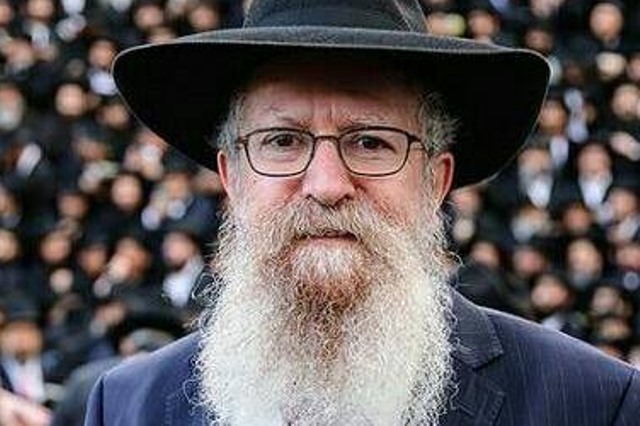
A particularly turbulent year has passed on campuses in the US and other countries around the world. Huge demonstrations against Israel. An anti-Semitic atmosphere towards Jewish students. Attacks on Jewish institutions and Jewish symbols. Many signs indicated the operation of hostile elements, who agitated and angered the students.
Those who found themselves at the forefront of the struggle are hundreds of Chabad emissaries on campuses. While they are routinely focused on inviting students to Shabbat meals, building a warm Jewish home for every Jewish student, putting on tefillin and lighting Shabbat candles, in the past year they have been required to mount a counter-response to the murky wave of anti-Semitism, and to lift the spirits of students who were horrified by the hostility shown towards them.
Blue hair
 Want more news, videos and stories? Join the Haredim 10 WhatsApp channel >>
""The demonstrations were not only in favor of ending the war in Gaza, but also expressed explicit support for the massacre that Hamas committed in the surrounding communities," says Rabbi Gil-Yosef Leeds, the emissary at the University of California, Berkeley campus. "There were repeated statements that Israel is a colonial project that must be erased. There were also violent incidents. Jewish students were beaten.".
But in retrospect, it turned out that it was precisely this hostility that created an awakening among Jewish students. They felt a need to connect with their roots. "I've never had a year where I put tefillin on so many Jews who were doing the mitzvah for the first time in their lives," says Rabbi Leeds. "I organized mass mincha prayers near the Green Gate in Berkeley, which had become a Hamas outpost. Crowds of Jewish students came up, took a siddur and joined in.".
A similar description is given by Rabbi Mendel Matsuf, the emissary at the University of Wisconsin-Madison: "We went through very difficult days after the Simchat Torah massacre. There was a parade here that celebrated the massacre. The campus administration did not issue any statement of condemnation. Jewish students experienced real trauma. I wrote an open letter, which was published throughout the campus, and asked how it is possible that the only time the university does not condemn terrorism is when its victims are Jews?!".
But it was precisely during these difficult days that many more Jews came to the Chabad House, and even those you wouldn't expect to see within its walls. "Students who dye their hair blue express a distinctly progressive identity and a denial of everything related to religion and tradition," he says. "One day, one such person came into the Chabad House and said: I am Jewish and I want to learn more about my people.".
Difficulty as a challenge
Data shows that the number of students participating in Jewish activities has increased significantly in the past year. On Shabbat Parashat Veira, more than two thousand students gathered for a special Shabbat in the Crown Heights neighborhood – almost double the number of participants last year.
At the global gathering of Chabad emissaries, all the forces at the forefront of the fight against anti-Semitism will meet together, share ideas, present models of success, and develop more tools to bring the younger Jewish generation closer to the values of Judaism.
""The Rebbe taught us that every difficulty is actually a challenge, that we need to catapult ourselves to a higher place," they say. "It is not enough to overcome the difficulty, but we need to turn it into a springboard, by which we become stronger and more powerful. We are sure that courage will come out sweet, and that hostility will fan the flame of Judaism even more.".