How do we know that water has reached our souls? We, the writers, know this when we fail to describe the sights, the events, the incidents that happen.
Take, for example, the title of an article/column/interview. Once, when we saw a headline that said: "Tragedy" - we realized that something essentially extraordinary had happened.
Nothing like this has happened in ages. Nothing like this has ever been heard of. And a headline like this hasn't appeared more than once a month, and that's a lot.
 Want more news, videos and stories? Join the Haredim 10 WhatsApp channel >>
People knew that if we called an article, a news report, or our own piece: "The Tragedy of the Cohen Family" - then something essentially extraordinary happened to the Cohen family. One that almost never happens.
Today, the word "tragedy" is a word that comes up several times a day. Tragedy and another tragedy and another, and the mind no longer contains so many tragic and traumatic headlines at the same time.
The headlines: "Permitted for publication," "Terrible disaster," "Unimaginable," "Unbelievable," and others like them are morning, noon, and evening headlines these days.
Slowly, we suppress the sights, the events, and the incidents whose title rises to the sky, and no longer perceive anything. Because how many tragedies, traumas, and world horrors can our minds absorb and digest?
•
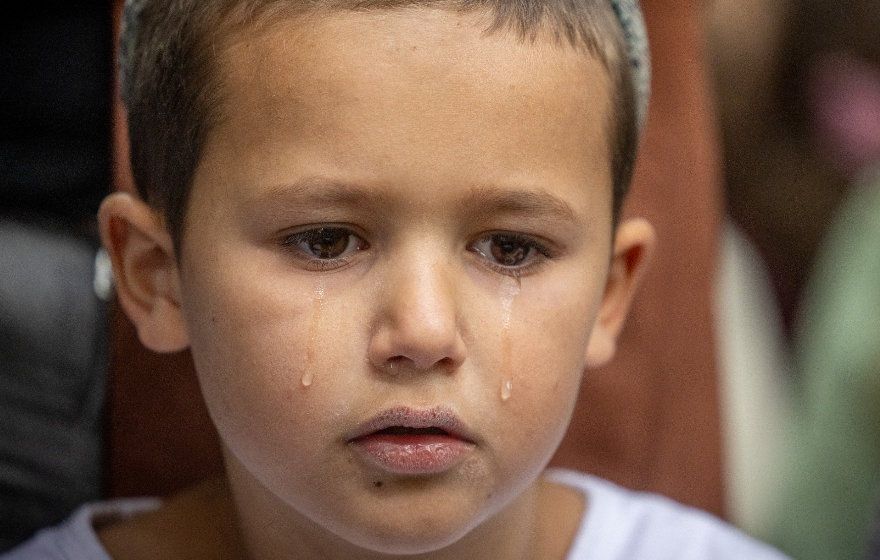
Once upon a time, when we wanted to describe what it was like to attend a heartbreaking funeral, we would describe the funeral with a sentence like: "There was not a dry eye left!", "Voices of weeping rose from the floor!", "The entire audience was in tears!""
Today we all cry every day, all day, all the time.
We don't need a funeral to cry, we don't need an obituary to wail, we don't need someone to wake us up and provide a reminder for us.
And the existing sentences in the Hebrew language and in general, are unable to describe what we feel: It is clear that the entire audience is proud of crying, how could it not? Certainly not a dry eye, because there is no such eye in the people of Israel, the only people in whom every loss is a loss for the entire audience.
•
Once upon a time, when we wanted to explain how terrible the loss was, we would state: "A young father to a tender baby!", "A father of ten," "Lost two of his sons," "Lost her only son"!
Today, every loss is a loss for the entire world.
There is no longer a house that does not touch the dead, even if not within it, then in the wider circle. This is how it is when losses are a daily thing. And no word or sentence that is tried to be used to make us feel is any longer capable of doing its job. Because the sorrow is as deep as the sea, and the mourning is a generation away from the sentences we were used to in those days.
•
Once, when we came to comfort the family of the fallen/murdered/dead - we would comfort them with the usual words, and be comforted by them: 'May death swallow you up forever,' 'May the place comfort you and add no more to the da'wah,' 'May you be comforted in the comfort of Zion.' We would think about each word and see how the person sitting in the Shiv listens, hears, and is comforted.
Today, no word of comfort is enough.
Beyond the window, another mourning is knocking, and we have no divine promise that this will be the last death.
'This difficult situation is called 'war routine.' 'death routine,' because death has come through our window.
And in all this, there seems to be no comfort.
•
And yet, we are grateful to God and our hearts are grateful to God, even though the city of God is bleeding to the ground. Despite everything, see us, all of us, raising our heads from the scorched earth, wiping our tears with a wet hand, swallowing our emptiness with hope and faith, and answering with the voice of a pure Jewish nation: "And though he delay, I will wait for him, for he will surely come!""
And in a moment, our whining becomes the power in our hands, and we continue to raise our offspring, be positive towards our people, care for and take care of everyone who needs our help, and pray at every moment to the Lord our God, that He may do what only He can do and not our strength and fortress.