
Maj. Gen. (res.) Yiftach Ron Tal, who is expected to assume the position of chairman of the board of directors of Tekoma, criticized today (Friday) on 103FM radio the manner in which the war in the Gaza Strip was being conducted - and expressed his opinion on the hostage deal.
""I am very afraid that a partial deal imposes a death sentence on most of the hostages who will remain in Hamas' hands," he said. "If there is a partial deal, Hamas will get what it wants, keep the rest of the hostages, and it will not return any of them to us.
""I also feel that everyone we can bring home, we should bring them, but we are passing a death sentence on a major part of the kidnapped who are still alive. I prefer to keep pressing, keep striving for a deal that will bring all the kidnapped people home.".
 Want more news, videos and stories? Join the Haredim 10 WhatsApp channel >>
And what about the north?
In his view, an agreement in Gaza would preserve our strategic problem in the north: "A deal like this, which at least the Americans reach in order to avoid an all-out war, also stops the campaign in the north. If we stop it when Hezbollah retains most of its strength, there will be no change in the security reality.".
He warned that we will remain in a problematic reality vis-à-vis Hezbollah: "Such a deal is very problematic in terms of the existence of the State of Israel. The main effort has long since ceased to be in Gaza, Hamas has been defeated militarily in Gaza. We have an existential problem that is getting stronger in the north. This is the neighborhood we live in, if we are not strong, we will not be there. We will remain in a very problematic reality. We need to find a way to bring about a decision in the north, otherwise we will find ourselves in a much more dangerous situation.".
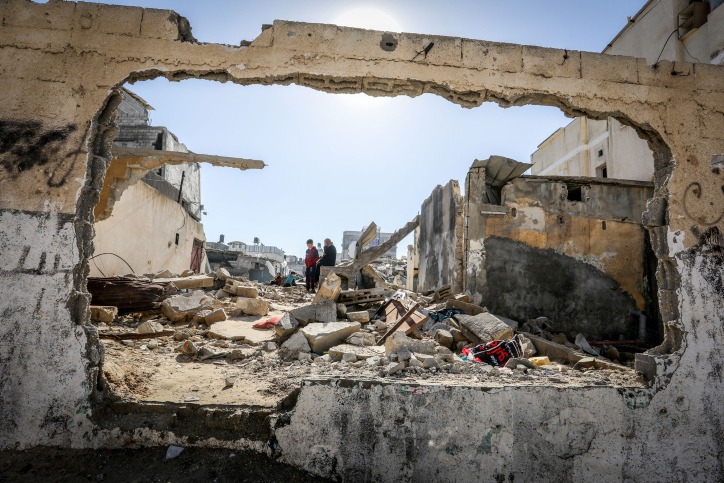
He also expressed his opinion on the Israeli war strategy: "The question of why they didn't enter Rafah (at the beginning of the war) is super important. In my opinion, it was a terrible strategic mistake by those who planned the attack on the Gaza Strip.".
According to him, "Entering Gaza from north to south using a folding method has led to the most convenient defensive battle for Hamas. It goes back, and we go forward, while the opening remains open. We can say up to this moment that we have not yet reached all the tunnels on this crazy highway between Egypt and Rafah. They built tunnels for us while we were there. Imagine what happened in the twenty years we were not there.".
He added: "The army was in such a big shock on October 7. There was no plan to occupy Gaza. There were plans to take over one way or another, but not to occupy Gaza. The plan was carried out quite hastily, and the mistakes made in it were a result of the trauma of October 7. If we had entered Rafah on the first day or the first week, the war would have ended after a month.".
According to him, "Rafah is Hamas's oxygen pipeline," and therefore missing out on immediate entry into Rafah was a significant mistake, which affected the course of the war.
Ron-Tal is set to take on a very important and challenging role at the beginning of next month: chairman of the Tekuma Directorate for the treatment and rehabilitation of evacuees from the Gaza Strip. In the meantime, he warns that the IDF's withdrawal from the border with Egypt could be devastating for the region in the future as well: "In northern Sinai, equipment on an insane scale is waiting for the moment when it can be brought through those tunnels into Gaza. Egypt has an interest, not just an interest in aiding Hamas - it's an economic interest that reaches all the way to Cairo.".
In his opinion, what built Hamas's military power were the tunnels connecting Rafah in Egypt and Rafah in Gaza, where, according to his estimate, more than 951,000 of the terrorist organization's weapons were smuggled.
""All the weapons fired at us in recent years came through these tunnels. If we don't close them hermetically, it will happen to us again. What stands between Hamas being unable to exist militarily anymore, and the fact that it will exist in the near future, is a strategic decision - to lock down Rafah so that not a fly can pass through there.".
He added: "They are saying something that in my opinion is much more serious - assuming we leave Philadelphia, if movement is detected going from Egypt to Philadelphia, we will return and attack. Do you think so? This is the concept that brought us to October 7. The most advanced technological wall in the world, the most deadly in the world, is the wall through which the Nuhba terrorists penetrated the State of Israel on crutches, on foot, on tractors.".




