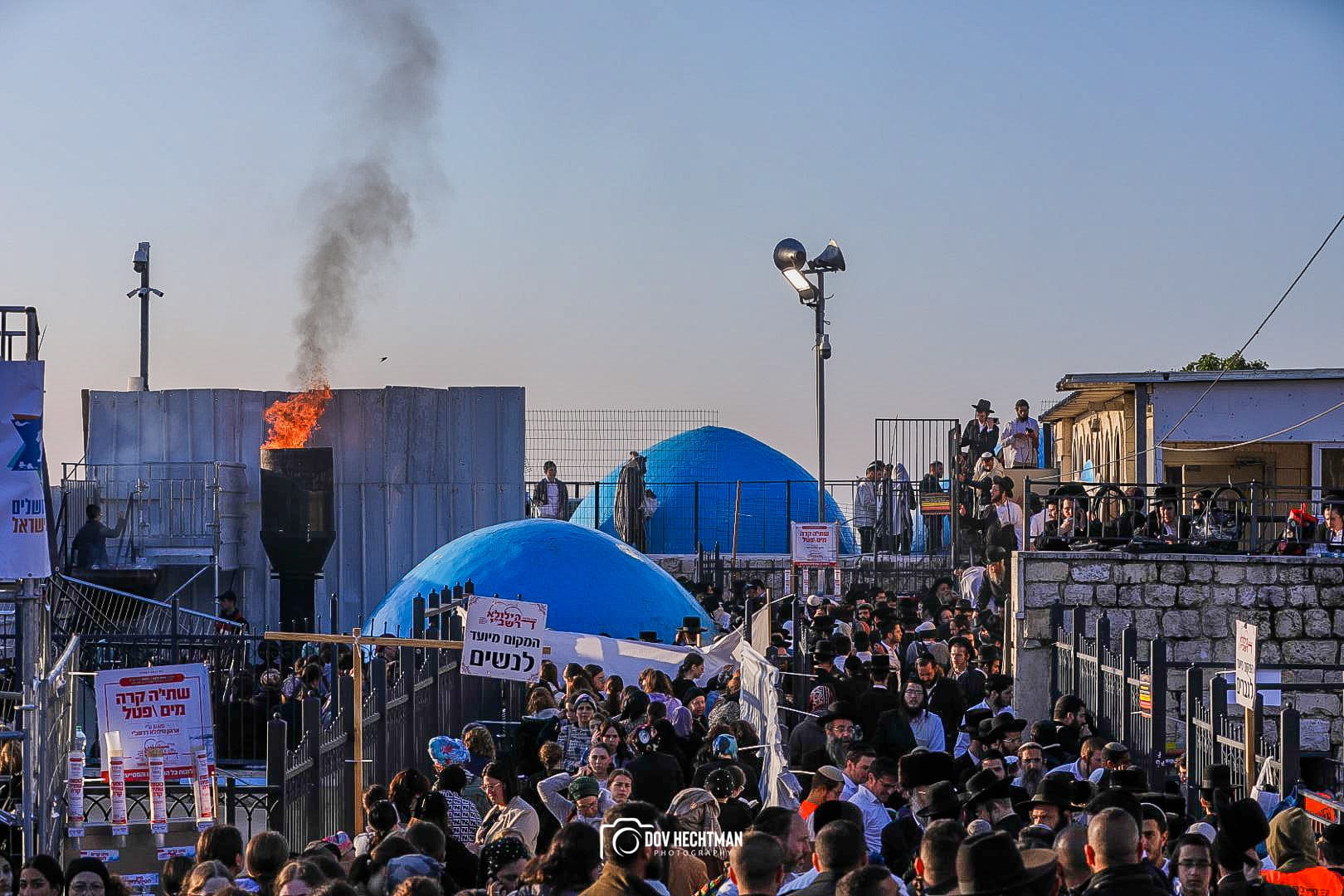
The National Security Committee approved last night (Monday) for second and third reading the bill regulating the limited event of the Rashbi's celebration on Lag BaOmer on Mount Meron.
Come explore Jerusalem from your mobile device: Enter the experience now
The purpose of the law is to establish arrangements for holding events to mark the Rashbi's celebration in Meron in a limited format, due to the security situation and the declaration of a special situation in the home front.
 Want more news, videos and stories? Join the Haredim 10 WhatsApp channel >>
According to the law, during the celebration, a central lighting event will be held at the Zion Rashbi complex of the Rebbe of Bayan - and two additional lighting events at the 'Bnei Akiva complex', of the Gersham Amar and the Gersham Eliyahu, subject to receiving a special permit from the Minister of Jerusalem and Jewish Tradition and at different times.
At these events only, the presence of up to 30 people with special permits will be permitted - 10 at each event, who are not residents of Meron, excluding emergency security and rescue personnel in these complexes.
By granting the permits, the Minister will work towards equal representation for Jerusalem's audiences, who have a unique, long-standing connection to the Lag BaOmer celebration held on the Mount.
For the purpose of holding the prayer at the grave site, the Minister will allow the participation of up to 30 people, representatives of the families of those killed in the Meron disaster, and representation for those who resided in the Meron settlement, including appropriate representation for women. This is in light of the security circumstances.
In addition, the minister will establish a procedure with the journalists' organization for the entry of five journalists from different media into the Bar Yochai Tomb complex and the 'Bnei Akiva Complex'.
It was further determined that if instructions are issued under the Civil Defense Law that do not allow the central lighting event or additional events to take place, they will be followed and the events will not take place.
The bill stipulates that a fixed administrative fine will be imposed, in addition to a fine under the Penal Law, on anyone staying in the Meron complex or in any of the complexes during the festivities without a permit, anyone who organizes or carries out lighting, anyone who organizes or holds another event in the Meron complex during the festivities, and anyone who rents an accommodation unit to anyone who does not have a residence permit.
The bill was introduced as a temporary provision and will be in effect until Iyar 25, 5774 - June 2, 2024.
During the discussions, various issues arose. Among other things, under what authority would the Meron complex be closed?.
Minister of Jerusalem and Jewish Tradition, Meir Porush and his team noted that the committee does not have a complete statement from the Home Front Command to issue an order to close the compound. "I am afraid of the lack of clarity that will be heard by the public. I am afraid to take responsibility when the police claim that if there is no general order, there is a fear that more will be raised.".
Yosef Deitch, Meron's project manager, added: "If there is no such clear statement, don't expect us to do the work for you. We need a clear statement. The minister cannot stand in front of the crowds that will come.".
Attorney Yaara Lemberger, Ministry of Justice, claimed that there are several legal ways to achieve the closure of the area. "Possibilities for a general order and we have chosen the path of anchoring it in primary legislation, and that should be enough.".
David Bavli, advisor to the Minister of National Security, argued, on the other hand, that the need for legislation is so that the police can implement the general's order - "But suddenly it turned around and the army became marginal. Say that the incident is security-related," said Bavli.
Major Anan Sarhan of the IDF responded that the event was not military, but rather religious-civilian, taking place during a period of security tensions.
The committee chairman, MK Fogel, commented: "The public understands the closure of an area by a general's order. If it is not, we may encounter an incident where the forces there will not be enough.".
Lt. Col. Slava Buchok, Northern District of the Israel Police, clarified that there was a document in which the commander said he would issue an order and at the same time we went to legislation. "The law is required to be complementary to the order and not in its place.".
His friend in the organization, Chief of Staff Shabtai Grabarchik, added that the event is religious and emotional: "A clear statement from the army is a seal of approval because the event is not held like every year. It's a bit strange to me that the army is going downhill. You are the sovereign in this security matter. No one can replace you on this issue.".
Ultimately, an outline was proposed whereby the head of the IDF would determine by order the areas that would be closed in accordance with this law and the Civil Defense Law.
The committee also discussed the issue of permit types, when it was determined that the list of holders of entry and residence permits will be approved, subject to the limitations of the Civil Defense Law and the principled position of the Israel Police, by the Minister of Jerusalem and Israeli Tradition with the consent of the Minister of National Security.
Regarding journalists, it was suggested that those who wish to attend the event register with the Office of Jerusalem and Israeli Tradition, and that the team that chooses to go to the two complexes will follow the reporting procedure, and will provide service to the other journalists.
Regarding the inspectors and ushers, it was said that if there is a demand, they will be selected and approved and will be subordinate to the police.
In addition, all parties were asked to prepare a table of forces and missions to monitor who was in the compound at any given moment. The committee also heard the request of the Al-Haddad and Yosef families to hold a memorial service for their loved ones who perished in the Meron disaster and are buried in the cemetery there.
Minister Meir Porush: "We saw from all the parties sitting here how everyone was required to be flexible in order to reach a minimum number of participants in the festivities.".
Committee Chairwoman, MK Zvika Fogel: "The law will allow the celebration and tradition of Israel to take place because it is part of our identity. This is a special event that is being held under security guidelines, the main focus of which is prevention and enforcement. We must adhere to the Home Front Command's guidelines in order to protect human lives.".
After a vote, the bill was approved for second and third reading and will be forwarded to the Knesset plenum.