1.
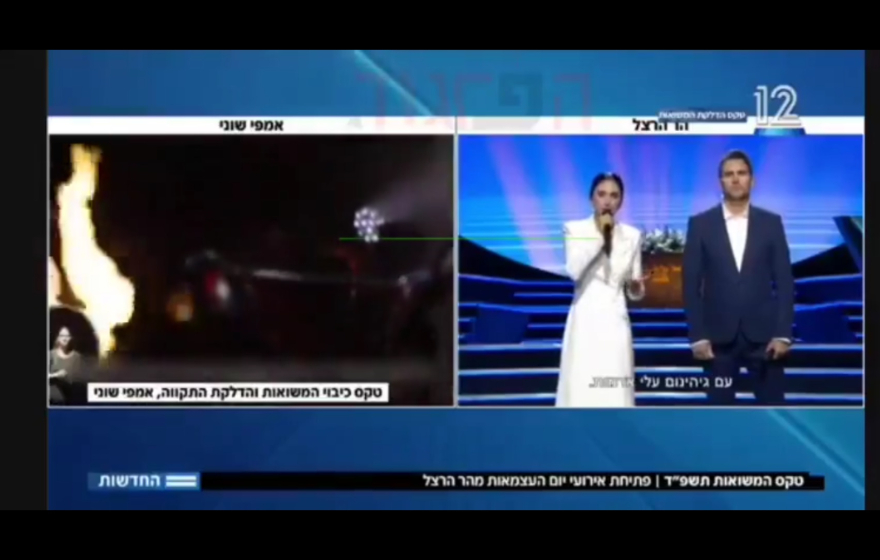
It's hard to overstate the importance of the split-frame on Channel 12 on Independence Day night. It's a seminal event, and not just in the world of media.
Never has the picture been as clear and refined as on the country's 76th Independence Day. In fact, one could say that the State of Israel is now splitting into two camps: the camp of the torchbearers and the camp of the torchbearers.
 Want more news, videos and stories? Join the Haredim 10 WhatsApp channel >>
Let it be emphasized right away: the division is not symmetrical. On the contrary, the most outrageous thing about this split screen is the optical illusion. The manipulation as if there are two events here of equal weight. Two equal camps. Oh, how unequal they are.
And another important point to make before we begin: I don't think the torchlight ceremony is a sacred event. To be honest, when I looked at the split screen, I didn't find myself in either the right or left square, as opposed to (is it permissible to say opposed to ceremonies?).
Yes, I have a lot to say about the style and content of the ceremony on Mount Herzl. This year and every year. In fact, like many, I prefer to mark the arrival of Independence Day not by watching flag parades and numbers being placed on Herzl's grave, but by a festive evening prayer with moving verses of thanksgiving to the Holy One, blessed be He. We did have a miracle.
By the way, have you noticed how much Psalm 17, the chapter that opens the Independence Day prayer, fits the story of the hostages in Gaza, "those who dwell in darkness and the shadow of death, prisoners of poverty and iron"? May we soon experience the fulfillment of the verse "And they cried to the Lord in their trouble - and He brought them out of their distresses.".
2.
And after the reservations, the division between torchlighters and Maccabi torchlighters cuts across Israeli society as a whole, and is clearly relevant even to those who have never watched the ceremony. And yes, even to those who prayed a completely normal evening prayer on Independence Day night and even said a tahanun on purpose the next day.
The question is whether you live here in the State of Israel, or even in this world, with the consciousness of lighting a beacon or extinguishing a beacon.
The image is so strong that it borders on kitsch. Like, couldn't they have come up with a less explicit parable than "lighters of beacons" versus "Maccabi of beacons"? Probably not. In general, we live in a time when everything becomes a bit exaggerated. There's no need to explain too much, just look at reality.
You know what, I'll try to go with a slightly less explicit parable than the Maccabees versus the Maccabees: the question is, from a perspective, what kind of inscription do all the processions of our lives create, about the good and the bad in them. Does it all ultimately connect to the word "desolation," or is it possible, with all the sorrow (and desolation!) to look up and look at reality a little differently?.
Of course, I'm not referring here to the families of the kidnapped who took part in the project. I have no ability to judge them, God forbid. I'm talking about those who, out of political cynicism, took them - and with them are trying to take an entire country - to this spiritually closed and extinguished place.
3.
It seems to me that this split-screen moment caused many Israelis - who until now were perhaps a little confused in the complex times we find ourselves in, who didn't know who exactly they belonged to - to make a decision. Not a political decision.
Much more than that: an identity decision. I'm sure, I hope, that many said to themselves this week (sometimes silently, without anyone knowing): If this is what the other side looks like, on Independence Day, then I know where I am. Or at least where I'm not. And you know what? This too is a kind of exit from darkness and the shadow of death.