
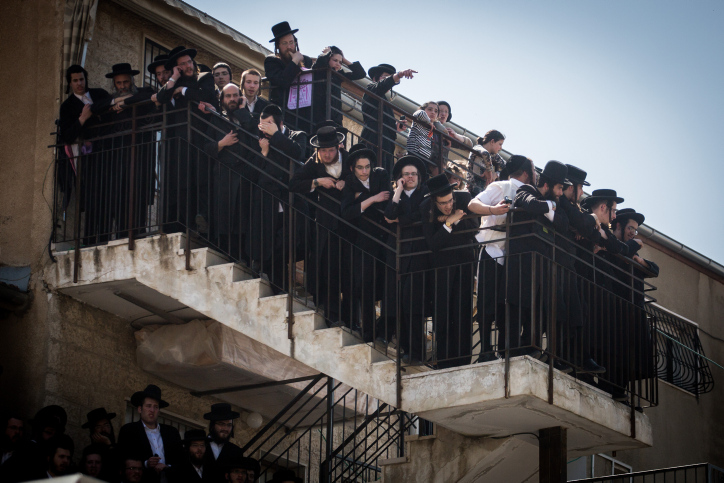
A report by the Haredi Institute for Policy Studies shatters paradigms about Haredi society and reveals that the number of Haredim is approximately 13% lower than the current accepted figure - and stands at only 1.21 million people in 2023.
Moshe Biton 'played' it. Want a path to success too? • This is how you join
In addition, according to the report - "State of Haredi Society Report 2023" - the growth rate of the Haredi population is approximately 101% lower than the prevailing estimate.
 Want more news, videos and stories? Join the Haredim 10 WhatsApp channel >>
The report is based on an innovative data generator that incorporates artificial intelligence and segments the Haredi public with a higher level of accuracy than ever before - by communities, geographic regions, age and gender.
According to the updated projections presented in the report, the slow growth rate of ultra-Orthodox society will result in it constituting only a quarter of Israel's population by 2065 - rather than a third according to the current prevailing forecast.
The Haredi family is the largest among the various population groups: its average size in 2022 was 5.15 people, compared to 2.8 among non-Haredi Jews and 4.15 in a family in Arab society.
The ultra-Orthodox population has the highest fertility rate, at an average of 6.2 births per woman. Among non-Urdu Jews, the average fertility rate is much lower, at 2.3 births per woman. In Arab society, the fertility rate is relatively similar to the non-Urdu Jewish population, at an average of 2.6 births per woman.
Among women in Haredi society, there was a gradual increase in average fertility - from 4.8 in 1955, the lowest fertility rate measured in Haredi society in these years, to 7.3 in 2003.
The peak fertility rate for Haredi women was in 2003: 7.3 births on average. Since then, there has been a continuous decline, and a relatively sharp decline between 2019 and 2020 resulted in the lowest fertility rate among the Haredi population in 40 years: 6.2 children on average.
Among non-Haredi Jewish women, the average fertility rate has not changed much in the past 70 years. In 1955, the fertility rate for this group was 2.4, very similar to today's figure of 2.3.




