Against the backdrop of the struggle over the draft law, which has sharpened the gaping chasm between Haredi and secular Israelis, Dr. Chaim Zichman's book 'Black, Blue and White' (Yediot Sfarim Publishing) was published. The book describes, in a fluent manner, the different angles of Haredi society in Israel, and presents the differences between the various Haredi communities. It presents the reader, in simple language, with the Haredi agenda, the cycle of the year and the path of life, alongside a variety of topics such as Haredi economics, Haredi politics, Haredi culture, the geographical space, and many other topics.
Among the book's pages, one can find answers to intriguing questions. For example, how the unwritten ranking of the best yeshivots was determined; why the Haredi refuse to teach their sons secular studies; what is the only sport that is desirable to engage in; and it explains - for those who want to know - what the Haredi view is on a variety of sensitive issues, such as religion and state, education, Zionism, conscription into the IDF, and more.
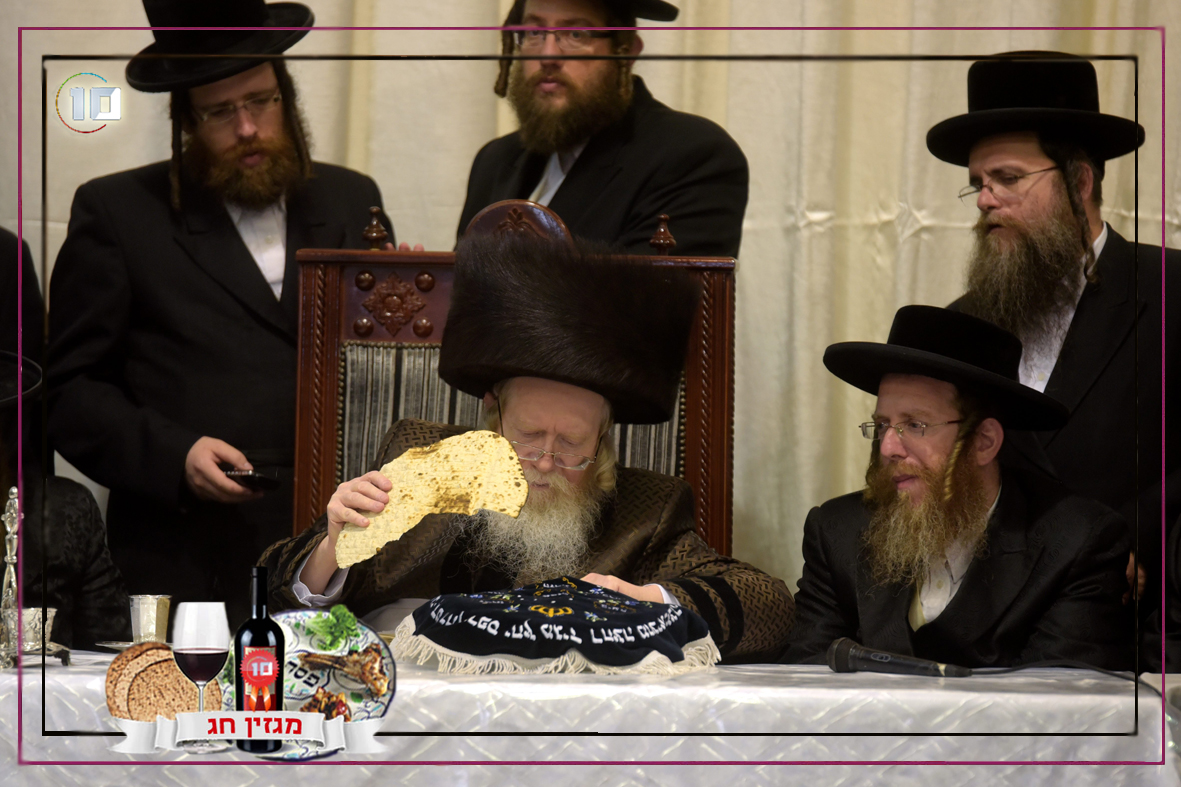
The book contains dozens of photos, presenting a colorful mosaic of the Haredim in Israel. Many of the photos were taken by Haredi photographer Boaz Ben Ari.
 Want more news, videos and stories? Join the Haredim 10 WhatsApp channel >>
In honor of the holiday, we sat down with the author for a short conversation about the book and the photos that accompany it.
Tempted for joy. What led you to write the book?
""The current political confrontation with the Haredi has grown against a backdrop of a sense of alienation between the Haredi and secularists in Israel. Most secularists know nothing about the Haredi, except what the media presents. And this, for obvious reasons, highlights the extremism.
A study conducted in 2012 for the Second Authority found that approximately 90 percent of Channel 2 news articles that dealt with the Haredi described incidents of violence by extremist factions. The secular observer, as a bystander, sees a distorted picture of Haredi society, and surprisingly, there is no current book from the last decade that can show him who the Haredi are and what really guides their way of life.
"I believe that the book has the ability to contribute to a more conciliatory discourse, which begins with an understanding of the Haredi way of life as it is, without apologizing or embellishing it.".
You are a lawyer and a legal expert. This is not exactly your field of expertise. Why did you decide to write the book yourself?
""Where there is no one, you have to stand up and take action. I saw the need, I talked to people about it, but nothing happened. I decided to take some time to write the book, and God willing, the result seems to be successful and the responses I receive are certainly encouraging. Precisely because I am not a sociologist, I did not approach the subject as a professional, but as someone who describes what he sees. I think the result is fascinating.".
Let's move on to the pictures. The book includes a lot of pictures of the Haredi lifestyle. What led you to choose these particular pictures?
""The decision to add pictures came only after the writing was finished. I became convinced that pictures have tremendous power, and that they are truly worth a thousand words. Each picture shows one layer, one piece of the puzzle, and it can make the reader think about what he sees, and that was the goal.".
Choosing the photos was a tedious task. I looked at thousands of photos taken by talented photographers, and began to choose, looking for photos that told a story, and that had depth to them. I also wanted them to represent the richness and diversity of Haredi society. With the help of my friend, Rabbi Zvi Yehuda Lau, I also made a list of events that must be featured there.
For example, the recent graduation ceremony of the Shas cannot be missed, which, even though it was held abroad, is an event that radiates tremendous power, both spiritually and physically. It was not an easy challenge to choose photos from everyday life, but without showing the faces of anonymous people. This is because most of the photos tend to show faces. In the few places where unfamiliar faces appear, I tried to locate the people photographed and ask for their permission.
"Here, in Haredim10, I also find the place to thank all the photographers who opened their archives to me, and especially to Boaz Ben Ari and Yaakov Lederman, two extremely talented photographers who know how to tell a long story with the click of a button. Their photos are amazing and you could make an entire book just from the photos.".
You opened the two image groups with images of two rabbis studying. In the first group, Rabbi Ovadia Yosef, and in the second group, Rabbi Elyashiv. Is there any statement in this or is this an edit by the publisher?.
""Ultimately, after all the words, this is the real story. The learning. This is what characterizes the Haredi scale of values most of all. The connection to the Torah, or what my yeshivah head used to define in his conversations as 'sunsets in learning.' That's why it was important for me to convey the message at the beginning, that these are the great ones at the top of the pyramid. Those few who have leaned on the Gemara for almost a hundred years without a break.".


Rabbis also find their place among the pages of pictures, such as the Rebbetzin of Belza and the Rebbetzin Kanievsky..
""That's right. One of the changes the book points to is the place of women in Haredi society, which is becoming stronger. Part of this phenomenon is women who are given status not only because they are 'women of', but because of their righteousness and deeds. And in the spirit of these days, we know that thanks to righteous women, Israel was redeemed.".

Which picture is your favorite?
""Many of them. For example, the photo showing a billboard in Bnei Brak that my friend Yaakov Lebi took. A seemingly innocent photo, but whoever digs into it will find a whole world. Only the municipality of Bnei Brak is capable of hanging a mourning notice for the passing of the Rebbe of Stemar, with on one side a notice calling for enlistment in the IDF, and on the other a notice about a day of remembrance for the fallen IDF soldiers. And in general, the manner of Haredi remembrance, the attitude towards the memory of the fallen, is also a fascinating subject in itself that the book deals with.
The picture of Rabbi Ovadia Yosef next to his son, both dressed in the robes of the Rishon LeZion, is also a favorite of mine. The resemblance between father and son, and the passing of the crown while continuing the tradition, are striking.
The photo below, which shows the Council of Elders with a picture of Rabbi Ovadia in the background, is chilling and tells the whole story, without words. Also special is the photo of MK Meir Porush handcuffed to the Knesset podium, in protest of the conscription law, with a picture of the ultra-Orthodox Nahal soldiers appearing below it.
The Haredi truth, it turns out, is complex and multifaceted. By the way, you took the last photo in the dead of night in the Knesset.".

Along with the other photos, one cannot ignore the photo of Dr. Yaakov Weinroth at the entrance to the courthouse, in the Beit Shemesh election affair, which was included in the book.
""Indeed, besides the fascinating story of the elections in Beit Shemesh and the decision to dismiss, Yaakov Weinroth is a prototype of a certain type of Haredi. One who managed to combine Haredi and Israeli, although I assume there were expensive prices for this on both sides. But the success of Haredi lawyers is due in no small part to him; he paved the way.".
Why did you choose to end the photo section with a photo from the Haredi demonstration in the Emanuel case?.
""For the past decade, a struggle has been going on in the face of ultra-Orthodox society. The state insists on stepping in and trying to 'educate' the ultra-Orthodox on a variety of issues. The army, core studies, employment. The ultra-Orthodox position on these attempts can be seen in a sign carried by one of the protesters that says it all: The Torah and the Supreme Court - the Torah determines.".
"This does not mean that change cannot be made, but it cannot be imposed from the outside. The Haredi hierarchy is clear and a wise government should avoid placing its citizens in a conflict that could cause it to lose.".