I always knew that life was full of surprises.
But as knowledgeable and experienced as I consider myself, nothing prepared me for this story, to which I was exposed when life led me to the Great Synagogue in the city of Frankfurt, Germany.
I was on my way home from an urgent trip abroad, when we made a stopover in Frankfurt. A delay in the flight schedule and the fact that the Ben Gurion Airport was closed to flights one day a year meant that I was forced to spend Yom Kippur on German soil.
 Want more news, videos and stories? Join the Haredim 10 WhatsApp channel >>
For the past twenty years, in fact, since the day I graduated from yeshiva and got married, I have prayed in a fixed place. I love our prayer. Yeshiva prayer, a serious atmosphere. The people praying also have a calm voice and a beautiful phrasing. And now, for the first time in years, I will not spend the holy day in the place where I have set my place, and may the G-d of Abraham be with me.
I informed my family, contacted the airline representative, and requested that they put me in a hotel near a synagogue. The kind clerk put me in a small hotel, a reasonable walking distance from the Great Synagogue of Frankfurt.
The thought of Yom Kippur on German soil has the power to permeate the soul of every Jew. The memory of my family and relatives who perished in the Holocaust floated up from the back of my mind and filled my thoughts and heart.
I prayed Mincha in my room, and improvised a meal for myself.
The day will turn and I will turn to the synagogue. My feet led me, clad in slippers. I was dressed in my weekday clothes, without a kilt and without a period, and a tallit folded under my arm. In my heart is a sour feeling of loss and the beloved and empowering melodies of prayer, humming from my lips.
•
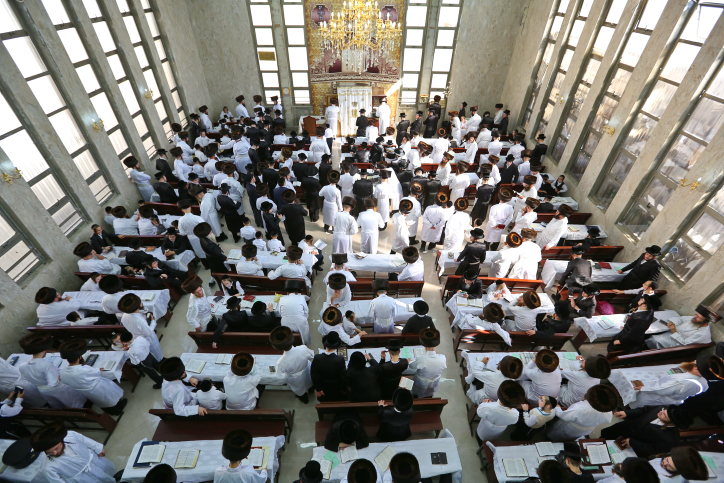
A huge building of immense proportions greeted me. I did not expect such a magnificent synagogue. There is also a purification bath on site. I quickly immersed myself, purified myself, and headed to the hall, which was already packed with thousands of people. I had never seen the splendor and grandeur I encountered there.
A huge crystal chandelier hangs in the center of the synagogue, whose walls are made of stone and whose stained glass windows are stunning, glowing in a variety of colors. The rays of the setting sun are reflected on the thousands of worshipers dressed in bright white, striped, multi-colored tallithas.
""Sholam aleyekem Rabbi Id!" The gabbai greeted me, and with a polite smile, he quickly arranged a seat for me. A Machzor was pulled out from somewhere. The text of the prayer, printed half in the Holy Tongue and half in Russian, reminded me of what I knew, that in Germany there is a large community of ex-Soviet immigrants.
The warm welcome calmed my turbulent soul a little and my spirit returned to me a little. I am in the West and my heart is in my corner at the neighborhood synagogue.
Silence! Only the rustling of leaves can be heard as two thousand people stand in their places, all waiting for the cantor who is about to begin the 'Kol Nidrei' prayer, his hands supporting the sides of the ark, a cantor's cap on his head, clad in a silver tallit and a bright white kittal. Everything is ready for the big moment.
The last of the latecomers enter and gather in prayer, each in his own kippah and each in his own art. I looked around me and saw that most of the worshippers, from their clothes it was clear that they were not wearing the synagogue robes and their kippah was not their art. However, one person prays more and one person prays less, provided that their hearts are directed as one man - with one heart. On local opinion and public opinion.
I am still absorbed in surveying the hall and the worshippers around me when the Ark of the Covenant is opened. The rabbi and the head of the congregation stand on either side of the Ark, a Torah scroll in a white velvet veil in their hands. The cantor's voice is resounding and fills the hall.
""Based on local opinion and public opinion, in the yeshiva of Ma'ale and in the yeshiva of Mate, we permit praying with the criminals.".
The words are so sacred, when they connect to the special melody of 'Kol Nidrei', they take on such tremendous power. The cantor's voice choked. I felt that he was in a tremendous emotional turmoil. And again his voice grew louder, rising and falling octaves. The entire hall trembled from the volume of the sound. The amazing acoustics and his unique voice vibrated every nerve in my heart.
And so I drift and rise, from "the lower seat" to the upper heavens, "Ahhhh, all my vows" my eyes watered, I felt that in the higher seat the heavens were splitting open.
""The Lord is God" Two thousand throats thundered the walls, seven times. And a stone from the walls of my heart cried out: "That we have lived and sustained and reached this time.".
My tears washed away the ink on the calendar and landed, one after another, on the armrests of the elegant benches.
An uncontrollable urge led me between Kol Nidrei and the Arabic, to the cantor. With swollen, red eyes.
""Good signing done." I shook his hand and introduced myself. I hoped that maybe he would tell me about the explosive intensity of emotion, the one I had never experienced before and nothing had prepared me for it.
-"A good signing, and may our prayers be accepted," he replied to me. "My name is Tzadok Greenwald, but everyone calls me Tzodik.".
""Listen, Rabbi Tzodik, you must explain to me what makes your 'Kol Nidrei' so special and moving.".
-"You ask what excites me so much about 'Kol Nidrei'?" he replied with an embarrassed smile. "If Providence summoned you here on Yom Kippur, there must be a reason. And maybe it's worth missing the flight, just to hear my story.".
•
For several years now, I have been serving as the chief cantor and approaching as a 'public messenger' during the Holy Days, here at the Great Synagogue in Frankfurt. As a descendant of Holocaust survivors, I feel a great privilege to approach the Ark precisely here, in this country, on the accursed earth.
What happened a few years ago changed my life.
It was the end of Yom Kippur. The big lights had long since gone out, the last of the worshippers had left the synagogue, hurrying home to break their fast, and the tax collector had locked the gates.
I, who had lingered a little while in the synagogue, left through a side exit. My rumbling stomach and dry mouth from fasting hastened my way to my hostel.
Near the large gates, at the main entrance to the synagogue, I see a man about fifty years old, a white silk kippah proudly placed on his long, curly hair, pinned up with pins. When he saw me coming out, he turned to me.
In half Yiddish, half German, and with an accent that betrayed his Russian origins, he asked me:
""Why are the synagogue doors locked?" (Why are the synagogue doors locked?) "Isn't this the day when all vows are prayed?" (Isn't this the day when all vows are prayed?)
I was silent.
""Please, answer me! Why are the synagogue doors locked?" (Please answer me! Why are the synagogue doors locked?), the man asked.
I realized that the man had made a mistake on the day and arrived at Kol Nidrei after the gate was locked.
My heart was torn. I felt I couldn't let him down. On the other hand, Yom Kippur was already over, and what would I answer him?
""Here's the thing, Rabbi Yid. Yom Kippur was given yesterday," I stammered. I tried to explain to him that Yom Kippur had passed and that Kol Nidrei would only be in a year, that all the worshippers had already left and gone to break the fast.
The man held his head in his hand and began to sob like a little child. Bitter with tears.
""You know," he said to me. "I've never missed any vows. Dad told me that as long as I go to synagogue on Yom Kippur, I won't be disconnected from the Jewish people. I promised Dad that I would go to synagogue every year on Yom Kippur.
""Farshest? This is my connection to my father who is no longer here, my only connection to the fact that I am even Jewish." .
And so, in front of me, a fifty-year-old Jew falls to pieces, whose only desire was to get to the synagogue for the "Kol Nidrei" prayer.
I broke down and was torn inside, I placed both hands on his shoulders and told him:
-"Listen, Rabbi Yehudi. You haven't missed anything. I am the cantor here in the synagogue. Come with me. We will both enter the synagogue and pray 'Kol Nidrei'.".
I entered the synagogue with him from the side entrance. Two Jews, brothers. My arm is wrapped around his shoulder.
I slightly illuminated the darkness of the hall and the synagogue glowed with a dim light. Thousands of empty chairs. He and I, walking towards the ark, arm in arm.
I sat the man down on a chair next to me and gave him a mashrut. I put on the turban again, wrapped myself in a kittel and a tallit, and began to pray 'Kol Nidrei.'.
What can I tell you, it was the strongest 'Kol Nidrei' I've ever had, in all my life. Just me, him and God Almighty. Such excitement, such a sublime feeling, a real expansion of physicality. I forgot about the fast, about the dry throat and I was completely focused, just on the words of the prayer, one prayer that connects a distant Jew to his father. Actually, also to my father, the father of us all.
Two years have passed and I see him again, in the synagogue. This time, he didn't get confused about the date. He approached me hesitantly. "Do you remember me?" he asked.
""How can I forget?" I replied. "You are my personal 'Kol Nidrei'.".
The man hugged and kissed me and said: "You know, I will never forget this huge gift you gave me.".
And that's it, I haven't seen a sign again since.
And every time, when I approach the Ark and begin 'Kol Nidrei', his face rises before me and my flesh becomes sharper and sharper. Tears burst and my heart overflows. Suddenly the words "and we will forgive, to all the congregation of the children of Israel, and to the stranger, who sojourns among them" take on meaning.
""You know what?" Tzodik added. "My entire cantor career is worth it just for this vow.".
•
It was time for evening prayers. I returned to my place, barely digesting what Rabbi Tzodik had told me. I felt at home. I was carried away in prayer with Rabbi Tzodik. Now I no longer missed my regular corner, in the neighborhood synagogue.
If the synagogue doors were locked, the gates of tears were not locked. They were not locked then, and even now, as I write the story, the tears flow.
And since then, every year, my "Kol Nidrei" is actually the "Kol Nidrei" of Rabbi Tzaddik and the Jew whose name I will never know.
And as it is said in the wonderful prayer for the public representatives: "Be with two-faced people the representatives of your people, the house of Israel, who stand to ask in prayer and supplications before you, for your people, the house of Israel... They lift up their eyes to you to heaven, they pour out their hearts like water, and you hear from heaven.".