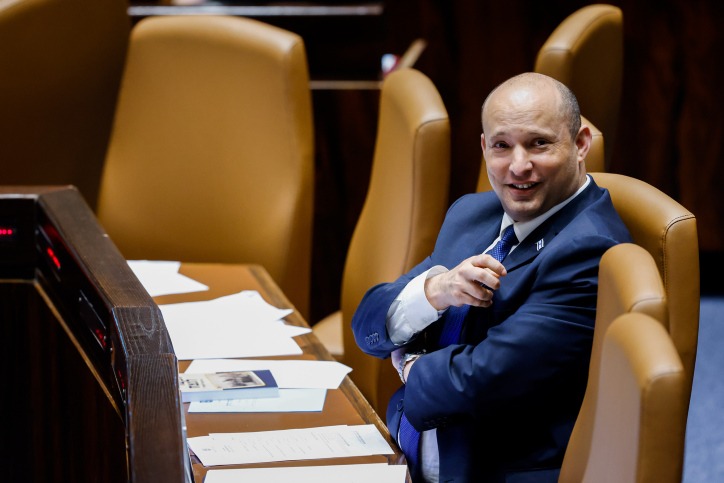
Yesterday (Sunday), former Prime Minister Naftali Bennett, who last year received harsh criticism from bereaved parents during a memorial service he attended, addressed the presence of government representatives in military cemeteries, and even claimed that they should indeed be there while exercising discretion. Bennett spoke with Anat Davidov and Gideon Oko and responded to the remarks.
""Will you come to one of the ceremonies tomorrow?" the pair of presenters asked at the beginning of the conversation, and Bennett replied firmly: "Yes. I assume I will come to Kfar Saba. Over the years, I would usually come to Rishon LeZion as a government minister." In addition, when asked if he was traumatized by last year's events and the riots during his speech, he clarified: "No, I am not traumatized and I am not entitled to traumatization. The ones who are traumatized are the families who lost their sons and daughters. I chose the path of public service, and over so many years, unfortunately, I have been to so many events, sometimes hours after a family lost their son.".
 Want more news, videos and stories? Join the Haredim 10 WhatsApp channel >>
He also admitted that "I have unfortunately gained mileage from being with families in very difficult moments. What I have learned over the years is that ultimately my role in such a situation is to listen, to remain silent, to contain the families' pain. After all, there is nothing I can say that will truly comfort a family in such a moment. I focus only on the families' pain. Losing a son, imagining this terrible thing, is truly an intensity of pain that the devil did not create. Therefore, even shouting, even if it is 4 minutes or 7 minutes, is simply nothing compared to the families' loss.".
""Although last year it really wasn't just families, it was what was discovered in retrospect by political activists from the Likud, some of them paid, I want to believe that it was a one-time thing and that a new custom of sending political activists to funerals or memorial days was not started. This is not the way of our country, we must regain our statehood, this basic Zionism that accompanied us throughout all the years of the state," he emphasized.
""I don't think it's right to prevent politicians from coming, on the other hand, it's permissible and appropriate to use common sense.""
Regarding the statement of some members of the government who announced that they would not attend the memorial ceremonies, he said: "I think that every minister and elected official who exercises the same sensitivity and discretion is acting correctly. On an official level, I think it is important that public representatives, ministers, come to represent the country at state ceremonies. It is a custom that has always existed, it is not something new, and in my government, ministers also came to cemeteries and spoke as they do every year. I do not think it is right to prevent politicians from coming to cemeteries because they do not come with their hats as politicians but as representatives of the kingdom. On the other hand, it is truly permissible and appropriate for a minister to exercise common sense and sensitivity. I would like to hope that in time we will return to the groove of Memorial Day being focused only on memory and not on these fringes of politics.".
""I'm not a judge here and I don't have the right to judge bereaved families who have certain desires. I will never preach to them, they are sacred," he emphasized, adding: "In the last decade, we have gradually seen ultra-Orthodox public representatives arrive, and I must say that I was moved by this. If we want a process that brings the ultra-Orthodox public into Israeli society, we need to go through this process. But I also don't want to give grades to a bereaved family that feels this way. Therefore, if you ask me, we need to stick to what has always been - that public representatives, regardless of their specific military service, arrived and represented the government. But for that elected official who hears that there is specific opposition, it may be that exercising discretion is the right thing, or to arrive and not necessarily to speak, not everyone is obligated to speak.".
In response to his statements, Anat Davidov and Gideon Oko mentioned Minister Ben Gvir, who continues to insist on coming despite the opposition of the bereaved families. Bennett explained that "I don't intend to give him advice. I think that every elected official who hears voices should do the math and say, 'Am I the subject of Remembrance Day?' The answer is no. If someone is going to become the subject, then it's better for them to exercise their own judgment. The fact that we're already a few minutes into a conversation about Remembrance Day and we're basically just talking about the surrounding area and which minister will come and which won't, is not a good thing.".
""At this time we need to focus on remembering the fallen""
""We are on the eve of Memorial Day, at this time we need to focus on remembering the fallen. I came up to talk about those fallen from the 1980s and 1990s in southern Lebanon, about the late Yossi Ohana, who was a company commander in the Golani and was my friend. To talk about Yoav, who was an officer in the paratroopers, a guy from Elkana. I want to say, Yossi Ohana was not Moroccan or religious or traditional to me, he was my brother. Yoav was not a settler or Ashkenazi to me, he was my brother. In the cemeteries, not everyone writes their opinion on the legal reform or the legal revolution - they are our brothers and sisters who fell for this country," he declared.
The former prime minister also addressed the citizens of Israel: "I urge the Israeli public, let's return to being one people with differences, but remember that we have one ethos, one country, and one heritage. We must learn to respect each other. I don't remember anything like this ever before. The State of Israel is 75 years old today. This is not the first Jewish state to be here in the Land of Israel. There were two states that preceded it, and they more or less perished in the 1970s because of gratuitous hatred, not because of an external enemy. The external enemy came and conquered us only after we had destroyed what was here with our own hands.".
""How much of a security risk does this pose?" the pair of presenters wondered at the end, and Bennett concluded: "It's a significant security risk, the internal polarization poses a significant security risk. Our enemies are looking inward, I think they're also wrong in their analysis, but they're looking and talking about it. This is a big part of the process of the fronts uniting or creating a single front that hasn't existed for years. Whether or not there will be a war depends on many things. I see the tremendous efforts of the Hamas and Hezbollah leaderships that are now meeting. The union of two axes is a very dangerous thing. We are stronger than all of our enemies put together, but on the condition that we are united from within, not that we agree on things, but that we are able to work together.".