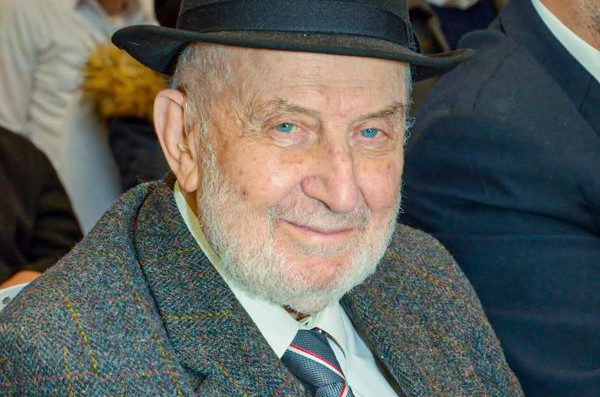
My grandfather, Pepi the righteous, passed away last night, at the age of 98.
I don't know exactly how the Beit Din of Ma'ale works, I do know that Pepi [Rabbi Yitzhak], like Mami [Colt] who passed away several years ago, doesn't linger there. He doesn't encounter selectors or other difficulties on his way to Heaven.
I, and everyone who knew him, know this.
 Want more news, videos and stories? Join the Haredim 10 WhatsApp channel >>
He was a clean, pure man, without any exaggeration. He never, ever hurt anyone, he feared God and loved people in ways that may not be familiar to us today, people of the 21st century. Sometimes I would ask myself, is this an ability reserved only for people of a bygone era? How is it possible to be so clean, to behave with such simplicity, with such purity without toys, papers, and games?
Pepi was born in 1925 in Algeria and at the age of 18 went to fight the Nazis as part of the Algerian-French force. Towards the end of the war he arrived by battleship to the city of Marseille and from there to the city of Poitiers. In this city he met the wonderful Seraf family. A family with Yakut roots whose history could be written in entire volumes.
Briefly, I will mention that the family went through the events of the Holocaust, rare stories of greatness about the events as well as their behavior in the face of them - pass through the family and some were documented by me. Between 300-400 people from the extended family were murdered by the oppressors.
In Marseille, Pepi became acquainted with the Seraf family and, as in the story of Rabbi Akiva, the younger daughter approached her mother and said that the shy Jewish soldier, perhaps not a great rabbi in Israel, was 'humble and above me' - one cannot help but notice his passionate and purposeful prayer. She declared that she saw herself as his wife. A short time later, the couple were married in the town of Niederweiss, the Seraf family's original residence, and Rabbi Dreyfus was the one who performed the Kiddushin.
During the wedding, which included only light refreshments, those present were surprised by a distinguished guest: Righteous Among the Nations priest Pierre Fleury, who is fondly remembered as saving the lives of my family members and the lives of many other Jews.
The couple lived in the city of Nidervis, where their six children were born: Yehudit, Eliyahu, Aharon David, Elkana, Moshe, and Yosef [peace be upon him, who drowned in the river about 9 years ago and was only 52 years old. Particularly sadly, tonight is the memorial day of Uncle Yosef, who was buried during his parents' lifetime].
Although the environment was decidedly Gentile, the children grew up in a God-fearing home, the likes of which, it seems, are lacking in our area. Colette and her mother were well-versed in the "Tzaina and Rayna" and the grandfather and Rabbi Yitzhak never missed a prayer in the small minyan held in their home. Newspapers and television never entered the house and every day the children studied the five-volume book of the Torah for an hour before bedtime.
How did the children who could not read and write in Hebrew learn the Bible verses? Grandma Colette's little sister, Miriam [later the wife of Rabbi Moshe Flax zt"l], was studying at the Beit Yaakov Seminary in Aix-les-Bains at that time, and she translated the parshiot into French for them and sent the pages to her sister's house. Later, she would come to their house and make sure to check her nephews on the pages she sent.
[gallery]
By the way, throughout their childhood they never tasted 'foreign milk', and since the village was populated mainly by non-Jewish residents, the children learned to milk from a young age.
The son, Cantor Aharon Heun, says: "I remember that for an improper circumcision we had to fast for a whole day... It didn't seem excessive to us. Even today. We children, who grew up in a village of Gentiles, knew very well what was a 'Jewish' act and what was a 'Gentile' act.".
Another stop for the young family was the city of Bula, where the children studied privately several days a week with a Jewish teacher who would come to them especially from the city of Tiville.
The mother, Colette, managed to get permission from the local school administration that her children would be allowed to wear a cap [casket] instead of a kippah. The children say today that they were attacked more than once for being Jewish, and they learned to defend themselves with harsh words, but also with iron fists.
At the age of 12, the children were sent to yeshivahs, the main ones being the Ex-Le Ben Yeshiva of Rabbi Chaikin, zt"l, the Haganheim Yeshiva of Rabbi Ruch, and the Gateshead Yeshiva in England.
At some point, the family arrived in the city of 'Pashtat' - a medium-sized city that had a small nursing home. The parents, Yitzhak and Kolet, took over the management of the place and turned it into one of the most famous nursing homes in the country. The father, Rabbi Yitzhak, was upright and pure in heart, treated the elderly like children, and as in the story of Noah's Ark, he made sure to feed them with his own hands without using messengers and without leaving even a single resident.
The children say that when one of the elderly was hospitalized from time to time in the local hospital, the director, Rabbi Yitzhak, would appear at the hospital, and make sure to sit by his bed while feeding him as if he were now in the nursing home. The devoted director's visits also extended to elderly people who were not clients of the nursing home, and word of the unique institution reached every corner of Europe.
Several years ago, as mentioned, Me'mi Tzadika passed away after a short illness and was buried on the night of Tisha B'Av on Mount Hamunuchot. Pepi lived in a nursing home on Hebron Road and his children, sons-in-law and daughters-in-law did not leave him and cared for him with great devotion. Yesterday morning, Pepi - my last surviving grandfather - passed away.
But it is symbolic that Pepi's passing occurred on the eve of Holocaust Remembrance Day. Pepi, who volunteered to fight the Nazis, and from Mimi and her family who met with them day in and day out, were able to and succeeded in establishing a glorious generation - among them many rabbis, avot batei din and cantors, as well as hundreds of sons, grandsons, great-grandchildren and even great-great-grandchildren.