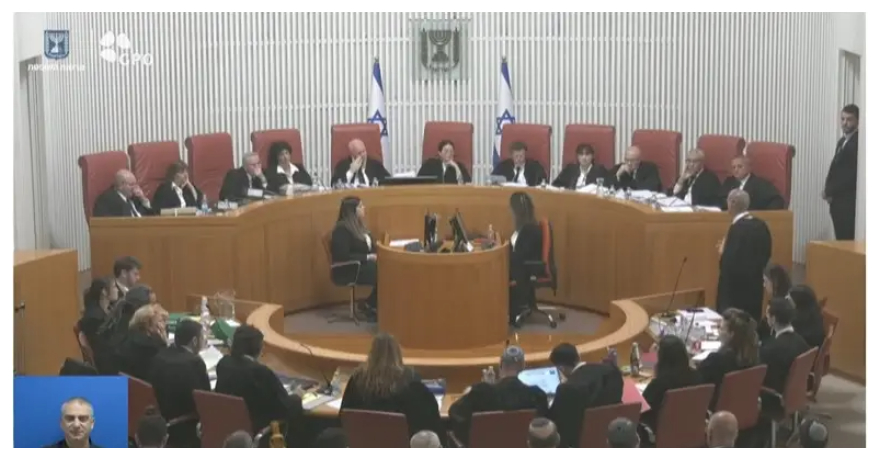
The High Court of Justice today (Thursday), for 6 hours, heard petitions against the appointment of Aryeh Deri as Minister of the Interior and Health, in an expanded panel of 11 Supreme Court justices.
At the beginning of the discussion, President Esther Hayut presented the topic of the discussion and the reasons for opposing Deri's appointment - and the schedule for the discussion.
""We have 3 petitions before us regarding the appointment of MK Deri as a minister. The first, one constitutional ground - abuse of the constituent authority of the Knesset regarding the amendment of the Basic Law of the Government in a way that qualifies someone who has been sentenced to probation and is not working to serve as a minister. The second, the ground of reasonableness - that his appointment as a minister is unreasonable in the circumstances of the case, considering his criminal past and recent conviction. The third, the ground of joint silence. The claim is that he was sentenced according to the plea agreement and pledged to retire from public life, and his return is now essentially barred to him in light of his statement on it.".
 Want more news, videos and stories? Join the Haredim 10 WhatsApp channel >>
President Hayut added: "We have appointed an expanded panel to hear these petitions and a conditional order was issued regarding the remedies. In yesterday's decision, I set a timetable that will be assigned to each of the claimants so that things will be within a time frame.".
Head of the Supreme Court Department, Attorney Aner Helman, on behalf of the attorney general, spoke about the amendment to the law that allowed Deri to be appointed minister: "What goes around like a duck and all - it's clear that it's a duck. There's no doubt that the law was amended in a personal way, to allow Deri to be a minister. They're changing a Basic Law to amend a criminal verdict.
'"In the petitions that were filed at the time against Deri's appointment as minister - about 7 years ago - due to his criminal past, it was ruled that it was on the border of reasonableness; the considerations were that time had passed, a young man who still had a way to go, and so on, they did not know that he would commit offenses again.".
President Hayut commented during the speech of the representative of the Attorney General's Office: "Deri's old offenses have been erased.".
The head of the High Court of Justice department added: "These offenses are offenses on the low level of tax offenses, but they are committed by an MK. It is clear that this is a personal matter. The offenses that the minister was convicted of are offenses that involve disgrace and not just any offense. The Attorney General's position is based on the totality of the circumstances.".
""We must say that Minister Deri is essential for the Prime Minister to form the government. Anyone who has worked with Minister Deri knows this is true. There is a broad discretion test for the Prime Minister. The question is whether the Prime Minister can appoint a person who has been convicted of crimes three times, in terms of public trust. This is not the Israeli regime's system. In the overall circumstances, Deri's appointment is extremely unreasonable.".
A representative of the Attorney General's Office is asking the High Court to remove Deri. Eran Hellman, the attorney general's representative at the hearing, said: "She believes that in the circumstances of the case, the appointment is extremely unreasonable. The prime minister is not willing to remove him from office and we are asking that the court order his removal from office.".
He added, following a question from Judge David Mintz, that Netanyahu as prime minister has broad discretion, and that he undoubtedly has a responsibility to maintain government stability, but added: "The scope is not unlimited.".
Judge Alex Stein: "The Prime Minister suffers from extreme unreasonableness? I don't really understand your argument.".
Attorney Anat Goldstein: "The mere fact that there is a personal matter that formed the background to the legislative matter does not mean that the norm formulated as a general one is personal. In the end, the test of results is examined. There is no doubt that it was impossible to clear MK Deri's matter. The Knesset members did think that his matter reflected a general public interest.".
One of the judges responded: "The legislator is discussing how this persona can be legalized, and the generality test reversed and said that it is everyone - and the truth is wrong.".
Goldstein replied: "A situation was created where some members of the Knesset thought that an absurd situation had arisen in which someone could receive widespread public support and serve as a MK and not as a minister. They believed that Deri's private matter certainly reflected some problem that they wanted to solve. The political considerations behind amending the Basic Law are not unusual.".
Attorney Michael Rabillo, representative of Prime Minister Netanyahu: "We believe that there is no room for judicial intervention in the Prime Minister's consideration of forming the government.
""It is worth noting that such interference in a prime minister's decision is unparalleled in the world, according to what the Honorable Deputy President Justice Bemelzer said in the Deri High Court in 2015 and in the High Court imposing the mandate. Deputy President Meltzer found a ruling in India in which the matter was discussed, and the court did not rule out the possibility of appointing a minister who had been convicted of a criminal offense since it had no legal basis.".
President Esther Hayut: "The entire government was sworn in, there was no reference to this or that minister. They expressed confidence in the entire government. There is a section in the law that allows the prime minister discretion to appoint this or that minister - and we examine this discretion within the accepted administrative parameters.".
The prime minister's representative explained that approximately 2.3 million Netanyahu bloc voters indirectly wanted Deri as minister, and approximately 400,000 Shas voters directly wanted the same thing - and therefore it is reasonable to appoint him to the position.
Judge Dafna Barak-Erez answered: "You can't trade everything in the name of the majority." She illustrated: "What if they decided to give one of the ministers an income tax exemption for a year or let him be a lawyer without a license, and all in the name of the majority?""
Judge Fogelman: Prime Minister Netanyahu did not ask the chairman of the Elections Committee whether Deri could serve as a minister because it was a question of choice and he was afraid of getting a no.
Attorney Navot Tel-Tzur, who represents Aryeh Deri: "If I were sent to the chairman of the elections committee, I would make a decision that there is no disgrace. No one was afraid of that. Probation reflects minor severity and actual imprisonment reflects severe severity. There was no commitment or representation of Deri's permanent retirement. There was a brief statement that hurts us very much. In our opinion, this case is much less conspiratorial and problematic than it is portrayed here and it was blown out of proportion. The term imprisonment was never interpreted to include probation.".
He added and claimed that Deri did not know that he had committed the tax offenses for which he was convicted at the beginning of the year. The judges answered him: "His plea agreement includes a confession that he signed and which says 'knowingly', he knew about the offense and you are making claims contrary to the plea agreement. We are not asking to change the law.".
Hayut Aksa: "It's shorter to amend a Basic Law.".
The attorney: "There is no connection between the offenses in the 1990s and the one in 2022. It is unfair to connect the cases and present it as repetition.".
President Hayut clarified that despite the statute of limitations on Deri's offenses in the 1990s, past convictions can be considered in all circumstances.
The judges attacked Deri's representative: "Why did you think not to contact the chairman of the Elections Committee regarding the question of disgrace?" They explained that the question of disgrace was not examined at the time of Deri's conviction, because he said he would not return to politics and therefore it was irrelevant.
Attorney Tel-Tzur: "We postponed the decision on the question of future disgrace, there was no indication of permanent retirement.".
Judge Mintz: "The court saw Deri's words as a commitment to resign";.
Attorney Tel-Tzur: "This is a rare incident of misunderstanding.".
Judge Stein quoted from the Magistrate's Court's sentencing protocol: "I want to invest the time I have left in representing the public in a different way and not in the Knesset. I made this decision with a heavy heart, it's important for me to emphasize.".
Judge Stein criticized: "You cannot say 'I am resigning' to obtain the benefit of a plea bargain that is convenient for you - and after a very short time say 'I want to return to the position of minister.'".
Attorney Tel Tzur: "The issue of retirement was not part of the plea agreement.".
Stein: "You have to convince the court.".
Judge Mintz: "The Magistrate's Court saw things this way. It understood that there was a commitment to permanent retirement.".
Tel Tzur: "This is a rare incident of misunderstanding. What happened after the elections was that Deri woke up in the morning with 11 seats. What was decisive here was the dimension of time.".
Hayut Aksa: "It's shorter to amend a Basic Law, you chose to go the path of amending a Basic Law and not go to the Elections Committee.".
Judge Kabub: "Given Deri's argument regarding the minor nature of the offenses, it makes sense that you should have come and insisted on explaining this to the Elections Committee.".
The judges attacked Deri's representative: "Why did you think not to contact the chairman of the Elections Committee regarding the question of disgrace?" They explained that the question of disgrace was not examined at the time of Deri's conviction, because he said he would not return to politics and therefore it was irrelevant.
Attorney Tel-Tzur: "We postponed the decision on the question of future disgrace, there was no indication of permanent retirement.".
Deri's lawyer, Adv. Tel-Tzur: "I regret that they chose not to go to the chairman of the Elections Committee regarding the defamation and amended the Basic Law instead.".
In response to Representative Deri who explained that the voters who chose Shas should be respected, President Hayut reiterated - and clarified that "the Prime Minister appoints ministers, not the public, that is his own discretion.".
Attorney Dafna Holtz-Lechner, who represents the petitioners, argued before the judges: "Deri escaped, it's a trick. What's the trick? 'Don't check my disgrace. I resigned to get a reduced sentence and got out of the story.' After a month, can I be elected to the Knesset again?""
Judges Wilner, Stein, and Fogelman are challenging Attorney Holtz-Lechner and asking her how she will convince the court to intervene in Prime Minister Netanyahu's discretion in his decision to appoint the Shas chairman as a minister, and what their authority is to prevent Deri from accepting a government position.
The chairman of the Movement for Quality Government, Attorney Eliad Shraga, began his remarks by mentioning the press conference held last night by Justice Minister Yariv Levin: "I want to talk about the cannon on the hill: Just last night we saw how the Minister of Justice threatened to smash the court if, God forbid, some kind of verdict is passed here - these things need to be said.".
Deputy Minister MK Moshe Arbel of Shas erupted at Attorney Shraga's words and claimed that he was lying. Shraga turned to President Hayut: "We need to throw him out of here, so what if he is a member of Knesset.".
Hayut intervened and commented to Arbel: "With us, we only speak with permission.".
Attorney Aner Helman on behalf of the prosecution responded to the claims of Attorney Navot Tel-Tzur, Deri's defense attorney: "If Deri's offense does not involve dishonor, then I don't know what offense involves dishonor.".
...